Barton’s Tunkillia resource upgrade strengthens the path to feasibility

Barton Gold has lifted Tunkillia’s Measured and Indicated gold resources to 989koz after 57,653 metres of infill drilling, while confirming the May 2025 scoping study’s pit inventory within 2%. The result strengthens the foundation for a pre-feasibility study due in early 2027, although the resource remains short of Ore Reserve status.
- 1.5Moz gold resource at 0.78g/t, including 989koz Measured and Indicated
- 151koz upgraded to Measured classification
- 1,011koz contained within the May 2025 scoping study pit shells
- 36koz of shallow higher-grade Inferred targets identified for conversion
- Pre-feasibility study and upgraded silver estimate targeted for Q1 2027
 Add us as a preferred source on Google
Tunkillia’s higher-confidence ounces take centre stage
Barton Gold Holdings Limited (ASX:BGD) has converted a substantial portion of Tunkillia’s gold inventory into higher-confidence resource categories, with Measured and Indicated resources now totalling 989koz. The South Australian project contains 1.5Moz of gold at 0.78g/t, including 151koz classified as Measured.
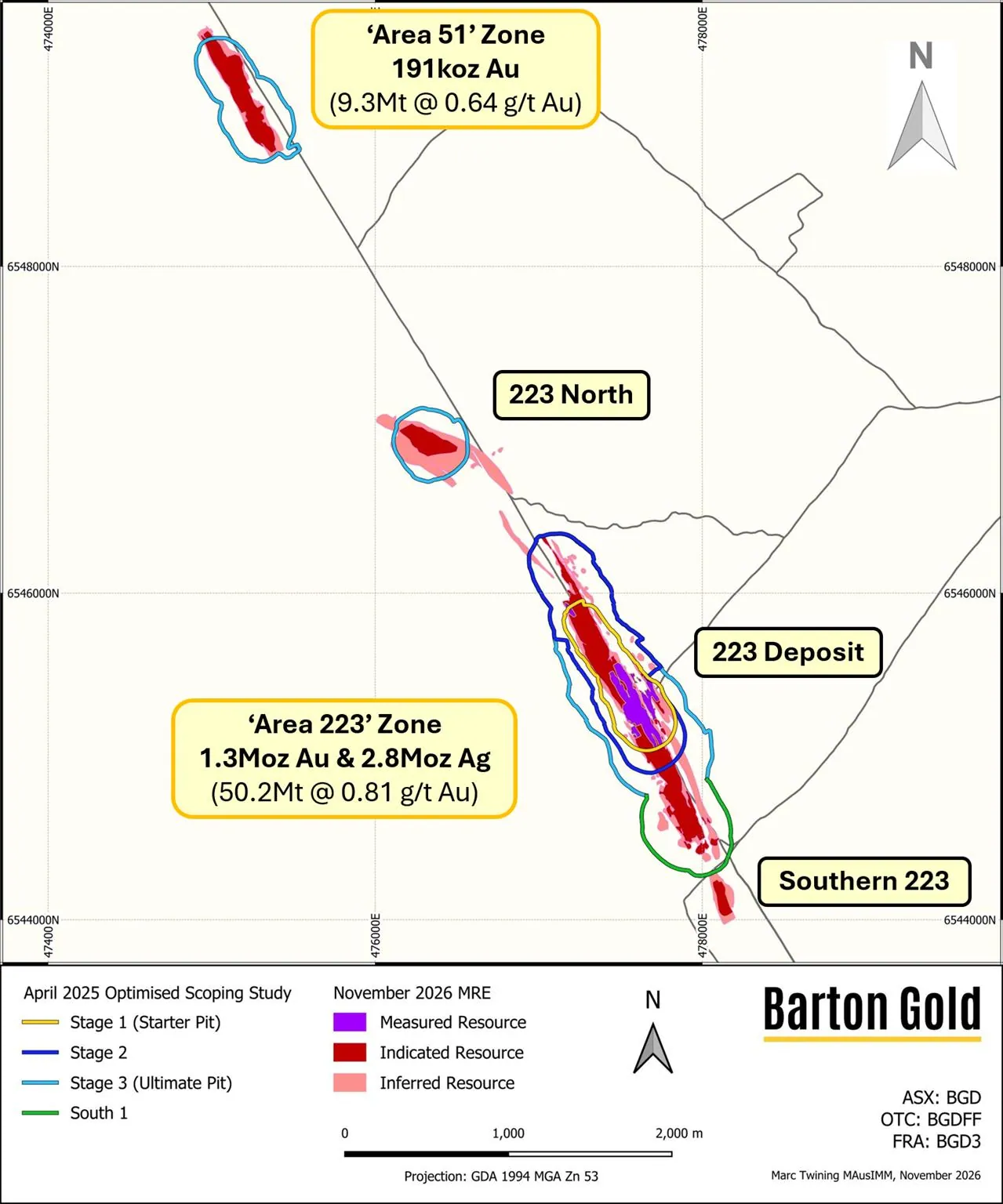
The upgrade follows 57,653 metres of reverse circulation and diamond drilling across 520 holes. Rather than simply expanding the headline resource, Barton remodelled the deposit using a more conservative approach constrained by optimised pit shells. The global resource is therefore smaller than the March 2025 estimate of 1.612Moz, but carries a materially stronger classification profile.
Scoping study pit inventory changes little
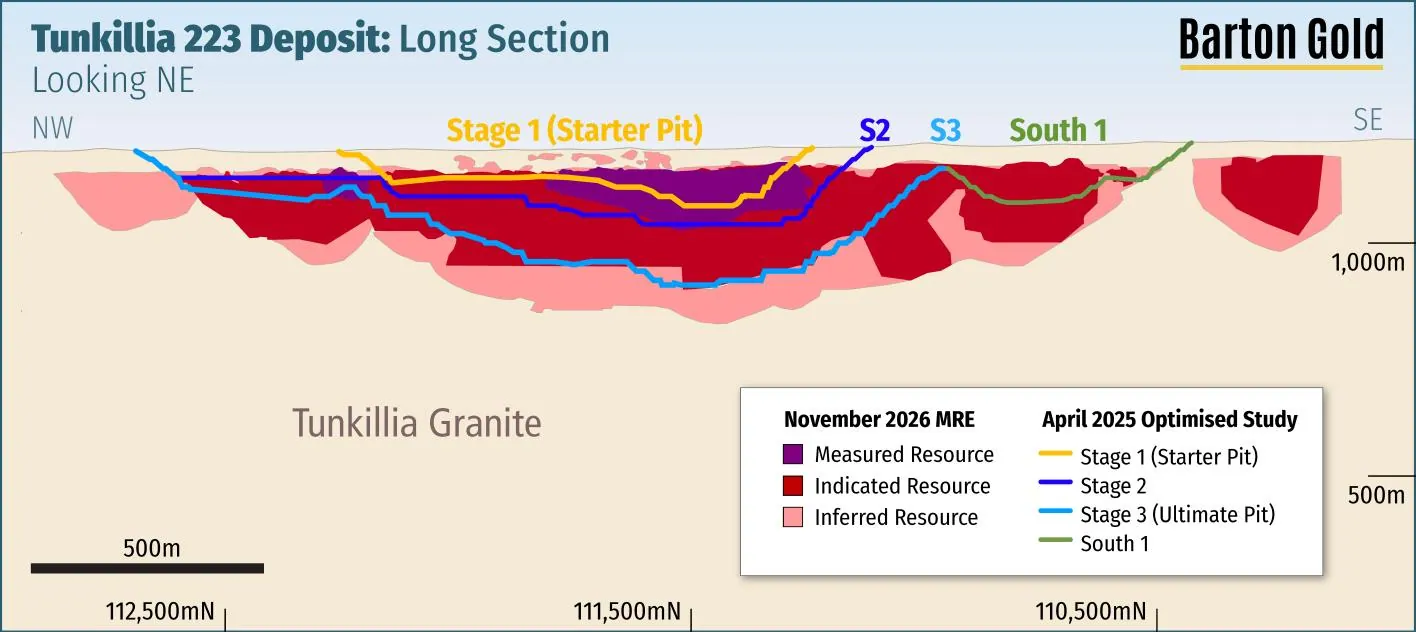
The more relevant test for the company’s development case is what happened inside the May 2025 Optimised Scoping Study pit shells. The updated model contains 1,011koz of gold in those shells, compared with 1,035koz previously, a 2% reduction. Average grade edged up from 0.82g/t to 0.83g/t.
Within the same pit designs, Measured and Indicated gold rose 14% to 822koz, while Inferred material fell 39% to 189koz. Barton said 81% of the mineralisation inside the OSS shells is now in the two higher-confidence categories. The S1 and S2 starter pits were similarly stable, holding 362koz at 1.06g/t against 365koz at 1.05g/t in the earlier model.
The result gives the company a firmer geological base for its next study phase. It also follows the %%October Tunkillia drilling results%%, which fed into the resource update and highlighted broad, higher-grade intersections across the planned starter-pit areas. The filing says 6.2Mt containing 131koz of Indicated gold sits outside the May 2025 pit shells, suggesting future PFS pit designs could extend beyond the earlier optimisation.
Shallow high-grade zones remain work in progress
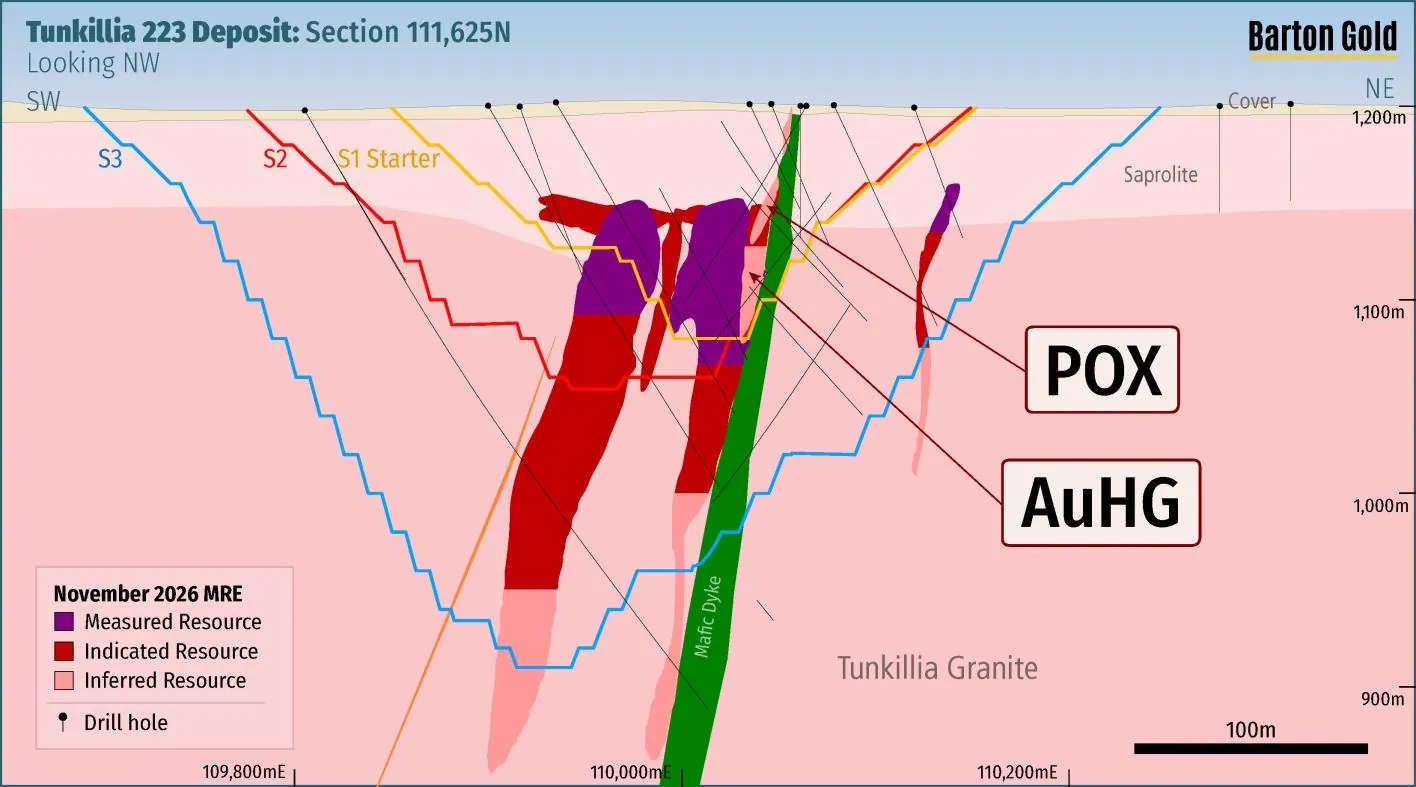
Not all of the attractive material has yet cleared the classification hurdle. Barton has identified 36koz at 2.04g/t in the shallow AuHG and POX domains within the S1 and S2 pit shells. These zones sit around the weathered margins of a mafic dyke and include some of the best grades in those shallow areas, but higher grade variability has left portions in the Inferred category.
The company regards the material as a priority conversion target, alongside further drilling at Area 51 and other Inferred mineralisation below or outside the current pit shells. Those opportunities could add value to the PFS model, but they remain exploration and resource-conversion possibilities rather than defined mineable inventory.
Silver estimate falls short of a complete project view
Tunkillia’s updated silver resource stands at 2.759Moz at 2.71g/t, reported entirely as Inferred and only as a subset of the gold resource. That is below the March 2025 estimate of 3.07Moz, but the comparison is limited because historical silver assaying has not covered the full project.
Barton plans to resample historical drilling and produce an upgraded silver estimate in the first quarter of calendar 2027. The company says the normal silver-to-gold ratio across Tunkillia is closer to 3:1, but the current by-product estimate is not yet a complete measure of the project’s potential silver credits.
PFS remains the next material test
Barton is targeting publication of the Tunkillia pre-feasibility study in Q1 2027 while progressing environmental and heritage work, infrastructure sterilisation drilling, tailings studies, development trade-offs and renewable-energy options. The company also said it is holding project-finance discussions, with the new Measured classification cited as support for those conversations.
The prior OSS outlined an unlevered, pre-tax NPV of about A$1.4 billion, an IRR of roughly 73.2% and an approximately 0.8-year payback period. Those figures remain study outputs, not forecasts established by the updated resource. A PFS will need to test them against revised pit designs, capital requirements, operating assumptions, recoveries and permitting. Most importantly, Tunkillia’s resources are still not Ore Reserves and do not have demonstrated economic viability.
Get ASX:BGD news the moment it breaks
 iPhone & iPad
 Android
Bottom Line?
The resource update reduces geological uncertainty inside the proposed pits, but the Q1 2027 PFS must now convert that confidence into a credible mine plan, funding case and Ore Reserve.
Questions in the middle?
- How much of the 36koz shallow higher-grade Inferred inventory can be converted before the PFS is finalised?
- Will the PFS retain the OSS economics once capital, infrastructure, recoveries and updated pit designs are fully tested?
- How much additional silver will Barton’s planned resampling add to the project’s eventual by-product profile?
Sources
1-
Upgraded Tunkillia MRE Validates Optimised Scoping Study (opens in a new tab)Verified source. Barton Gold Holdings Limited · 11 Nov 2026