Flight Centre targets $325m FY27 profit as leisure recovery takes hold

6 min read
8:21am on Wednesday 11th of November, 2026 AEDT ~8am, 11th Nov, 26
Flight Centre Travel Group is targeting underlying FY27 profit before tax of A$290 million to A$325 million as leisure travel rebounds and corporate expansion gathers pace. The company expects earnings to be heavily weighted to the second half, while shareholders delivered a first strike against its remuneration report.
- Initial FY27 underlying PBT target of A$290m-A$325m
- Leisure recovery expected to drive a sharply second-half-weighted result
- Corporate TTV up 7% in constant currency in the first quarter
- AI tools cutting quoting, support and itinerary construction times
- Remuneration report receives 74.28% support, triggering a first strike

 Add us as a preferred source on Google
FY27 profit target depends on a stronger second half
Flight Centre Travel Group Limited (ASX:FLT) is aiming to turn a disrupted FY26 into a year of profit recovery, setting an initial underlying profit before tax target of A$290 million to A$325 million for FY27. The range implies growth of about 4% to 17% on the A$278 million delivered in FY26, but the arithmetic comes with a pronounced seasonal warning: management expects the first half to fall below last year and the second half to carry the result.
The target is built around a recovery in leisure travel after Middle East hostilities stripped an estimated A$60 million from the division’s fourth-quarter profit. July was the strongest month ever for leisure total transaction value, according to the company, surpassing the pre-pandemic 2019 peak. That early improvement is encouraging, though the guidance remains exposed to further geopolitical disruption, macroeconomic volatility and the strength of the key fourth-quarter trading period.
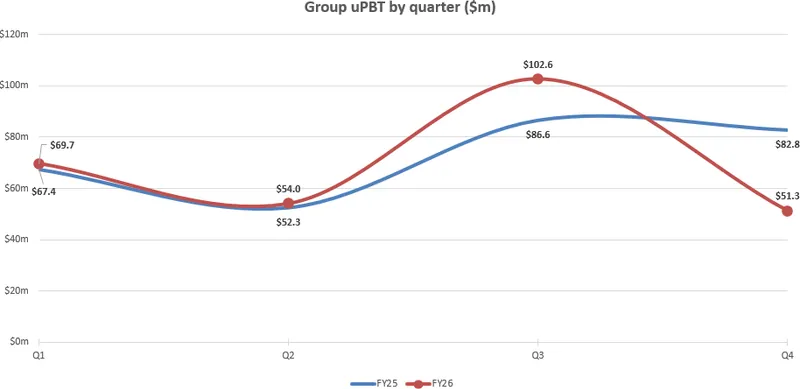
The new outlook builds on record FY26 transaction value, when group TTV reached A$25.7 billion despite the late-year shock. Statutory net profit after tax rose 38% to A$149 million, while underlying PBT declined 4% to A$278 million. Corporate travel provided the ballast: underlying PBT rose 28% to A$240 million on TTV of A$12.7 billion, more than offsetting the collapse in leisure’s fourth-quarter earnings.
Corporate expansion is being funded before it pays back
Corporate trading has continued to grow beneath the reported currency noise. Global corporate TTV rose about 7% in constant currency in the first quarter, led by the United States, where US-dollar TTV increased about 15%. Converted into Australian dollars, group corporate TTV growth was only 1.2%, highlighting the effect of exchange rates rather than a stated deterioration in underlying demand.
The division’s near-term earnings will nevertheless be softer. Flight Centre is investing up to A$5 million in Northern Hemisphere small and medium-sized enterprise growth, while accounts won late in FY26 are still being onboarded. Customers with combined annualised spend of about A$350 million are expected to begin trading in November and December, and accounts representing a further estimated A$400 million in annual spend have been secured so far this financial year, with most expected to start in the second half.
That timing helps explain why the company expects roughly 31% of FY27 underlying PBT in the first half, compared with the more typical 34% first-half share in FY24. Productive Operations and World360 Rewards create a combined A$16 million first-half accounting headwind, higher interest expense is expected to reduce first-half earnings by A$6 million to A$8 million, and touring is forecast to swing from a A$3.5 million profit to a A$1.5 million loss before management expects improvement in the second half.
AI and loyalty are being asked to close the profit gap
Flight Centre is placing artificial intelligence at the centre of its effort to convert sales growth into margin improvement. Its Workspace Quote tool has reduced the average time to send a trip proposal from 17 minutes to six, with a newer version cutting that to 3.5 minutes for about 290 FCM and Corporate Traveller customers. In mature corporate businesses, touchless transactions have risen from below 30% to 60% under the Productive Operations program.

Leisure is also being used as a testing ground. The Co-Consult system’s AI agents handled almost 20,000 requests in the past three months, while trip construction for new consultants has fallen from more than an hour to less than 20 minutes. The company says its AI Trip Support Agent resolved 80% of more than 10,000 customer queries at a cost of 11 cents per customer, compared with about A$40 for a traditional support call.
World360 Rewards now has about 750,000 Australian members, and the early figures are notable but still management-generated indicators rather than a completed financial outcome. Members spend about 40% more per booking at Travel Associates and almost 30% more in Flight Centre shops, while their enquiry-to-booking conversion rate is about four times that of non-members. More than 160,000 members have since booked, and a business version of the program is launching through Corporate Traveller and Flight Centre Business Travel.
Buy-backs remain flexible as debt costs rise
Capital allocation is becoming a live trade-off rather than a one-way buy-back story. Flight Centre completed its initial A$200 million on-market repurchase and had bought back more than 20 million shares across the programs by the AGM. A further buy-back of up to A$200 million is under way, but management said it may instead use cash to reduce debt, manage its convertible notes or pursue acquisitions if those alternatives offer better shareholder returns.
The company paid 42 cents a share in fully franked FY26 dividends, returning A$87 million or 47% of underlying NPAT, and issued a new A$450 million convertible note to retire 2028 notes and part-fund the Iglu cruise acquisition. Higher interest expense is now one of the explicit swing factors in FY27, making the balance between capital returns and balance-sheet reduction more consequential than it was when rates and earnings timing were less obstructive.
Remuneration report records first strike
Shareholders gave the remuneration report 74.28% support at the AGM, below the 75% threshold and triggering Flight Centre’s first strike. The board said the concerns raised by shareholders related less to pay levels or the one-off exercise of discretion over executive incentives, and more to the structure of remuneration packages and how they were presented externally.
Rob Baker retired from the board after 13 years, with Gareth Turner elected and set to succeed him as chair of the Audit and Risk Committee. The board also said it had begun a broader renewal and succession process, including work on a future chair transition. Those governance changes arrive alongside an operating plan that assumes the hardest part of FY26 was cyclical, not structural. The next material test is whether the second-half recovery can deliver that distinction in reported earnings, rather than only in management’s targets.
Get ASX:FLT news the moment it breaks
 iPhone & iPad
 Android
Bottom Line?
Flight Centre’s FY27 target rests on leisure recovering into its most profitable trading months while corporate investments begin to pay back. The first-half result will be noisy; the second half will carry the real test of the recovery thesis.
Questions in the middle?
- Can leisure profit recover towards its pre-disruption trajectory during the FY27 fourth quarter?
- How quickly will newly won corporate accounts convert pipeline and bookings into earnings?
- Will management prioritise further buy-backs, debt reduction or acquisitions as interest costs remain elevated?
Sources
2-
Chair & MD's AGM Speeches (inc trading update & guidance) (opens in a new tab)Verified source. Flight Centre Travel Group Limited · 11 Nov 2026Listed on fctgl.com/investors (opens in a new tab)
-
AGM Presentation (inc trading update & guidance) (opens in a new tab)Verified source. Flight Centre Travel Group Limited · 11 Nov 2026Listed on fctgl.com/investors (opens in a new tab)