White Cliff links Danvers copper prospects with sulphides across 580-metre gap

White Cliff Minerals has reported a new shallow copper zone at Danvers 1 and visual sulphides across the previously untested gap between Danvers 2 and 3. The results expand the geological picture, but the most consequential intersections remain subject to laboratory assays.
- 63m at 0.39% copper from 21m at Danvers 1
- 25.14m at 0.69% copper extending mineralisation to about 180m vertical depth
- Visual copper sulphides to 521m downhole in deepest Danvers 1 hole
- 86.89m and 155.33m of visual sulphides across the Danvers 2-3 gap
- Assays expected in six to eight weeks for key visual intersections
 Add us as a preferred source on Google
Danvers 1 adds shallow copper and depth
White Cliff Minerals Limited (ASX:WCN) has added both breadth and depth to the Danvers copper story, with a new shallow zone returning 63 metres at 0.39% copper from 21 metres in hole DAN26050. A separate intersection in DAN26048 delivered 25.14 metres at 0.69% copper from 203.36 metres, extending confirmed copper mineralisation to roughly 180 metres below surface.
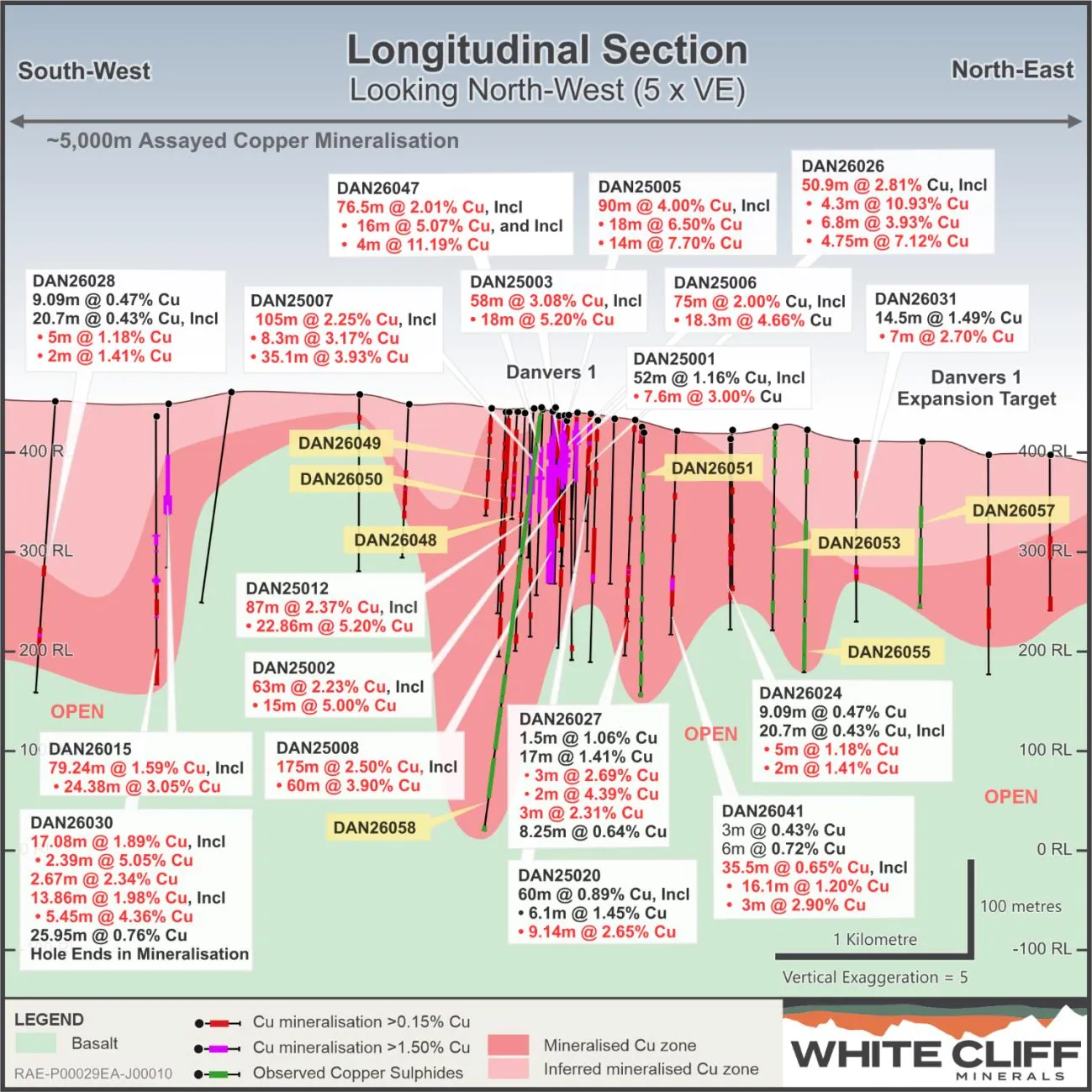
The shallow result sits beside the main Danvers 1 breccia, pointing to additional mineralised ground beyond the previously modelled core. It follows the Danvers 1 depth extension, which earlier reported a 76.5-metre copper-silver interval and visible sulphides in deeper holes. White Cliff says the latest drilling was designed to test gaps in the geological model rather than simply repeat known intersections.
Deepest hole reaches bornite at 521 metres
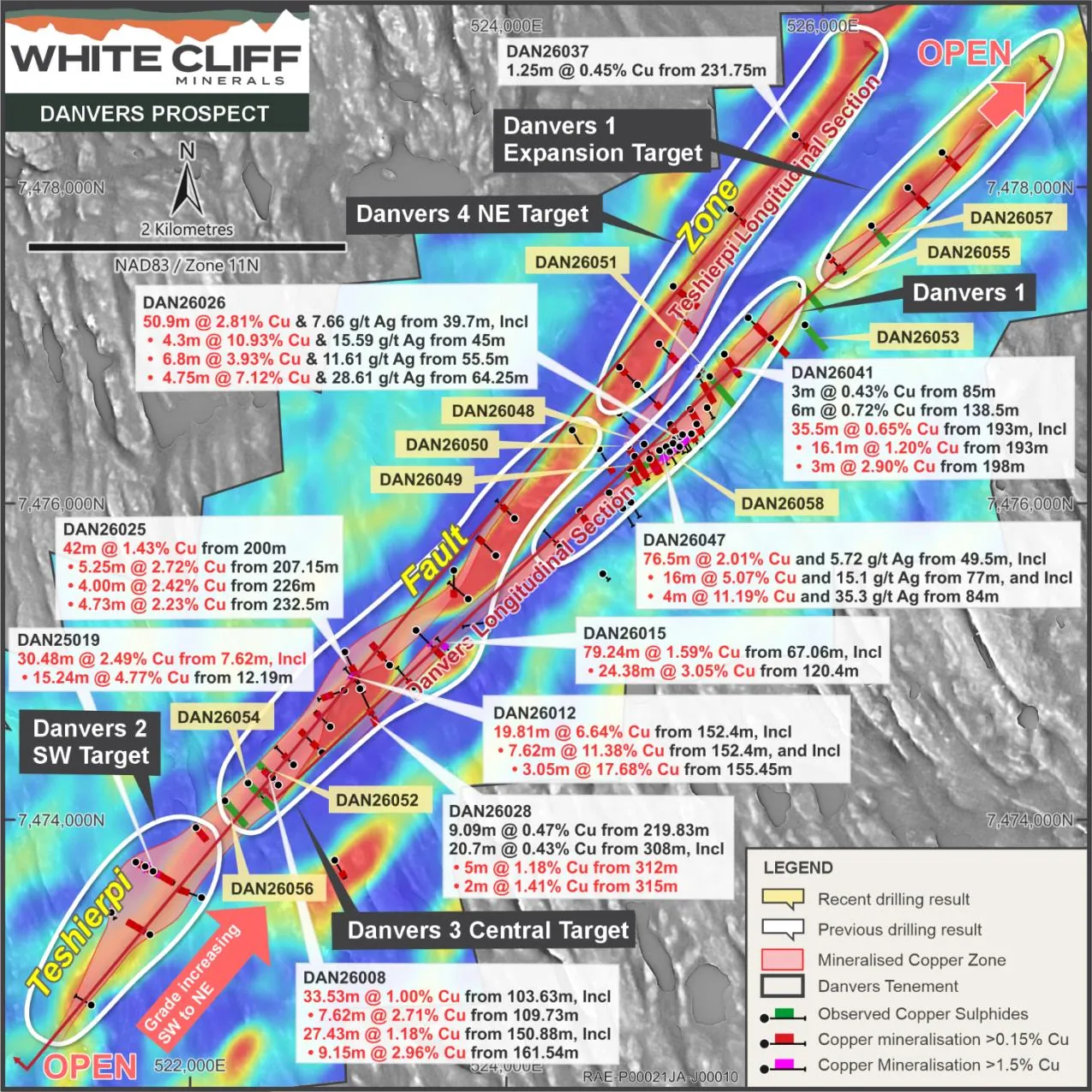
Hole DAN26058, drilled down-dip of the Danvers 1 breccia, reached 522 metres and logged visual copper sulphides as deep as 521 metres downhole. The hole recorded a cumulative 386 metres of visual sulphides from 13 metres, including semi-massive bornite between 456 and 466 metres and chalcocite-rich breccias near the top of the hole.
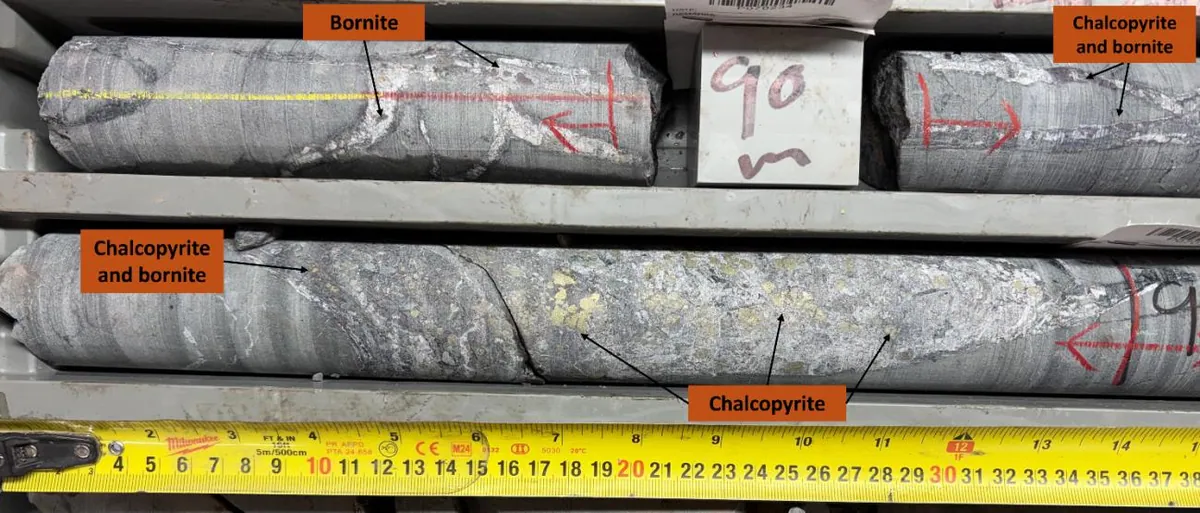
That is an encouraging geological observation, not a grade result. White Cliff explicitly cautions that visual estimates cannot substitute for laboratory analysis, and assays for DAN26058 are expected in six to eight weeks. The company says the hole was also intended to provide structural, density and sample information for future metallurgical and comminution work. Because it was drilled down the mineralised structure, the reported lengths are downhole widths rather than true thicknesses.
Sulphides bridge the Danvers 2 and 3 gap
The second thread is potentially more important for scale. Two diamond holes drilled through a previously untested gap of roughly 580 metres between Danvers 2 and Danvers 3 logged 86.89 metres of visual copper sulphides in DAN26054 and 155.33 metres in DAN26056. Both holes were guided by the Teshierpi Fault Zone and are being incorporated into White Cliff’s geological model.
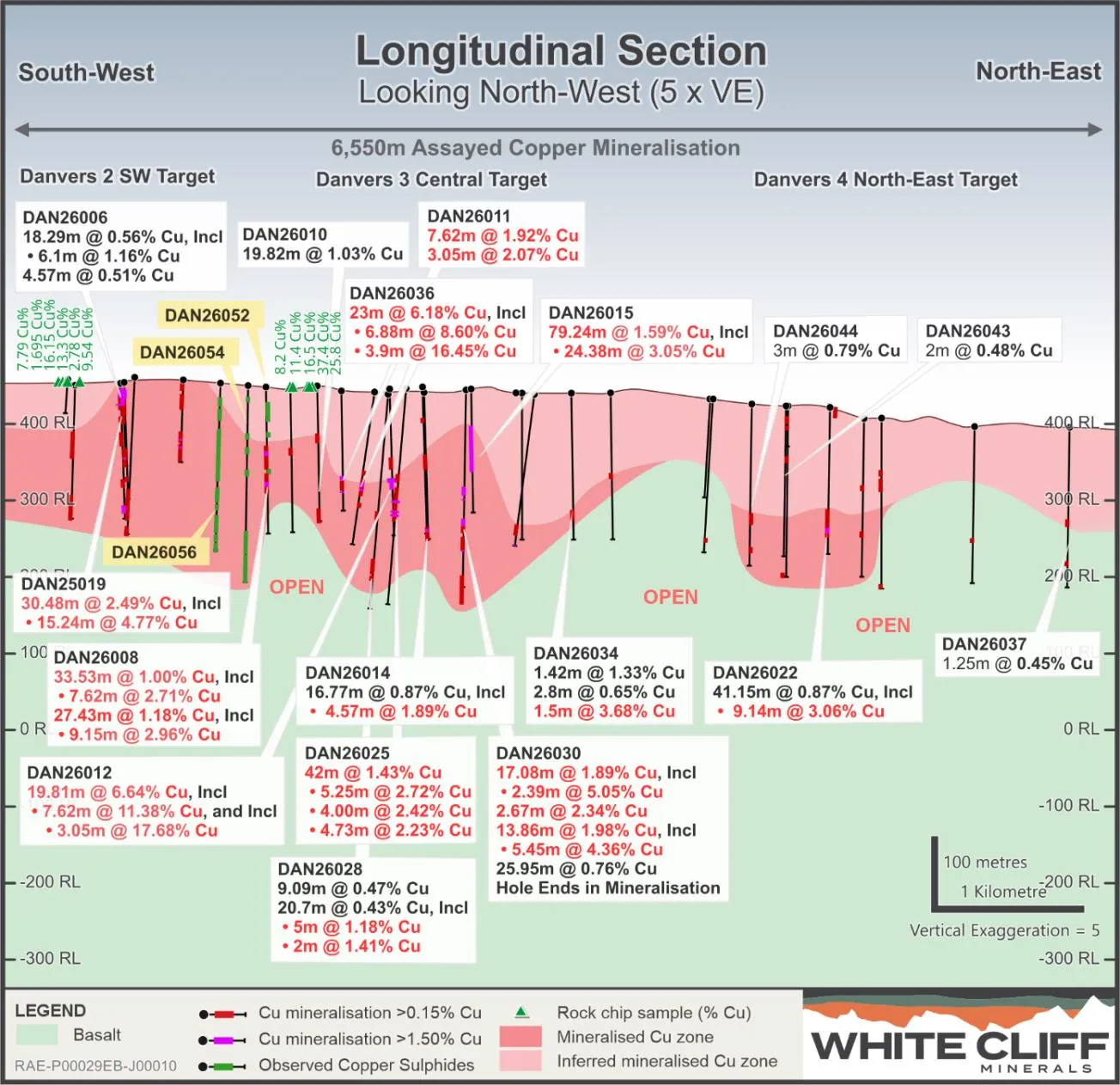
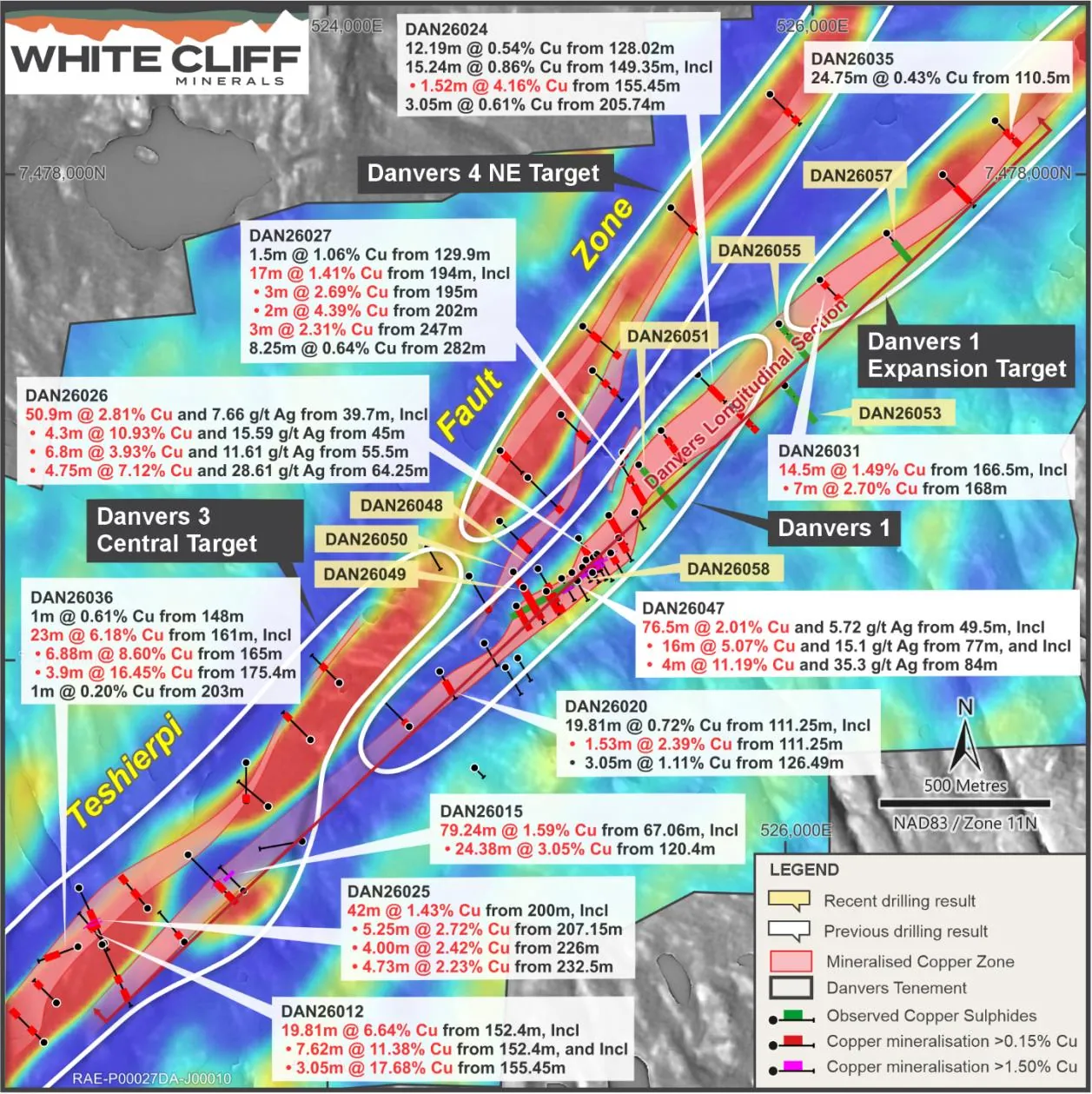
The result gives the company new evidence for continuity between prospects that were initially explored with widely spaced drilling. White Cliff’s Danvers system expansion had already described mineralisation extending across 4.75 kilometres of the Teshierpi corridor, while the company has also reported a parallel Danvers structure mapped over 2.8 kilometres. The latest holes do not establish a resource or economic continuity on their own, but they close a material piece of the exploration map.
Modelling precedes resource definition
White Cliff is now combining the new assays, drill observations and geological modelling to prioritise follow-up work across Rae. Airborne magnetic, gravity and radiometric data are being processed, while till and surface-rock results from the Thor-Rocket areas remain pending and are intended to guide 2027 targeting.
The company’s stated milestones are an Exploration Target followed by the work required for a maiden Mineral Resource Estimate. The immediate test is narrower: whether the pending assays convert the visual sulphide intervals into coherent, grade-supported zones, and whether the evolving drill density is enough to support a defensible model rather than another promising set of sections.
Get ASX:WCN news the moment it breaks
 iPhone & iPad
 Android
Bottom Line?
The geological footprint is widening, but the next six to eight weeks of assays will determine whether the visual continuity carries meaningful copper grades.
Questions in the middle?
- Will assays from DAN26058 confirm economic-grade copper at depth, particularly around the bornite zone below 456 metres?
- Do DAN26054 and DAN26056 establish consistent grades and true widths across the Danvers 2-3 gap?
- How much further drilling will be needed before White Cliff can support an Exploration Target and progress toward a maiden resource?
Sources
1-
Danvers 1 Drilling Identifies Cu Sulphides to 521m Downhole (opens in a new tab)Verified company source. White Cliff Minerals Limited · 12 Nov 2026 · relait.wcminerals.com.au