Tamboran’s Beetaloo wells improve as first gas sales begin

Tamboran Resources has recorded the first gas sales from the Beetaloo Basin, delivering 0.31 Bcf and US$1.8 million during the September quarter. Stronger Shenandoah South well results mark genuine operational progress, but commissioning-stage accounting, continuing losses and future funding needs keep the milestone provisional.
- First Beetaloo gas sales of 0.31 Bcf and US$1.8 million revenue
- SS2-2H ST1 averaged 10.2 MMcf/d over 720 interrupted hours
- SS2-3H and SS2-5H recorded IP30 rates of 8.8 and 10.0 MMcf/d
- Three SS1 wells drilled, with stimulation planned through the December quarter
- US$12.5 million quarterly net loss and ongoing substantial doubt over going concern
 Add us as a preferred source on Google
Beetaloo gas sales begin before commercial operations
Tamboran Resources Corporation (NYSE: TBN; ASX:TBN) has crossed the Beetaloo’s symbolic commercial threshold, selling 0.31 Bcf of gas and generating US$1.8 million during the September 2026 quarter. Tamboran and Daly Waters Energy were the first parties to sell gas from the basin, with first cash inflows received in early November.
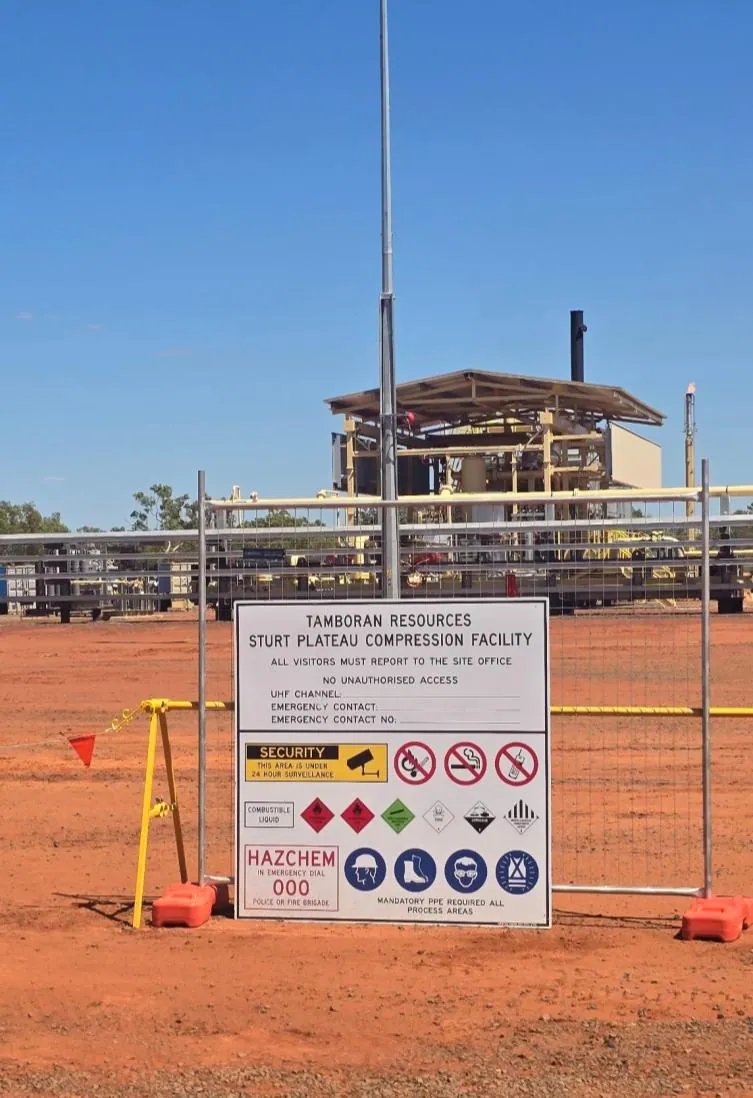
The milestone remains a commissioning event rather than a fully established earnings stream. The Sturt Plateau Compression Facility is still being commissioned, gas sales are currently priced at 75% of the contract price because supply remains interruptible, and the company says its take-or-pay contract with the Northern Territory Government is expected to begin in early 2027. The 40 TJ/d contracted volume is therefore still a forward step, not a quarter-end operating reality.
That distinction was already apparent in the first Beetaloo gas sales, which began in September with volumes constrained by commissioning and Northern Territory nominations. Tamboran said it met 98% of nominations between September 5 and October 31, while the facility is forecast to be completed about US$10 million below budget.
Shenandoah South wells show stronger cleaned-up performance
The more consequential operating data came from the SS2 pad. SS2-2H ST1 averaged 10.2 MMcf/d over 720 hours of interrupted production across roughly 5,500 feet of lateral, which Tamboran says normalises to 18.4 MMcf/d over 10,000 feet. That compares with 7.2 MMcf/d during its 2025 testing period, although the company cautions that the latest figure was not a conventional IP30 result and production was interrupted.
Two newer wells delivered 30-day initial production rates of 8.8 MMcf/d for SS2-3H and 10.0 MMcf/d for SS2-5H. Both were tied into the compression facility without a soaking period and continued to produce stimulation water, at roughly 300 to 500 barrels a day in the activities report. Tamboran says their relatively high bottomhole pressures may allow rates to improve as the wells clean up, but that remains an operating expectation rather than a demonstrated outcome.
The SS2 campaign also provides an early test for locally sourced Beetaloo Red Sand. Ten stages on SS2-5H used the local proppant, with early performance showing no degradation in deliverability against the imported-sand stages, according to Tamboran. The company plans to test the material again during stimulation of the SS1 wells.
Drilling expands the production test and appraisal pipeline
Tamboran completed three wells on the SS1 pad, with about 29,000 feet of combined usable lateral. A downhole issue on SS1-2H required a sidetrack, but the company said the revised program remained within its contingency capital budget. Stimulation is planned for the December 2026 quarter and over the wet season, with tie-in to the compression facility expected in the first quarter of 2027.
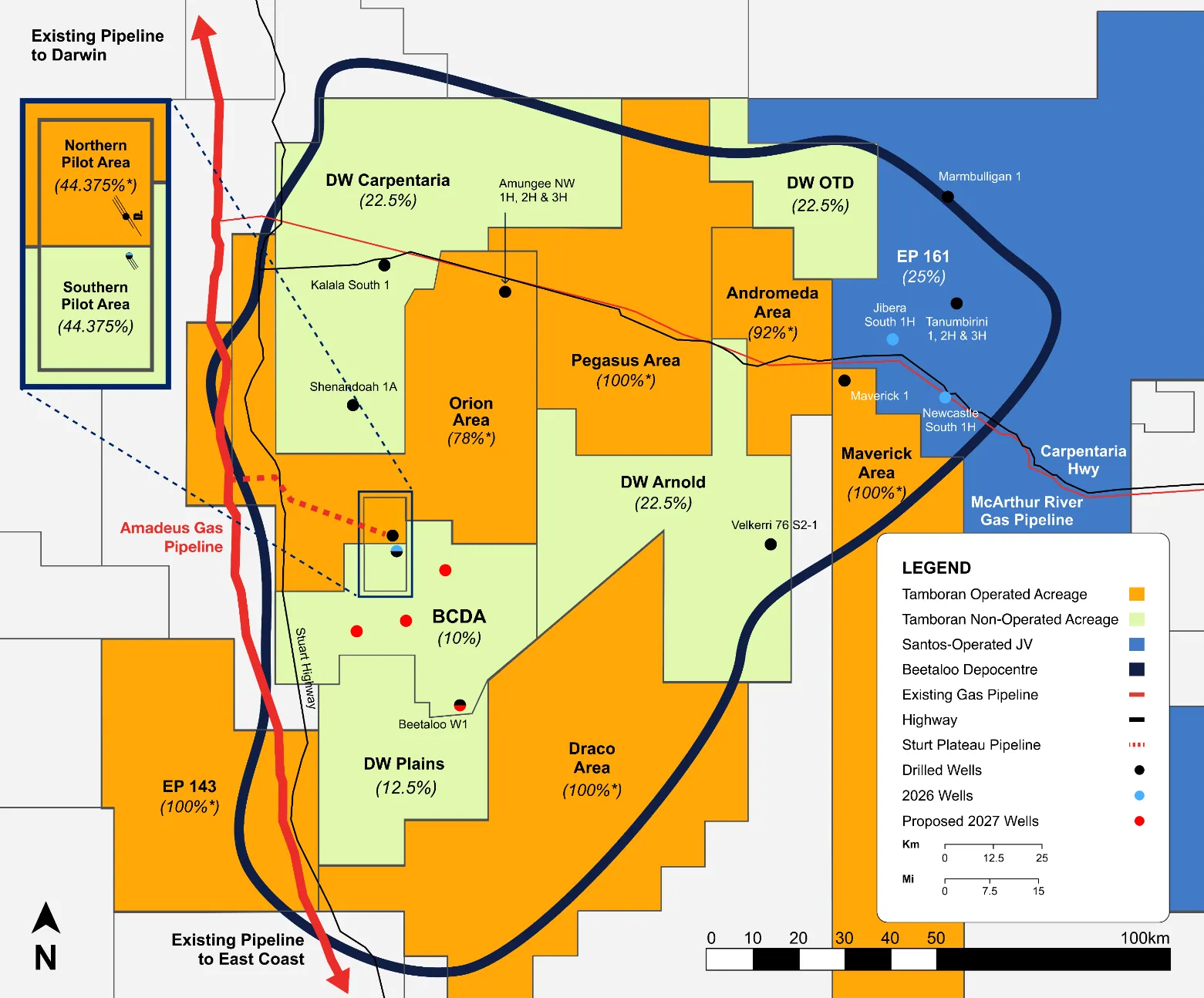
Separately, Santos (ASX:STO) has begun a two-well appraisal program in EP 161, where Tamboran holds a 25% non-operated interest. The Jibera South pilot hole reached about 11,300 feet and intersected the Velkerri shale formations in line with expectations; its 10,000-foot horizontal section is now being drilled, followed by a second well at Newcastle South. Both are planned for stimulation and flow testing in 2027.
Cash runway improves, but losses and funding pressure remain
Tamboran reported US$165 million of cash at September 30, including its share of restricted cash, and cited total cash and near-term inflows of about US$180 million. The US GAAP filing reported US$160.1 million of unrestricted cash and US$9.6 million of restricted cash, alongside US$72.5 million of gross syndicated debt. Net debt drawn for the compression facility was reported as US$37 million in the activities report.
The balance sheet is being asked to support an expensive transition. Cash used in investing activities reached US$94.4 million in the quarter, including US$73.3 million on exploration and evaluation and US$10.5 million on the compression facility. Tamboran posted a US$12.5 million net loss, wider than the US$9.1 million loss in the prior corresponding quarter, while management said additional capital will be required after June 2027 to execute its broader plans.
The 10-Q also retains substantial doubt about the company’s ability to continue as a going concern, dependent on completing SS1 drilling and stimulation, tying the wells into the facility, finishing commissioning and securing future funding. A previously disclosed material weakness in internal controls also remains, covering management review documentation and segregation of duties in certain systems. Gas sales have begun, but the next test is whether they can become dependable cash generation before the development program demands another large cheque.
Get ASX:TBN news the moment it breaks
 iPhone & iPad
 Android
Bottom Line?
The Beetaloo has moved from promise to initial sales, but the investment case now turns on commissioning, sustained well performance and how much capital is needed before take-or-pay revenue begins.
Questions in the middle?
- Can Tamboran complete the compression facility commissioning and commence 40 TJ/d take-or-pay revenue in early 2027?
- Will SS1 stimulation and tie-in results support the productivity implied by the SS2 wells after water unloads?
- How will Tamboran fund its post-June 2027 commitments without materially increasing debt, dilution or asset-level partnerships?
Sources
3-
First Quarter Activities Report period ended September 30 (opens in a new tab)Verified source. Tamboran Resources Corporation · 13 Nov 2026
-
Form 10-Q Quarterly Period ended September 30 (opens in a new tab)Verified source. Tamboran Resources Corporation · 13 Nov 2026
-
First Quarter Results Presentation (opens in a new tab)Verified source. Tamboran Resources Corporation · 13 Nov 2026