Aldoro validates seawater route for Kameelburg rare earths

4 min read
9:22am on Monday 16th of November, 2026 AEDT ~9am, 16th Nov, 26
Popular on LinkedIn
Aldoro Resources says independent Perth testwork has validated seawater hydrochloric acid leaching for its Kameelburg project, with rare earth extraction broadly matching a freshwater baseline and barium impurity falling sharply. The result supports a conceptual coastal processing model, although scale-up, permitting and further laboratory confirmation remain outstanding.
- 71.9% total rare earth extraction using natural seawater
- 85% reduction in barium impurity co-dissolution
- 92.5% strontium extraction versus 98.9% with freshwater
- Conceptual Walvis Bay hydrometallurgical plant added to scoping study
- Second-laboratory validation and engineering work remain pending
 Add us as a preferred source on Google
Seawater preserves rare earth recovery while reducing barium
Aldoro Resources Limited (ASX:ARN) has cleared a potentially important processing hurdle at its Kameelburg rare earths and strontium project in Namibia: natural seawater performed broadly as well as freshwater in an independent leach test, while sharply reducing a key impurity.
ALS Metallurgy in Perth recorded 71.9% total rare earth extraction from Kameelburg mineralisation using ambient hydrochloric acid prepared with raw seawater, compared with 69.1% in Aldoro's earlier freshwater baseline. Strontium extraction was lower at 92.5%, against 98.9% with freshwater, but barium co-dissolution fell from 58.0% to 8.9%, an 85% reduction. That matters because barium carbonate had previously been identified as the primary impurity challenge during strontium carbonate recovery.
The result extends the project's recent metallurgical progress, following the MREC and SrCO3 validation that produced laboratory samples of both products. Aldoro says the sulphate naturally present in seawater precipitated dissolved barium as insoluble barite, potentially improving the purity of the strontium carbonate stream. Aluminium co-extraction was higher in the seawater test, however, at 49% versus 33% in the freshwater comparison, leaving further impurity management and flowsheet optimisation on the work programme.
Walvis Bay concept shifts wet processing to the coast
Aldoro is now asking SLR Consulting to incorporate a preliminary dual-site model into the Kameelburg Scoping Study. Under the concept, mining, crushing and dry magnetic separation would remain at Kameelburg, while fine grinding, seawater leaching, impurity removal and precipitation of mixed rare earth carbonate and strontium carbonate would take place near Walvis Bay.
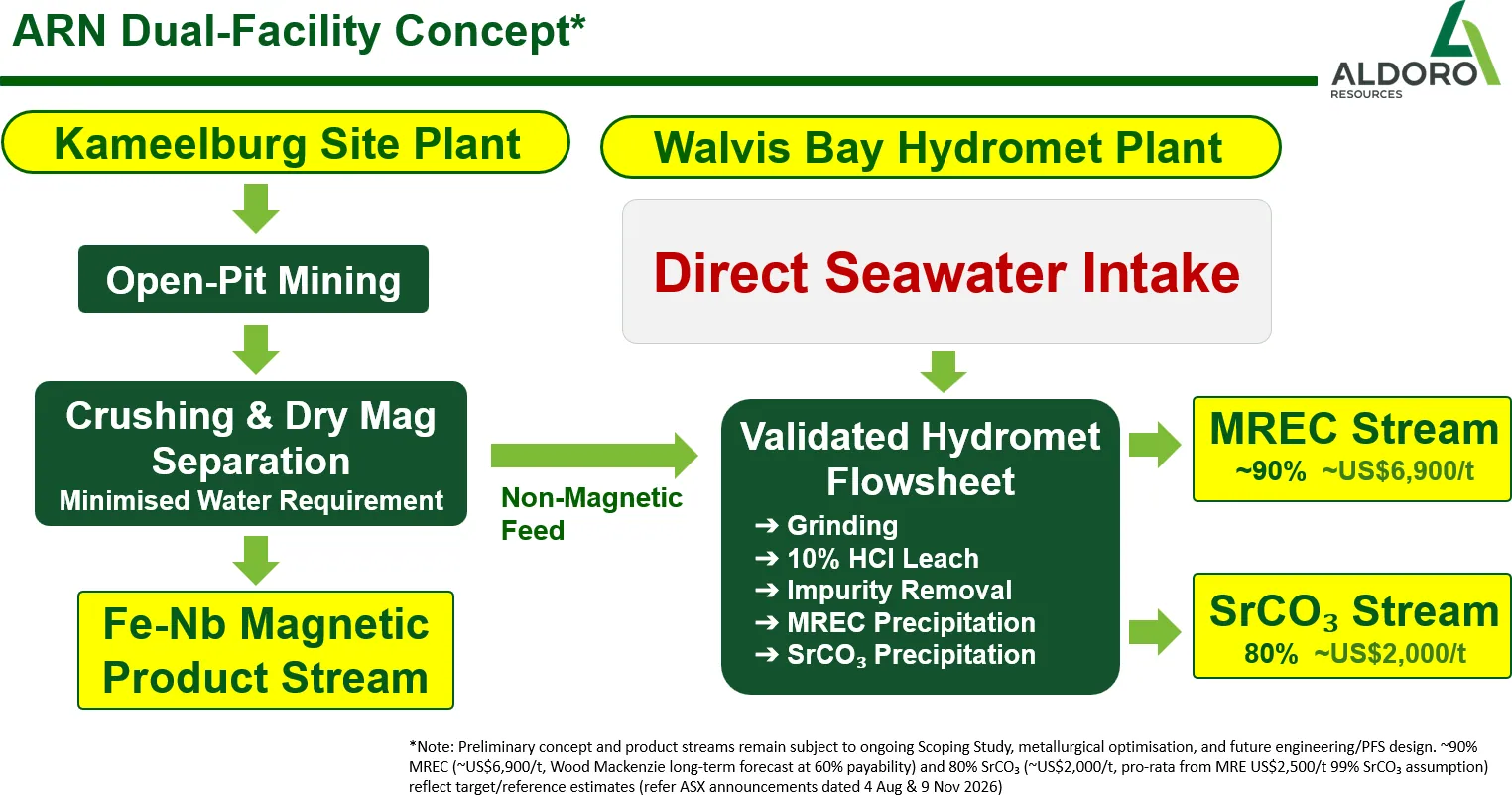
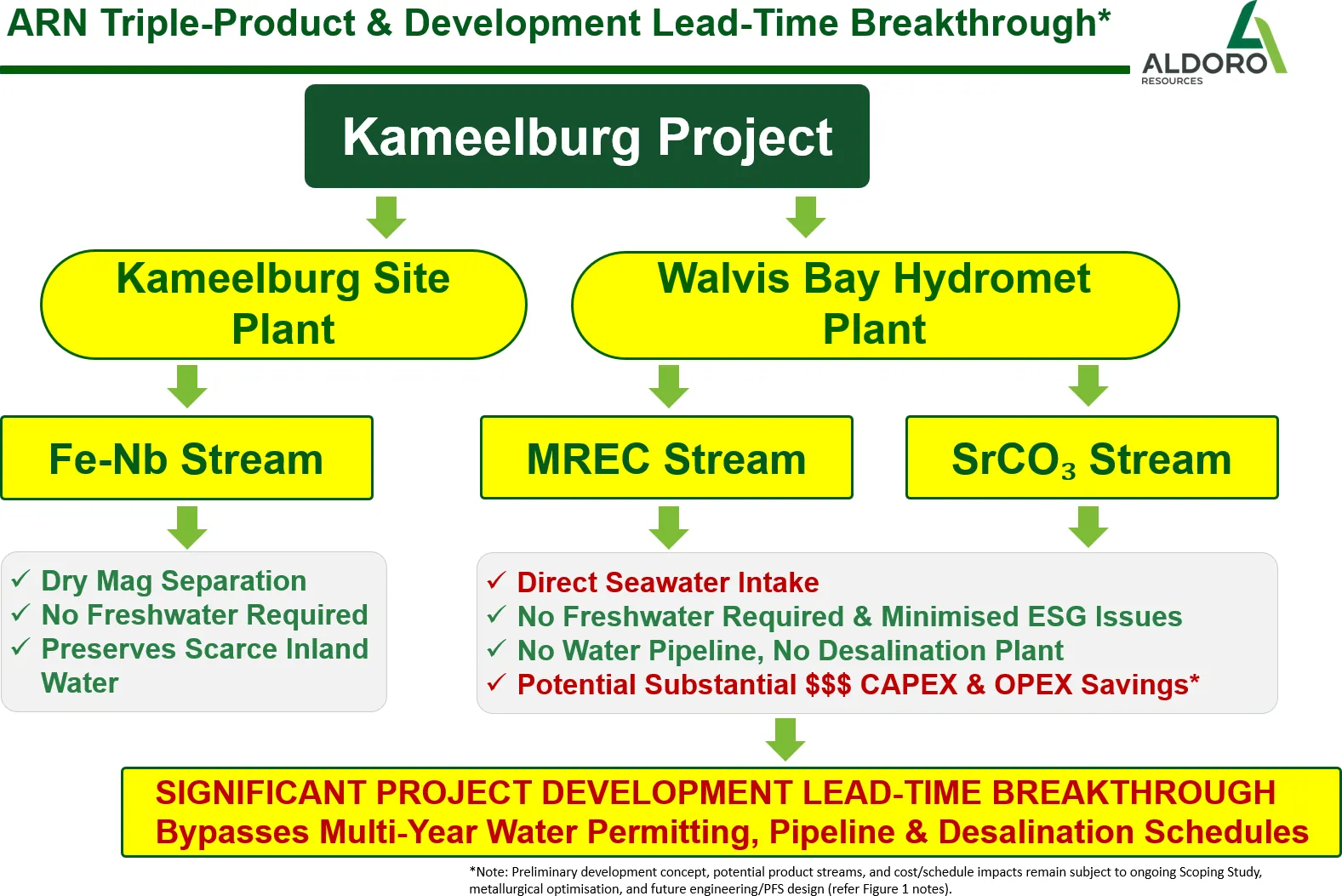
The proposed coastal location would provide direct access to seawater, imported hydrochloric acid and export infrastructure, with upgraded feed transported from the mine by existing rail. Aldoro says the arrangement could remove the need for large inland freshwater systems, desalination, long-distance pipelines and inland acid storage and trucking. Potential reductions in infrastructure capital and water-permitting lead times remain conceptual, with rail transport costs and other operating trade-offs still to be assessed.
The concept arrives as Kameelburg moves into development studies after the 804.5Mt resource upgrade, which increased the reported mineral resource by 35%. The latest processing result may improve the project's development architecture, but it does not yet establish project economics, commercial-scale recoveries or a construction schedule.
Single-composite test leaves scale-up questions open
The comparison used identical 500-gram splits from a magnetically pre-concentrated composite derived from 30 metres of core in a single drillhole, DD004D. The seawater test also used slightly more acid, at 514 kilograms per tonne versus 503 kilograms per tonne, and a four-hour residence time rather than two hours in the freshwater baseline. A second independent laboratory is conducting further seawater validation, with results due separately.
Those qualifications matter because the coastal plant, triple-product model and claimed schedule and capital benefits are all subject to the scoping study, engineering, environmental approvals and future feasibility work. The next meaningful evidence will be whether the seawater chemistry reproduces across laboratories and broader samples, and whether the savings in inland water infrastructure outweigh the cost of moving feed to Walvis Bay.
Get ASX:ARN news the moment it breaks
 iPhone & iPad
 Android
Bottom Line?
The chemistry has strengthened Aldoro's coastal processing case, but the investment story now depends on reproducibility, rail economics and scoping-study numbers rather than the headline leach result alone.
Questions in the middle?
- Will the second laboratory reproduce the 71.9% rare earth extraction and 85% barium reduction?
- Can rail transport to Walvis Bay offset the infrastructure savings from avoiding inland water and acid systems?
- What capital cost, operating cost and permitting outcomes will emerge from the scoping study?
Sources
1-
Innovative Seawater Leach Validated For Ore-to-MREC Route (opens in a new tab)Official market announcement. Aldoro Resources Limited · 16 Nov 2026 · aldororesources.com