Aldoro’s Kameelburg gains a second chemical revenue stream

Aldoro Resources says Wood Mackenzie has set a long-term forecast price of about US$6,900 per tonne for Kameelburg’s mixed rare earth carbonate, while a separate strontium carbonate stream could add another chemical product. The figures will feed into a Scoping Study that is nearing completion, but depend partly on purity targets not yet achieved.
- US$6,900/t long-term MREC forecast at 60% payability
- Magnet rare earths account for 89.2% of forecast MREC value
- SrCO₃ reference pricing estimated at US$2,000 to US$2,250/t
- Rare earth magnet demand forecast to rise 79% by 2050
- Wood Mackenzie inputs transferred to SLR Consulting’s Scoping Study
 Add us as a preferred source on Google
Wood Mackenzie puts long-term MREC value at US$6,900/t
Aldoro Resources Limited (ASX:ARN) has received an independent market study that places a long-term real-terms forecast price of about US$6,900 per tonne for mixed rare earth carbonate produced from its Kameelburg project in Namibia. The estimate covers the 2030 to 2050 period and assumes 60% payability, a 90% MREC purity target and roughly 65% total rare earth oxide content.
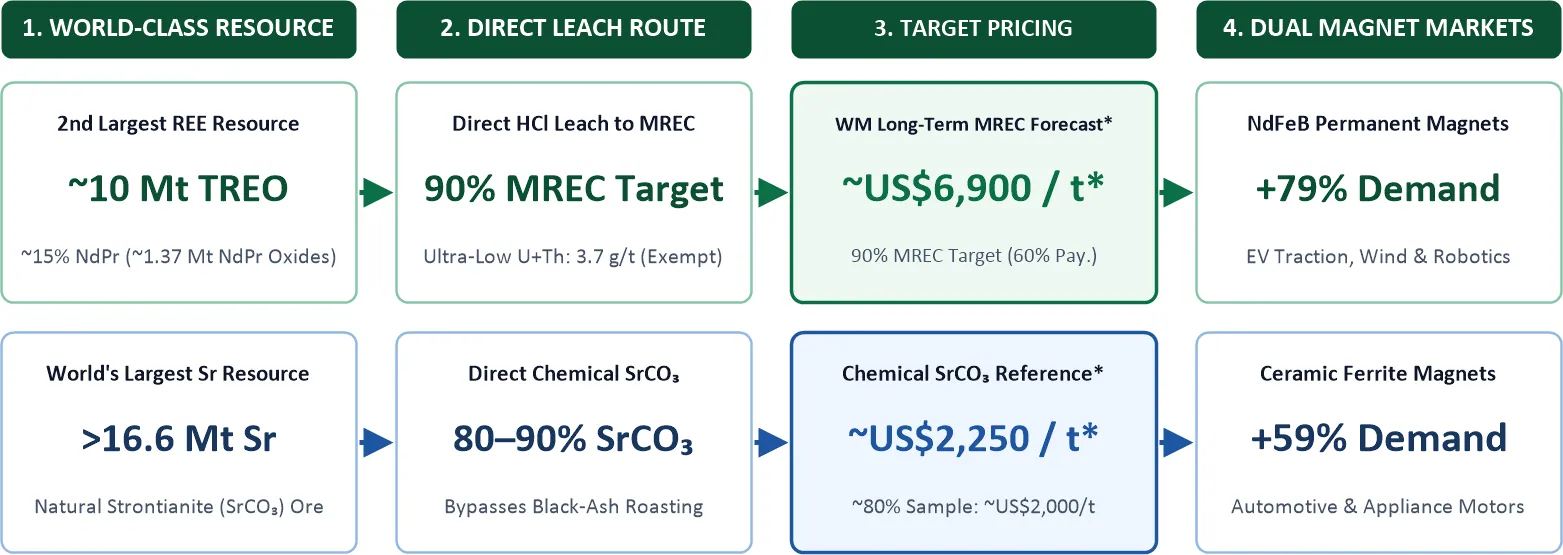
That distinction matters. The 90% purity level remains an optimisation target rather than an achieved commercial specification, while the price is a forecast basket valuation rather than a realised sales contract. Even so, the study gives SLR Consulting a market-price framework for the Kameelburg Scoping Study, which Aldoro says is in its final stages.
NdPr and heavy magnet elements dominate the value basket
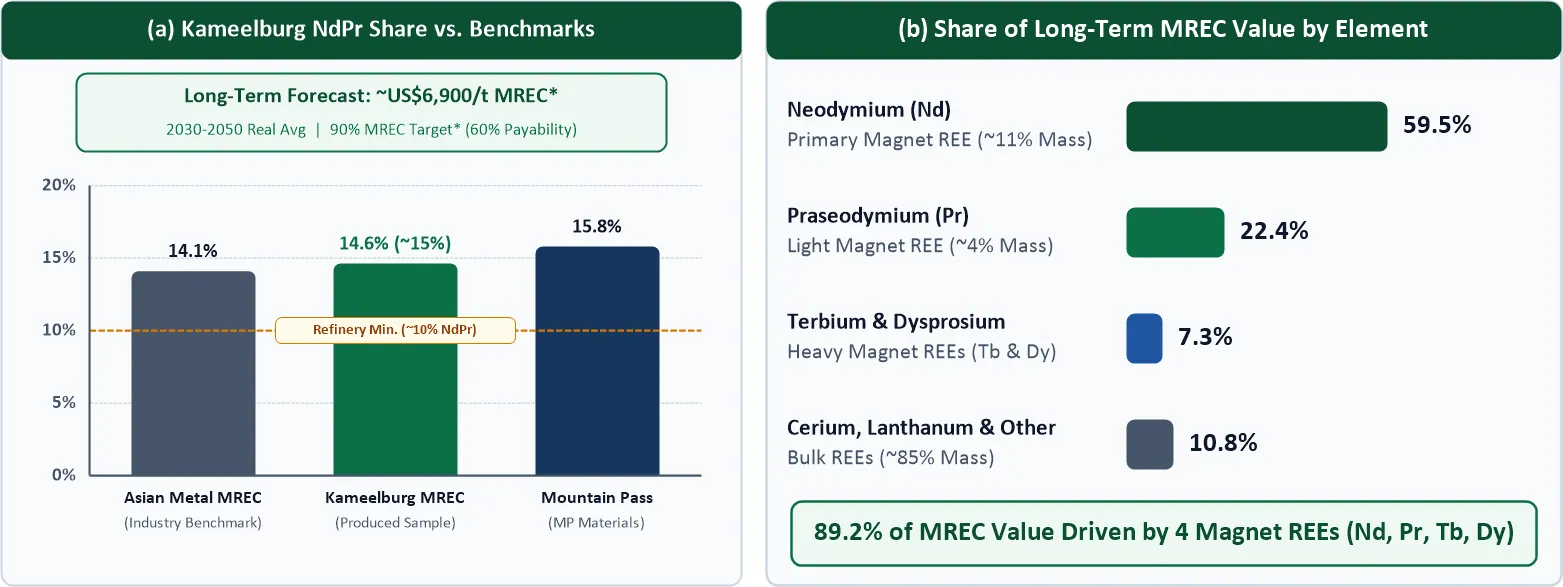
Wood Mackenzie’s element-by-element modelling suggests Kameelburg’s revenue would be driven far more by its valuable magnet elements than by the bulk of its rare earth mass. Neodymium and praseodymium together contribute 81.9% of the forecast MREC value, with terbium and dysprosium taking the total contribution from permanent-magnet rare earths to 89.2%.
The project’s produced MREC sample contained a roughly 14.6% NdPr share, which Aldoro says is comparable with cited industry benchmarks and above the approximately 10% NdPr threshold generally required by commercial refineries. The project’s earlier Kameelburg carbonate samples produced MREC and strontium carbonate in laboratory testwork, but the company still has to demonstrate that the targeted purity and recovery levels can be sustained at larger scale.
Strontium carbonate adds a second chemical product
Kameelburg’s commercial pitch does not rest solely on rare earths. Aldoro is also assigning a pro-rata reference value of about US$2,000 per tonne to its validated roughly 80% purity strontium carbonate sample, rising to about US$2,250/t at a 90% purity target. Those figures are based on an earlier US$2,500/t reference price for 99% purity material; they are not a Wood Mackenzie product-price forecast.
The proposed advantage is geological as much as commercial. Kameelburg hosts natural strontianite, a strontium carbonate mineral, rather than the celestite sulphate used by most producers. Aldoro says that could avoid the high-temperature “black-ash” roasting normally required to convert celestite into strontium carbonate. The study forecasts global strontium demand rising 58% from 301 kilotonnes in 2026 to 475kt by 2050, with ceramic ferrite magnets a major source of growth.
Demand outlook supports rare earth supply diversification
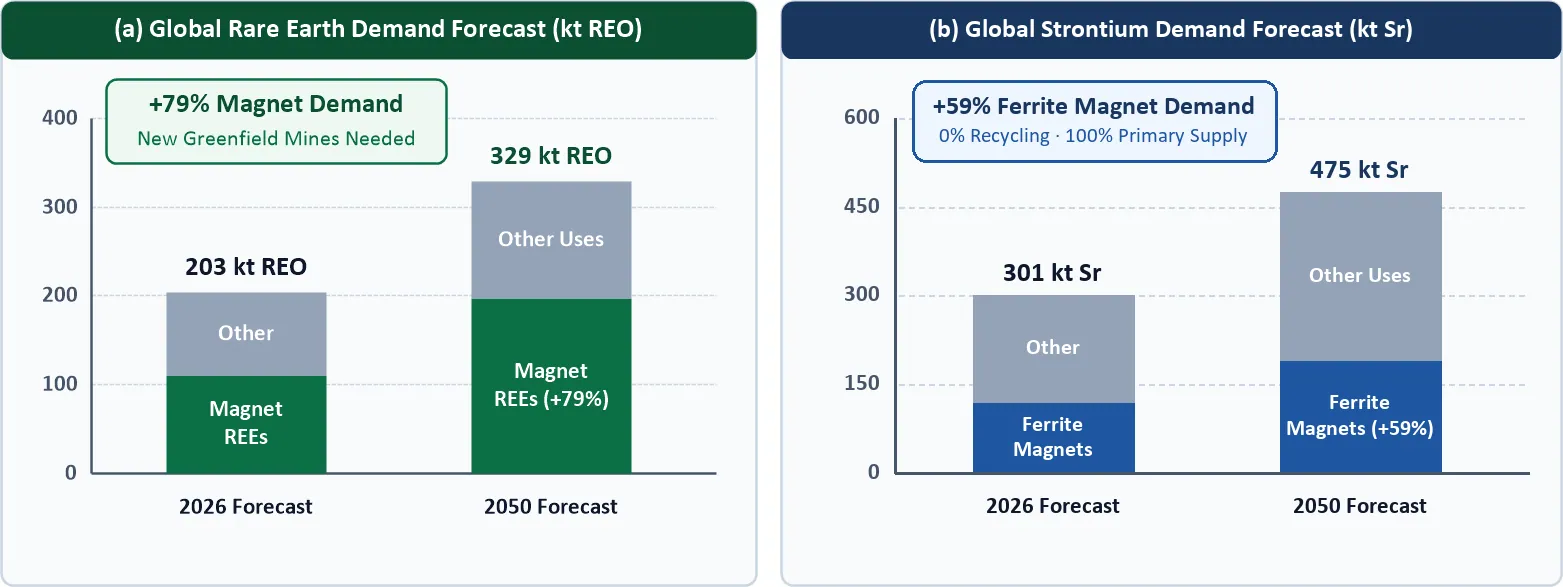
Wood Mackenzie forecasts total rare earth oxide demand growing from 203kt in 2026 to 329kt in 2050, while demand for permanent-magnet rare earths rises 79%. Existing operating mine supply is expected to plateau from 2029, according to the study, leaving new projects to meet demand growth after the end of the decade.
Aldoro also points to the Kameelburg MREC sample’s combined uranium and thorium content of 3.7 grams per tonne as a potential logistics and refinery-access advantage. The company says the sample’s low radionuclide content supports classification as non-radioactive general cargo, although any future commercial classification and regulatory treatment would depend on the final product and applicable approvals.
Scoping Study now carries the commercial test
The market study arrives as Aldoro advances a proposed development pathway with WILLETECH, after the pair outlined a strategic partnership involving a proposed 51% interest in the Kameelburg project company and a non-binding RMB2 billion development commitment in the WILLETECH strategic partnership. Aldoro says the Wood Mackenzie pricing, payability and market inputs have now been passed to SLR Consulting, alongside plans for customer sample qualification, pilot-plant work and offtake and financing discussions.
The decisive information is still to come in the Scoping Study: production rates, recoveries, capital and operating costs, product specifications, permitting requirements and funding needs. Until those numbers arrive, US$6,900/t describes the potential value of a targeted chemical product under a long-term forecast, not the economics of an operating mine.
Get ASX:ARN news the moment it breaks
 iPhone & iPad
 Android
Bottom Line?
The pricing framework is supportive, but Kameelburg’s investment case now depends on whether SLR can convert purity targets and market assumptions into credible project economics.
Questions in the middle?
- Can Aldoro achieve the 90% MREC and 90% SrCO₃ purity targets consistently beyond laboratory-scale testwork?
- What production rates, recoveries and costs will the Scoping Study assign to the two chemical product streams?
- Will the proposed WILLETECH funding pathway progress from non-binding commitments to definitive, financeable agreements?
Sources
1-
Wood Mackenzie Confirms Strong MREC and Dual-Magent Market (opens in a new tab)Official market announcement. Aldoro Resources Limited · 17 Nov 2026 · aldororesources.com