Powerhaus unlocks Malbec uranium exploration after environmental approval

Powerhaus Uranium has secured two years of environmental approval for exploration at its Central Malbec project in Argentina, clearing the way for trenching in December and planned drilling in January. The early field signals are encouraging, but laboratory assays remain the next important test.
- Two-year environmental approval covers up to 66 drill sites, 30 trenches and 160 sonic holes
- Approximately 10 backhoe trenches planned across two calcrete terraces from early December 2026
- Hand-dug pits recorded up to 3,200 cps and exposed visible carnotite beneath soil cover
- Six Terrace del Molle and seven Aguada de Piedra samples await laboratory assays
- First uranium drilling at Malbec targets a 4,000 to 5,000 metre January 2027 program
 Add us as a preferred source on Google
Environmental approval unlocks Central Malbec work
Powerhaus Uranium Limited (ASX:POW) has removed a key permitting obstacle at its flagship Central Malbec project in Argentina, securing a two-year environmental approval that covers a substantially broader exploration program than previously outlined.
The approval allows up to 66 drill locations, 30 backhoe trenches and 160 sonic holes across the two uranium target styles at Malbec. That compares with the 20 trenches and 142 sonic holes described in Powerhaus's September quarterly report, although the company has not committed to completing the full approved scope.
The timing gives Powerhaus a sequence of near-term exploration catalysts. It plans to begin approximately 10 trenches across the Terrace del Molle and Aguada de Piedra calcrete terraces in early December 2026, followed by a 4,000 to 5,000 metre drilling campaign into the deeper Salamanca Formation target in January 2027, subject to water-use and hazardous-waste requirements.
Pits reveal radioactivity beneath apparently quiet surfaces
Recent hand-dug pits have added a wrinkle to the earlier surface survey. At Terrace del Molle, where a ground radiometric survey found no significant surface response, five of seven pits reached calcrete and four recorded readings above 500 counts per second. Aguada de Piedra produced peak in-pit readings ranging from 760 to 3,200 cps, including the highest result at a depth of 0.5 metres.
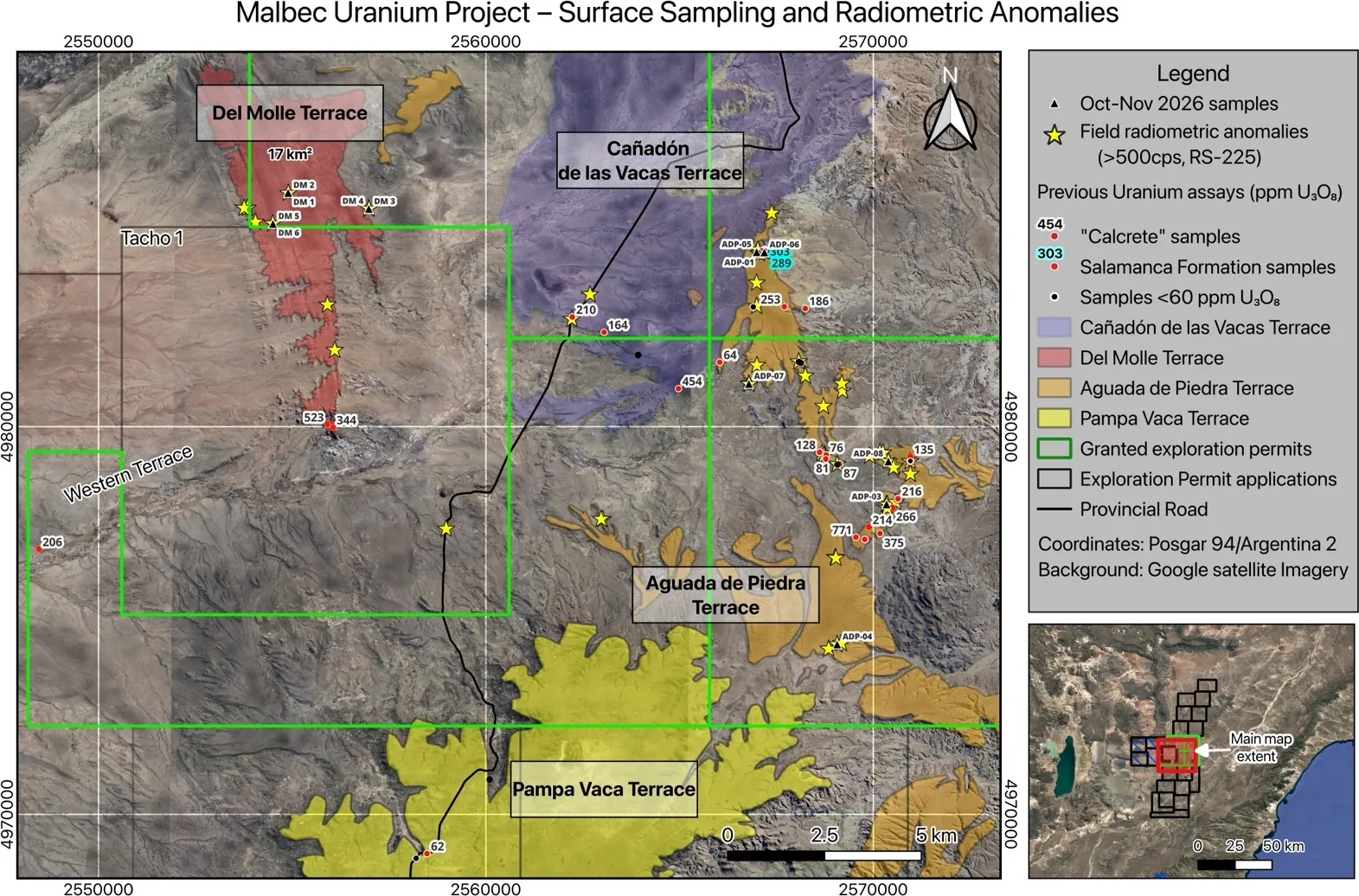
Field staff also reported visible carnotite at both terraces, while previous grab samples returned up to 771 parts per million U3O8 at Aguada de Piedra and 523 ppm and 344 ppm at Cerro Tacho. The finding that soil cover can mask radioactivity helps explain why the earlier surface survey was inconclusive, and supports the decision to move to trenching. It also gives fresh relevance to the Malbec field survey, which had reported no significant surface radiometric response and outstanding pit assays.
The numbers come with an important limitation. Handheld spectrometer readings measure total gamma radiation, not uranium grade, and can include contributions from thorium and potassium. The sampling was selective and reconnaissance-level, with no drilling completed and no mineral resource established at Malbec.
Assays and trenching will test the calcrete targets
Powerhaus has submitted six Terrace del Molle channel samples and seven Aguada de Piedra grab samples for laboratory analysis. Those assays, expected through the fourth quarter of 2026 and first quarter of 2027, should provide the first direct check on whether the elevated field readings translate into uranium grades.
The planned trenches are expected to reach about three metres, with some potentially extending to 3.5 metres where ground stability and trench design allow. Powerhaus intends to log and channel sample the exposed calcrete for thickness, grade and continuity before deciding where to deploy sonic drilling, initially on a 400 metre by 400 metre grid.
January drilling targets untested Salamanca Formation
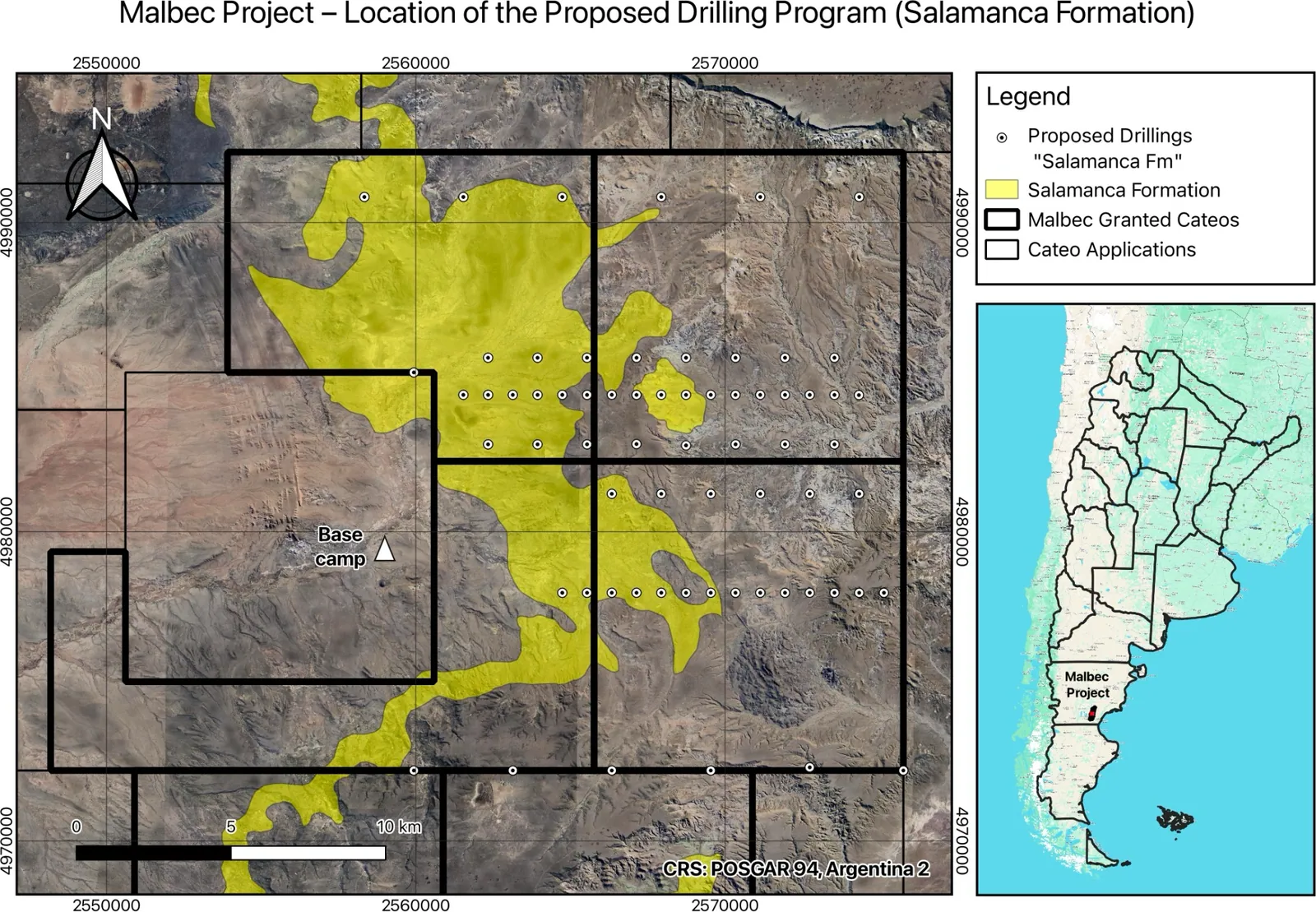
The separate Salamanca Formation program is designed to test a deeper sandstone-hosted roll-front uranium model. Previous outcrop samples returned 303 ppm and 289 ppm U3O8, which Powerhaus interprets as a possible surface expression of mineralisation beneath a sedimentary succession estimated at 75 to 125 metres thick.
The company has signed a letter of intent with Capricorn Drilling but expects to finalise a formal contract before mobilisation. Existing seismic and oil and gas well data are also being acquired to refine the proposed drill targets. Whether the interpreted channels contain economic mineralisation remains unresolved, and the suitability of any discovery for in-situ recovery has not been established.
Get ASX:POW news the moment it breaks
 iPhone & iPad
 Android
Bottom Line?
The permitting milestone turns Malbec from a largely surface-led story into a testable exploration campaign, but the next valuation-sensitive evidence is still pending assays and drill results.
Questions in the middle?
- Will the pending assays confirm that the strong gamma readings represent elevated uranium grades?
- How much of the approved trenching and sonic drilling scope will Powerhaus ultimately undertake?
- Can the January drilling program proceed on schedule once water-use, hazardous-waste and contractor requirements are finalised?
Sources
1-
Environmental approval paves way for start of drilling (opens in a new tab)Verified company source. Powerhaus Uranium Limited · 18 Nov 2026 · investors.powerhausuranium.com