KMD’s digital push gains traction as Kathmandu powers a resilient Q1

KMD Brands has started FY27 with modest sales growth, a stronger gross margin and a sharp lift in digital revenue, led by Kathmandu. But the recovery remains uneven, with Oboz sales falling and Bluestar Alliance set to walk away from takeover talks unless the parties reach a late agreement.
- Q1 group sales increased 1.6% year on year, with exchange rates contributing about 5%
- Kathmandu sales rose 10.2%, while Oboz fell 19.5% during a distribution centre relocation
- Gross margin expanded 140 basis points to 57.3% and digital revenue grew 25.5%
- Bluestar exclusivity is expected to end on 2 December after the parties failed to agree revised terms
- KMD remains focused on cash generation, deleveraging and its Next Level turnaround strategy

 Add us as a preferred source on Google
Kathmandu leads a modest FY27 start
KMD Brands Limited (NZX/ASX:KMD) has opened FY27 with a small but useful sales gain: group revenue rose 1.6% in the first quarter to 31 October, while gross margin widened 140 basis points to 57.3%. The headline improvement came with an important qualification. Currency movements contributed approximately 5% to reported sales when Rip Curl’s Australian-dollar results and Oboz’s US-dollar results were translated into New Zealand dollars.

Performance was notably uneven across the portfolio. Kathmandu sales increased 10.2%, with direct-to-consumer same-store sales, including online, up 5.8% at constant exchange rates. Rip Curl edged 0.8% higher, or 2.5% on a same-store basis excluding Ozmosis, while Oboz sales dropped 19.5%. KMD said Oboz’s wholesale decline was planned and reflected the relocation of its distribution centre, with a return to growth anticipated in the second quarter.
The stronger channel data sits online. Group digital revenue grew 25.5% heading into the key trading period, while total direct-to-consumer same-store sales rose 3.1% over the 14 weeks to 1 November. KMD said Australian consumers remained focused on value, a constraint that has not disappeared simply because the gross-margin line improved.
Takeover talks face a 2 December deadline
The trading update arrived alongside a more consequential strategic development: Bluestar Alliance is expected to end its exclusivity arrangement with KMD at 5.00pm New Zealand time on 2 December. Bluestar has declined to progress due diligence and negotiations unless KMD either extended restrictions on responding to a superior proposal or agreed to reimburse Bluestar’s costs if a transaction did not proceed. The board rejected both requests as unacceptable in the circumstances.
The breakdown follows the Bluestar exclusivity arrangement, which had given the US consumer-brand group access to confirmatory due diligence and discussions over a possible acquisition of all KMD shares. KMD said the expected conclusion of talks was not driven by any material adverse matter identified during Bluestar’s due diligence. The board said it would still consider credible approaches capable of delivering greater value for shareholders.
Turnaround gains meet balance-sheet pressure
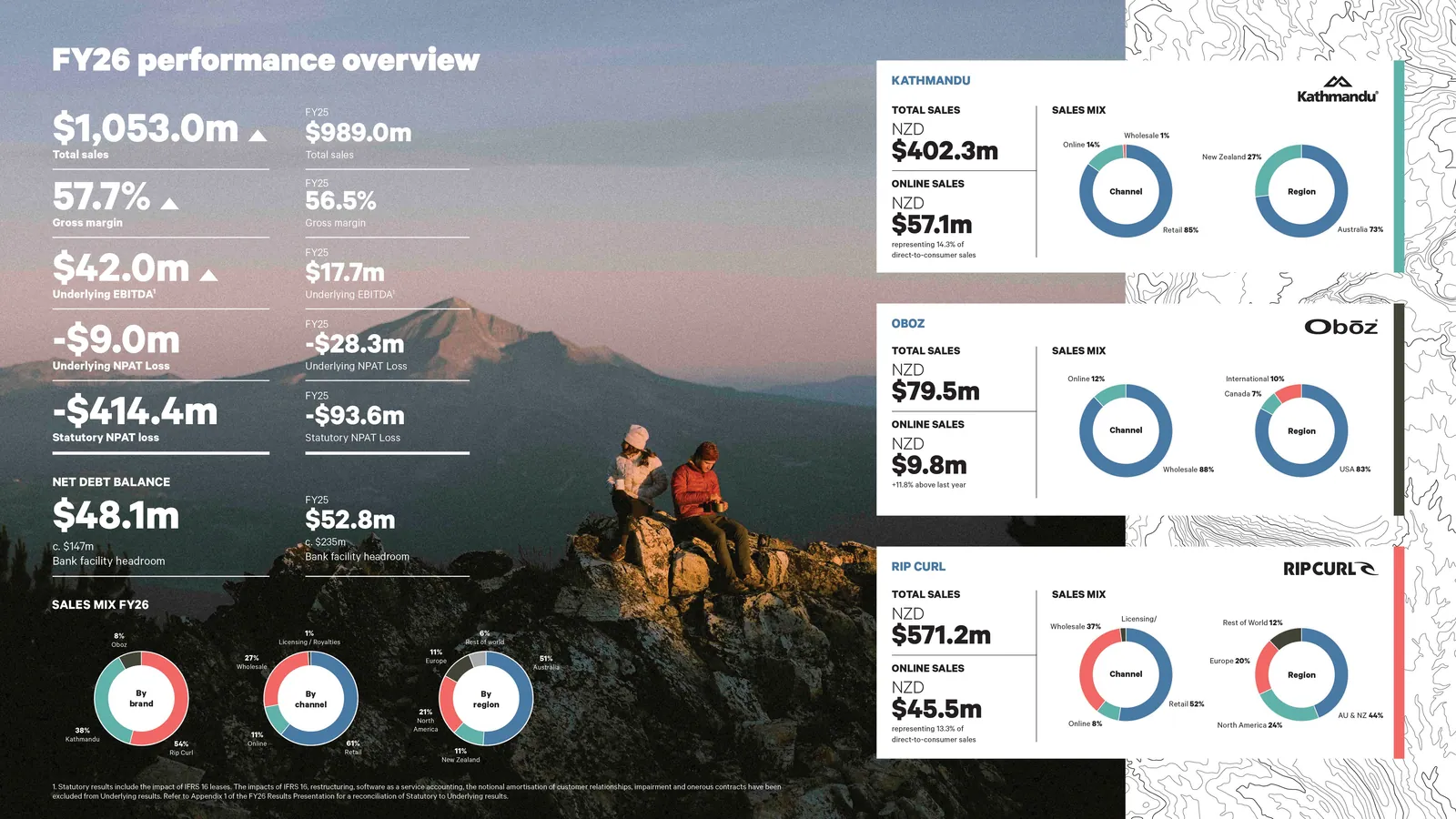
The early FY27 figures build on a stronger FY26 operating result. KMD reported revenue growth of 6.5%, underlying EBITDA of NZ$42.0 million, and a 120-basis-point improvement in full-year gross margin to 57.7%. It also delivered NZ$27.5 million of cost savings and closed 17 underperforming stores. Those gains came after the NZ$65.3 million equity raising, which KMD said strengthened liquidity and supported its banking relationships but diluted shareholders who did not participate.
The balance sheet remains the less glamorous, and more important, part of the recovery story. Net debt stood at NZ$48.1 million at 31 July 2026, while management said New Zealand-dollar depreciation continued to pressure operating costs, finance costs and net debt. The board has made free-cash-flow generation and leverage reduction central FY27 priorities, alongside further store closures and cost-base restructuring.
Rip Curl’s next product cycle and Oboz’s post-relocation wholesale recovery provide near-term tests, while Kathmandu currently supplies the clearest momentum. The key question is whether improved margins and digital growth can translate into cash before consumer weakness, currency effects and the cost of the turnaround again take centre stage.
Get NZX:KMD news the moment it breaks
 iPhone & iPad
 Android
Bottom Line?
KMD has produced encouraging early operating signals, but the recovery still depends on turning margin and digital gains into cash while the takeover option fades.
Questions in the middle?
- Can Kathmandu’s sales momentum offset weaker Oboz trading and continued value-seeking behaviour in Australia?
- Will the 25.5% digital revenue growth persist through the key trading period without renewed discounting?
- Once Bluestar exclusivity ends, will credible alternative approaches emerge or will KMD remain focused solely on deleveraging and execution?
Sources
6-
2026 Annual Meeting Presentation (opens in a new tab)Verified source. KMD Brands Limited · 25 Nov 2026
-
KMD Brands 2026 Impact Report (opens in a new tab)Verified source. KMD Brands Limited · 25 Nov 2026
-
KMD Brands 2026 Modern Slavery Statement (opens in a new tab)Verified source. KMD Brands Limited · 25 Nov 2026
-
Chairperson's Address (opens in a new tab)Official market announcement. KMD Brands Limited · 25 Nov 2026 · kmdbrands.com
-
CEO Address (opens in a new tab)Official market announcement. KMD Brands Limited · 25 Nov 2026 · kmdbrands.com
-
KMD Brands Trading Update (opens in a new tab)Official market announcement. KMD Brands Limited · 25 Nov 2026 · kmdbrands.com