BCM builds momentum at Ema as rare earth supply chains shift

Brazilian Critical Minerals has moved several parts of its Ema rare earth project forward, including land access, exploration approvals, FEED engineering and project staffing. But environmental approvals, offtake agreements and construction funding remain outstanding as the company positions Ema for ex-China supply chains.
- ANM has approved Final Exploration Reports for both Ema tenements
- INCRA land-access agreement awaits final ratification in Brasília
- IPAAM licensing and two trial mining applications remain pending
- Offtake and project funding discussions continue without signed agreements
- FEED and magnesium sulphate plant design work are advancing

 Add us as a preferred source on Google
Ema advances while the critical approvals remain open
Brazilian Critical Minerals Limited (ASX:BCM) has advanced several workstreams at its Ema rare earth project in Brazil, but the development still rests on a set of unresolved regulatory and financing steps. The company says the Final Exploration Reports for both Ema tenements have been approved by Brazil’s National Mining Agency, while environmental licensing and two trial mining licence applications remain pending.
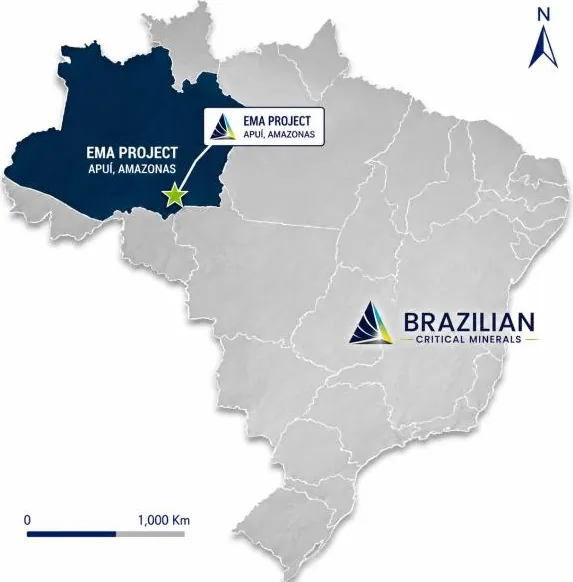
INCRA Amazonas has also approved a land-access agreement covering proposed activities on INCRA-controlled land and issued a certificate confirming there is no impediment to environmental licensing continuing. Final ratification by INCRA in Brasília is still outstanding. That approval pathway was identified as a key land-access milestone in BCM’s October development and funding update.
The immediate permitting priorities are approvals from the Amazonas Environmental Protection Institute, known as IPAAM, and the remaining ANM processes. BCM says local resources have been deployed to support the environmental approval process, while engineering and development planning continue in parallel.
FEED moves towards Brazilian execution planning
Altris Engineering continues to lead Ema’s Front-End Engineering and Design program, carrying forward work from the feasibility study. BCM is now selecting a Brazilian engineering partner to refine the processing plant and infrastructure design, confirm equipment choices, obtain firm vendor quotations and update the capital estimate and schedule to local standards.
The next phase is intended to provide a firmer basis for detailed engineering, procurement and construction planning. It marks a practical progression from the FEED appointment announced earlier this year, when Altris was tasked with moving Ema from feasibility towards financing and construction readiness.
Supply-chain strategy broadens beyond the mine
BCM is also progressing the proposed acquisition of a 90% interest in a Brazilian magnesium sulphate producer. An initial process design has been completed, including process design criteria and a mass balance. Detailed design by a Brazilian engineering company is due to begin shortly, after which BCM says it will determine the plant’s nameplate capacity, complete the acquisition and start construction activities.
The magnesium sulphate project is intended to support Ema’s in-situ recovery process, which uses magnesium sulphate solution to recover rare earths from mineralised clay. The proposed transaction, previously described as a way to secure greater control over a key reagent, remains a work in progress rather than an operating supply solution.
Customer interest has not yet become a financing package
Discussions with prospective offtakers and funding partners are continuing in Brazil and North America. BCM says parties are assessing Ema’s product specifications, development schedule and potential supply arrangements, with the company seeking agreements that can support construction funding and preserve long-term shareholder value.
The important qualification is that no offtake agreements have been executed. Nor does the update disclose committed project finance, a final capital estimate, a plant capacity or a revised production schedule. Those omissions leave the commercial case dependent on negotiations that have not yet crossed the line into binding commitments.
Ex-China pricing strengthens the strategic pitch
BCM is presenting Ema against a favourable strategic backdrop. It says restrictions on US defence procurement from 1 January 2027 will extend to upstream mining, refining and separation of certain rare earth magnets in China and other designated countries, increasing the emphasis on traceable supply chains outside China.
The company also points to recent price increases for dysprosium and terbium outside China, with November prices cited at US$3,000 to US$4,000 a kilogram for dysprosium and US$8,000 to US$9,000 a kilogram for terbium. BCM says Ema’s basket is relatively elevated in samarium, dysprosium, terbium and yttrium. These price observations are company-presented market data, not a new project forecast, and do not remove the permitting, funding or execution risks still in front of Ema.
BCM has added a dedicated project manager, Shahriar Masud, with construction and commissioning experience in Brazil, and a chief metallurgist with more than two decades in the rare earth sector. The appointments strengthen the team available to deliver the project, but the next evidence of progress will need to come from approvals, signed commercial agreements and a completed capital estimate.
Get ASX:BCM news the moment it breaks
 iPhone & iPad
 Android
Bottom Line?
Ema is becoming more engineered and better positioned for ex-China supply chains, but its investment case still turns on whether regulatory progress can be converted into funded construction.
Questions in the middle?
- When will INCRA ratify the land-access agreement and when might IPAAM and ANM approvals be secured?
- Can BCM convert current offtake and funding discussions into binding agreements without materially changing the project’s commercial terms?
- What capital estimate, plant capacity and construction schedule will emerge from the Brazilian FEED and magnesium sulphate design work?
Sources
1-
Ema Project Development And Commercial Progress (opens in a new tab)Verified company source. Brazilian Critical Minerals Limited · 26 Nov 2026 · braziliancriticalminerals.com