Corazon finds three new gold targets around Chalice

Corazon Mining has identified three gold pathfinder targets within its Chalice mining lease after reinterpreting 377 soil samples collected for lithium exploration. The strongest anomaly sits on the projected northern strike of the existing orebody, but the samples were not assayed for gold and drilling remains the test that matters.
- 600m by 800m Northern Extension anomaly open to the north
- Two untested bismuth-molybdenum-tungsten anomalies across the Eastern Corridor
- 1.4km tungsten-copper-arsenic anomaly at El Paso
- Selected soil pulps to be re-assayed for gold
- RC drilling planned at Northern Target
 Add us as a preferred source on Google
Northern anomaly points along Chalice strike
Corazon Mining Limited (ASX:CZN) has found three new gold pathfinder target areas inside the granted Chalice Mining Lease in Western Australia, giving the company more search space around a deposit it is already trying to expand. The most compelling result is a 600-metre by 800-metre bismuth-molybdenum-tungsten anomaly north of the Chalice orebody, where the company says 20 of 24 samples recorded statistically significant hotspots.
The Northern Extension, also called Target A, is open to the north and carries both geochemical signatures recognised at Chalice: bismuth-molybdenum-tungsten associated with a later mineralisation stage, and tungsten-copper-arsenic linked to the deposit's main stage. It lies on the projected north-northwest strike of the orebody and the same mafic-granite contact that hosts the known mineralisation. The result adds a northern counterpart to the 450-metre southern extension reported from Corazon's current drilling campaign.
Two additional corridors widen the search
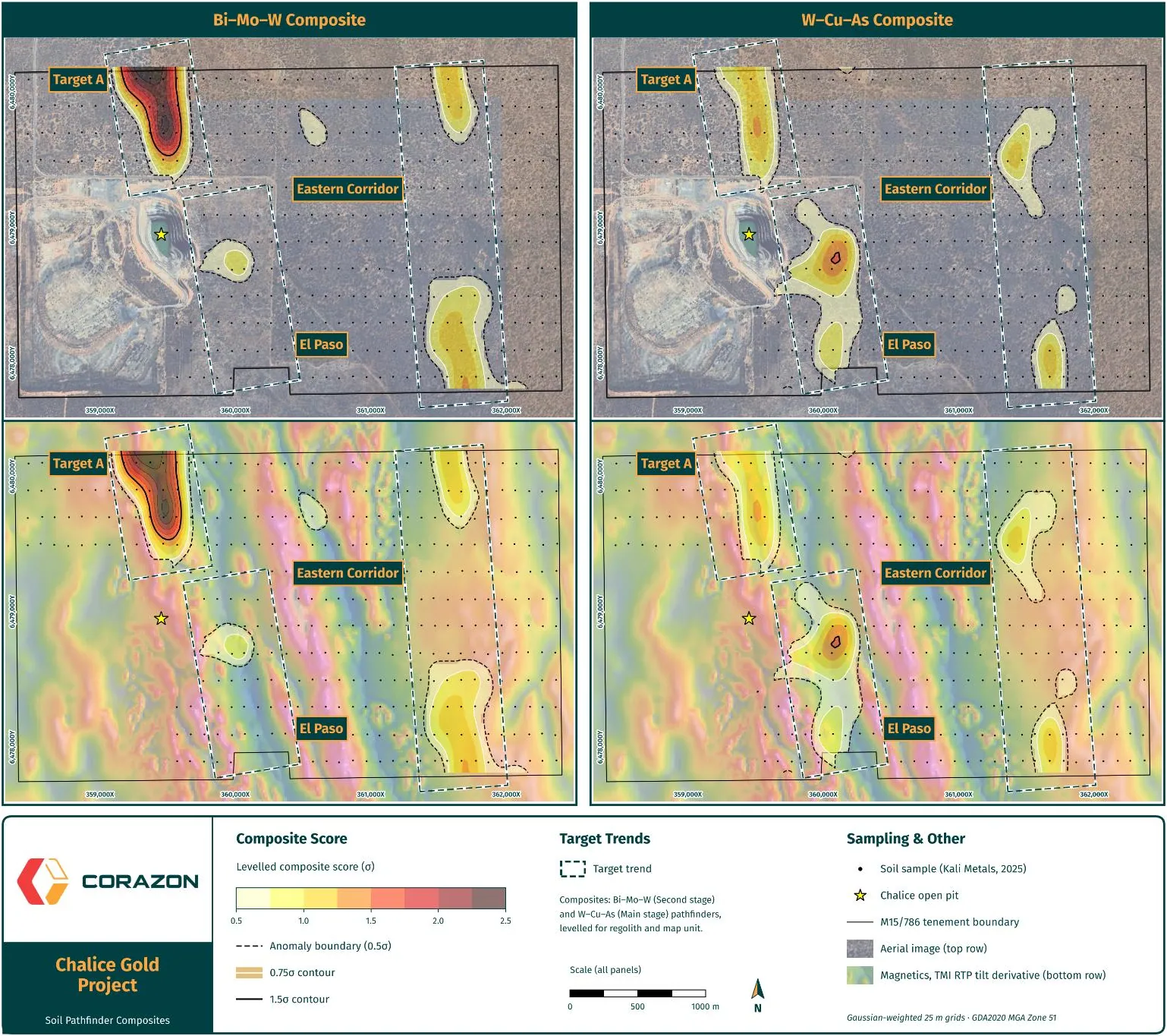
Corazon's review also identified a 2.2-kilometre Eastern Corridor in felsic volcaniclastic sediments about 2km east of the Chalice pit. Two bismuth-molybdenum-tungsten anomalies at the northern and southern ends have not been drill tested, while corrected arsenic-tungsten highs persist across roughly 800 metres of strike.
A separate 1.4-kilometre tungsten-copper-arsenic anomaly at El Paso sits about 600 metres east of the pit, on a mafic-rock and granite contact similar to the setting at Chalice. The company says 20 of 37 samples in the zone were tungsten-copper-arsenic hotspots. In the Eastern Corridor, one sample also returned elevated zinc, lead, cadmium and silver, a combination that may reflect a sulphide source but could equally be surface debris; Corazon plans to resample it.
Gold remains unconfirmed in repurposed soil data
The targets emerged from 377 multi-element soil samples collected by Kali Metals Limited (ASX:KM1) in 2025 for lithium exploration. Corazon corrected the data for regolith and mapped geology before applying statistical hotspot analysis, but the original program did not include gold assays. The company therefore plans to re-assay selected pulps for low-level gold and extend sampling north and south of the anomalies.
That limitation is particularly important at Target A. Corazon says the anomaly is stronger in residual laterite than transported colluvium, suggesting a bedrock source, while historic drilling in the area was generally shallower than 50 metres and did not test the target beneath a thin granite sheet. However, the target lies downslope from former mine infrastructure, so the company acknowledges that sheetwash may have contributed to the surface signal. The soil dataset was also collected and assayed by a third party, and Corazon says it has not reviewed Kali's original sampling protocol or quality-control results, making the results suitable for first-pass targeting rather than resource estimation.
RC drilling becomes the next valuation test
Corazon plans to drill an RC hole into the interpreted Chalice host contact at Northern Target, with full multi-element assays. The company is also extending soil traverses across the Eastern Corridor and checking the El Paso anomaly against historic drilling and mine-disturbance records.
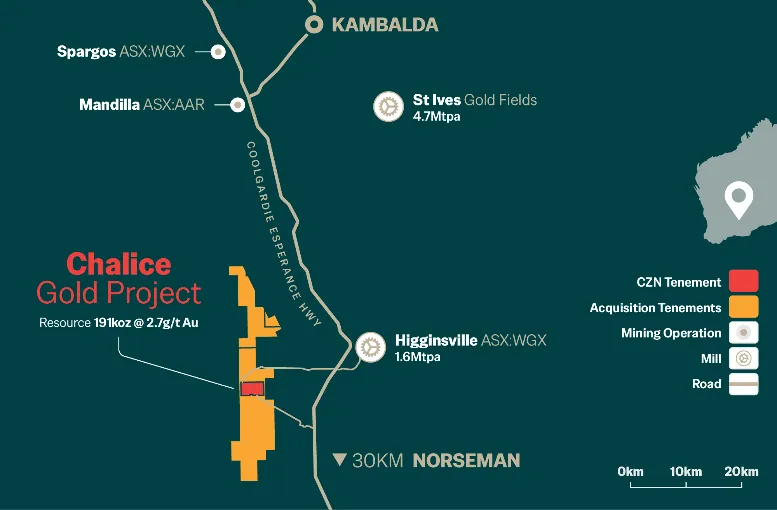
Chalice currently hosts a Mineral Resource of 2.18 million tonnes at 2.74 grams per tonne gold for 191,000 ounces, alongside a conceptual Exploration Target of 600,000 to 830,000 ounces that includes the existing resource. The three new areas are separate opportunities beyond the current resource, but the filing does not establish gold grades, mineralised widths, continuity or economic mineralisation at any of them. Those questions now move from geochemistry to the drill rig.
Get ASX:CZN news the moment it breaks
 iPhone & iPad
 Android
Bottom Line?
The Northern Target has the clearest geological case, but gold assays and the first RC hole must determine whether a strong surface fingerprint represents bedrock mineralisation or exploration noise.
Questions in the middle?
- Will the planned RC hole intersect gold mineralisation beneath the shallow historic drilling and granite cover?
- Do re-assayed pulps confirm gold at the Northern Extension and Eastern Corridor anomalies?
- Can the El Paso and Eastern Corridor signals be separated from mine disturbance, transported cover or isolated surface effects?
Sources
1-
Soil Geochemistry defines new gold pathfinder targets (opens in a new tab)Verified company source. Corazon Mining Limited · 26 Nov 2026 · investors.corazon.com.au