NexGen finds further high-grade growth at Patterson Corridor East

NexGen Energy has extended the high-grade uranium subdomain at Patterson Corridor East to 739 metres vertically and 238 metres along strike. The broader mineralised footprint now spans 905 metres vertically, although assay results and true thickness estimates are still pending.
- High-grade subdomain reaches 739 metres vertically and 238 metres along strike
- Overall mineralised footprint expands to 905 metres vertically and 678 metres along strike
- RK-26-300 records 10.0 metres above 10,000 cps, including 1.8 metres above 61,000 cps
- Southwest drilling points to further depth and strike growth
- 47 holes completed in the 42,000-metre 2026 PCE program, with assays pending

 Add us as a preferred source on Google
Patterson Corridor East reaches 905-metre vertical footprint
NexGen Energy Ltd. (ASX:NXG) has pushed its Patterson Corridor East uranium discovery into a larger and more continuous system, with the overall mineralised footprint now extending 905 metres vertically and 678 metres along strike. The latest results from 15 holes also lifted the high-grade subdomain to 739 metres vertically and 238 metres along strike.
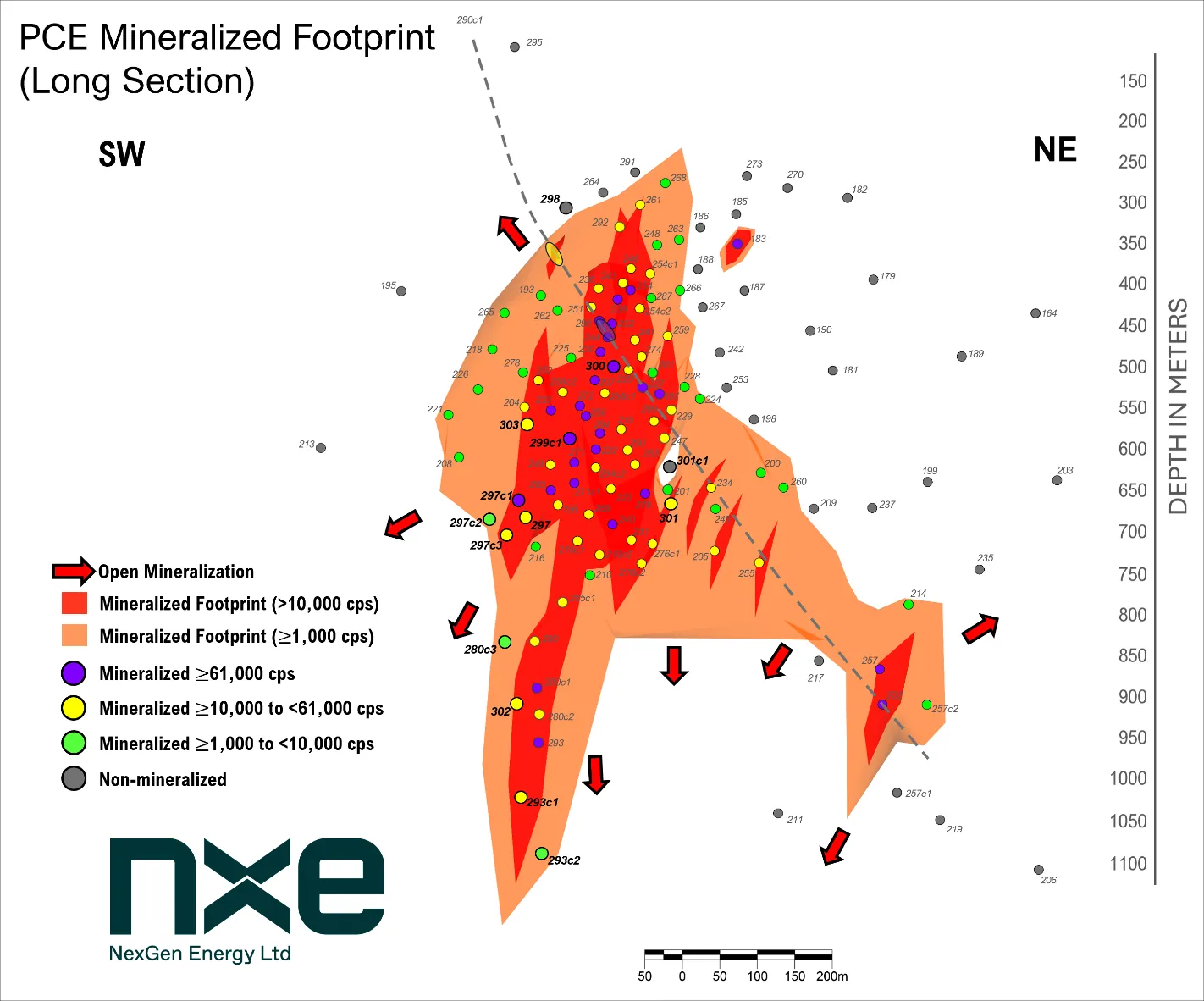
The high-grade zone grew by 95 metres vertically, or 15%, through hole RK-26-293c1, while new intersections in holes RK-26-297c3 and RK-26-301 extended its strike length by 28 metres, or 13%. That follows the May PCE assay update(6e409e1f-a386-4ce3-b9d0-91273e326745), which reported expansion and continuity of high-grade mineralisation at the same discovery.
Drilling links nearby high-grade lenses
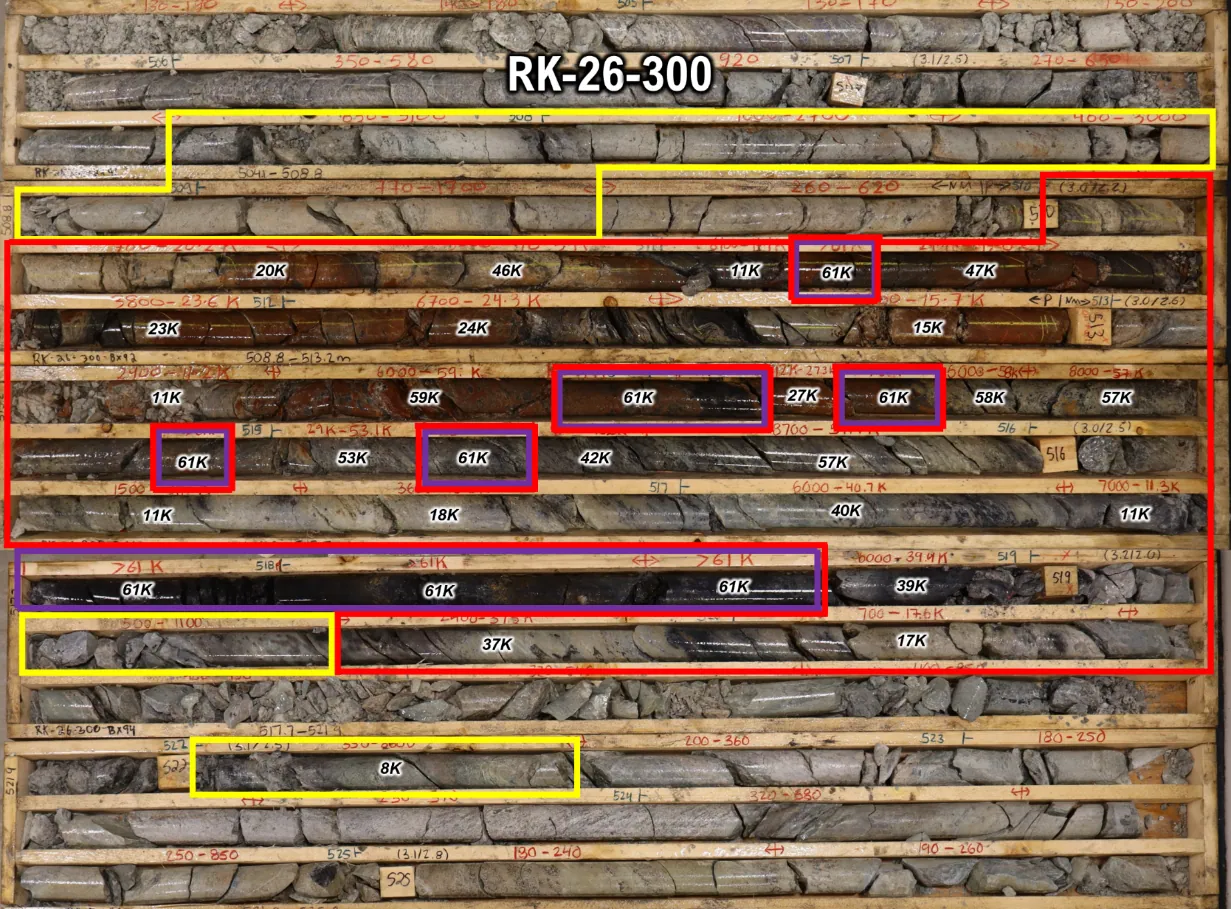
Hole RK-26-300 supplied the clearest continuity result in the release, returning cumulative 10.0 metres above 10,000 counts per second, including 1.8 metres above 61,000 cps. NexGen said the intersection sits 25 metres from RK-24-207, which previously returned 9.5 metres at 2.9% U3O8 including 0.5 metres at 28.2% U3O8, and 29 metres from RK-25-230, which returned 7.5 metres at 5.3% U3O8 including 0.5 metres at 35.9% U3O8.
The result extends an interpretation of connected mineralisation along the same shear, rather than representing an isolated hit. It also continues a drilling story that had already seen the high-grade zone expand to 550 metres vertically in the April PCE expansion(1f0b772f-0e95-4402-8d6f-d558061e3e0a).
Southwest zone emerges as the next growth target
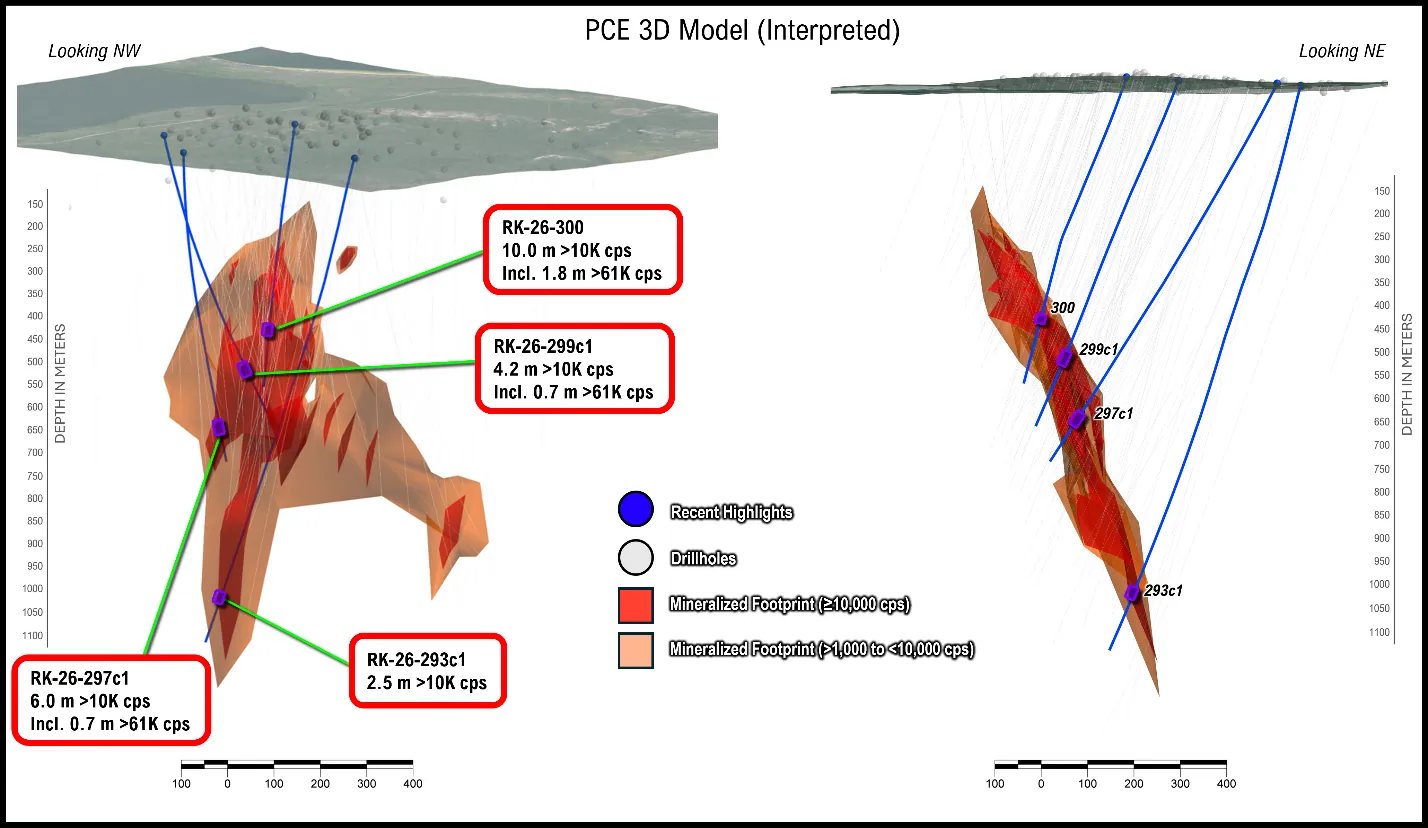
The southwest portion of PCE is now drawing particular attention. RK-26-299c1 returned cumulative 4.2 metres above 10,000 cps, including 0.7 metres above 61,000 cps, extending the reported continuity across a series of nearby high-grade intersections. At depth, RK-26-297c1 returned 6.0 metres above 10,000 cps, including 0.7 metres above 61,000 cps, while nearby holes RK-26-297 and RK-26-297c3 added further anomalous and high-grade readings.
NexGen has completed 47 holes totalling 31,480 metres at PCE during 2026, against a planned 42,000-metre program. The remaining drilling is aimed at testing internal high-grade continuity and expanding the system, with samples being submitted in batches to the independent Saskatchewan Research Council Geoanalytical Laboratory.
Assays remain the important test
The results are encouraging, but the headline measurements are handheld gamma-spectrometer readings rather than a new mineral resource estimate. NexGen defines high-grade as readings above 10,000 cps and intense high-grade as readings above 61,000 cps, while cautioning that total-count gamma readings are preliminary indicators and are not directly or uniformly equivalent to uranium grades.
All reported intervals are downhole measurements, so true thicknesses have not yet been established. The next material step is whether laboratory assays confirm the reported continuity and support an updated geological model. Until then, PCE is expanding impressively on paper, but its economic significance remains a question for the assay batches and future resource work.
Get ASX:NXG news the moment it breaks
 iPhone & iPad
 Android
Bottom Line?
PCE is growing in the dimensions that matter for geological confidence, but pending assays and true-thickness modelling will determine how much of that growth can translate into a defined resource.
Questions in the middle?
- Will laboratory assays confirm the strong gamma-spectrometer readings across the expanding high-grade subdomain?
- How much of the 905-metre vertical footprint can ultimately be converted into an economically meaningful resource?
- Can the remaining 2026 drilling establish a coherent connection between the southwest growth area and the central high-grade lenses?
Sources
1-
NexGen Grows High-Grade Subdomain Vertically & along strike (opens in a new tab)Verified company source. Nexgen Energy (Canada) Ltd · 25 Nov 2026 · nexgenenergy.ca