Ora Banda finds fresh gold upside beneath Round Dam

Ora Banda Mining has reported high-grade gold intersections beneath and beyond its Round Dam resource, alongside a new 4.5km Bluey trend and strong results from Mulline and Python. The results expand the company’s exploration targets, but remain early-stage evidence rather than a new reserve or mine plan.
- Round Dam drilling returned 1.0m at 30.5 g/t gold and 7.2m at 5.3 g/t
- New Bluey trend defined over 4.5km east of Round Dam
- Mulline drilling produced 4.3m at 13.6 g/t, including 1.4m at 36.0 g/t
- Two Gums follow-up drilling returned 2.6m at 4.3 g/t, including 0.7m at 14.4 g/t
- $75 million FY27 exploration budget continues across the Davyhurst district

 Add us as a preferred source on Google
Round Dam Drilling Extends Below Resource
Ora Banda Mining Limited (ASX:OBM) is finding more gold where a conventional open-pit story starts to give way to an underground one. Drilling below the currently reported 1.3 million-ounce Round Dam Mineral Resource has returned intersections including 1.0 metre at 30.5 grams per tonne gold, 7.2 metres at 5.3 g/t and 11.0 metres at 12.1 g/t, with mineralisation identified as deep as 280 metres below surface.
The company says the results sit outside the current prefeasibility study pit design and support the potential for resource growth down dip and down plunge. That is a meaningful exploration result, although it is not yet an underground mine decision: the reported widths are down-hole lengths, true widths have generally not been disclosed, and further resource, economic and geotechnical work remains necessary.
Bluey Adds a Parallel 4.5km Target
Round Dam’s potential is also widening laterally. Regional drilling has mapped prospective host rocks beneath a previously under-explored, covered section of the trend and intersected gold in multiple parallel lodes between the Round Dam resource and Lady Eileen South. The company has highlighted a three-kilometre section between Waihi and Lady Eileen South for detailed mapping, ground magnetics, diamond drilling and RC drilling, following earlier high-grade results at Midnight reported alongside the Waihi underground start.
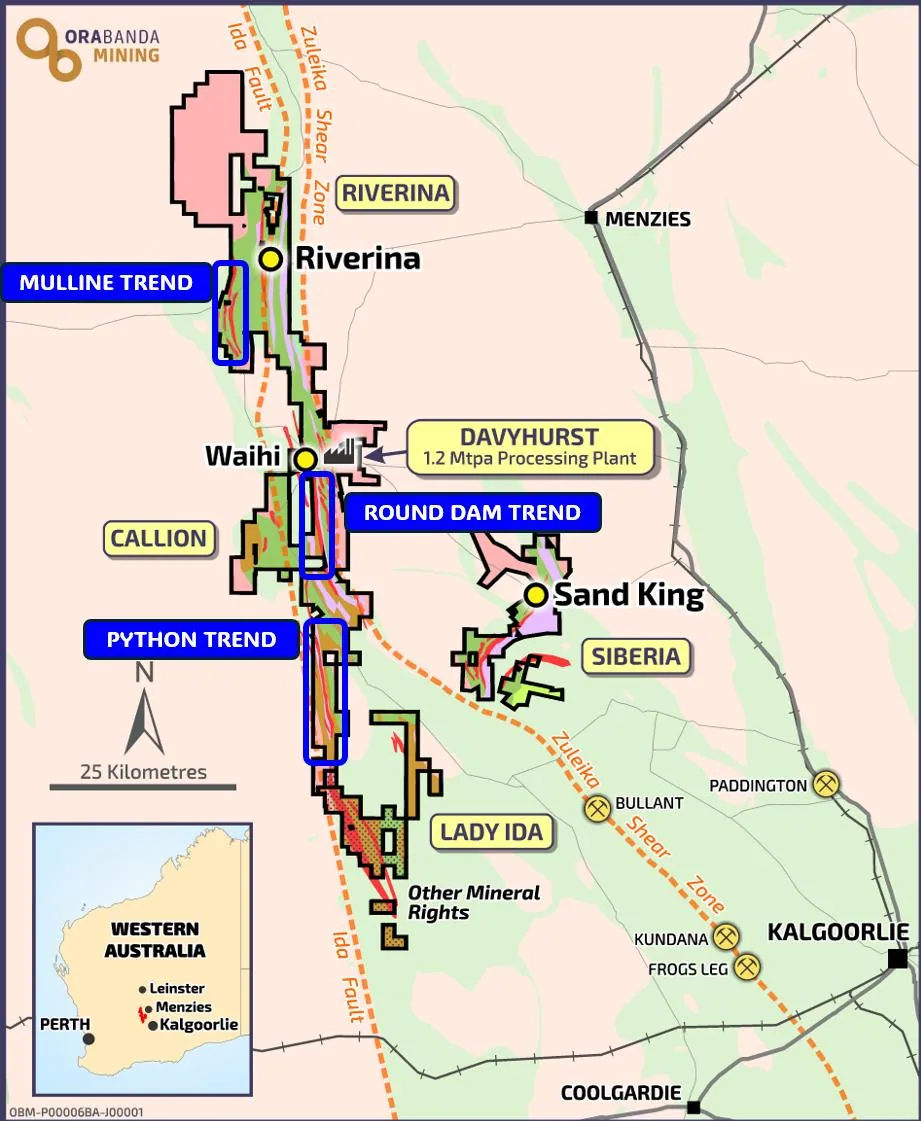
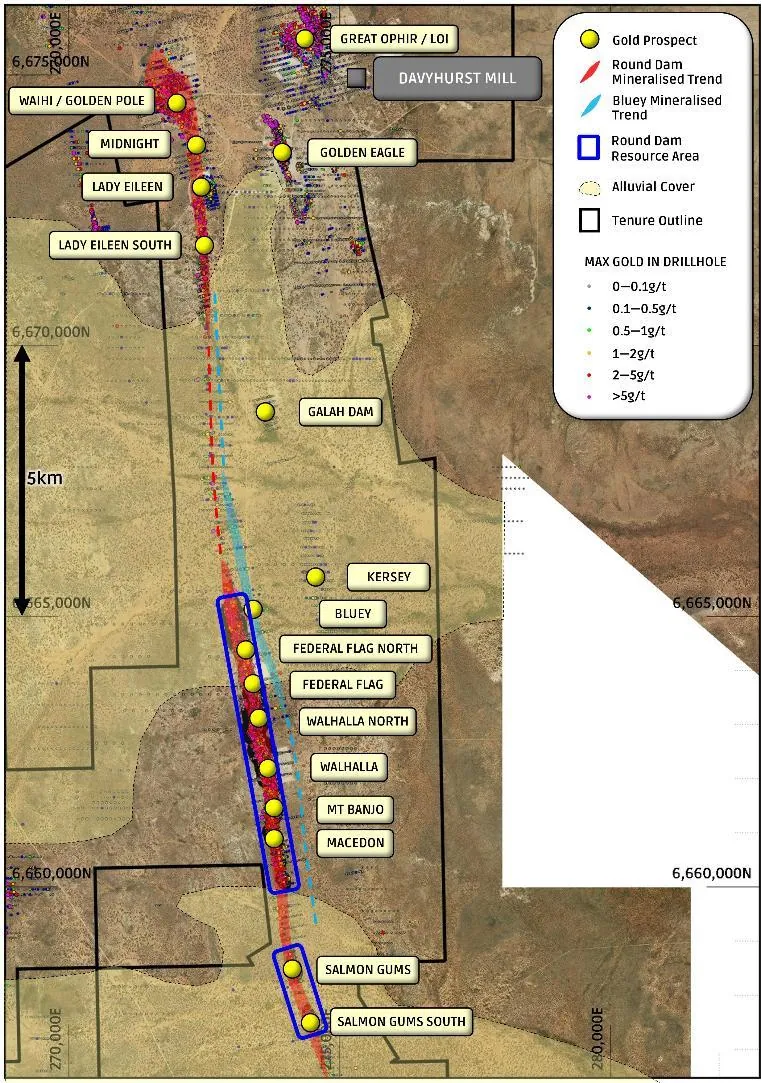
East of the main Round Dam trend, aircore and reverse-circulation drilling has outlined the new Bluey trend over 4.5km of strike. Bluey lies about 400 metres east of Round Dam, remains open to the north and south, and has had little effective historical testing. Results include 3.0 metres at 5.7 g/t and 5.0 metres at 2.2 g/t. Ora Banda plans further aircore and diamond drilling to establish whether the new trend can support a more substantial target.
Mulline Model Produces High-Grade Hits
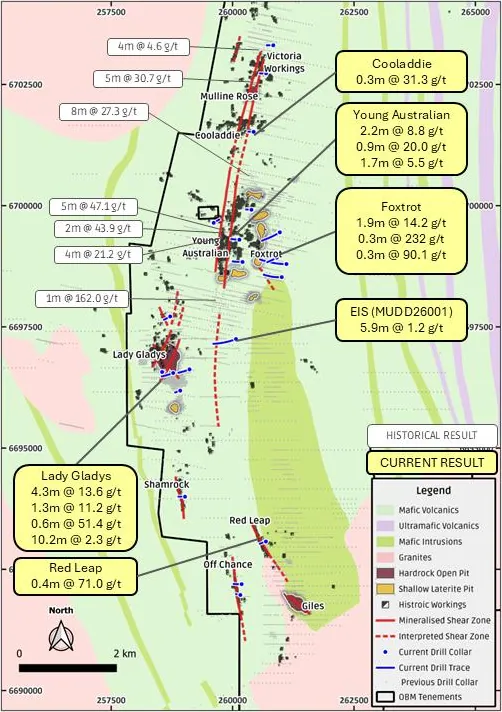
At Mulline, 23 widely spaced diamond holes were drilled against a new three-dimensional structural model. Eleven holes returned gold grades above 10 g/t, while all but one intersected mineralisation, according to the company. Among the more notable results were 4.3 metres at 13.6 g/t at Lady Gladys, 1.9 metres at 14.0 g/t at Young Australian and narrow high-grade intervals of 0.3 metres at 232.0 g/t and 0.3 metres at 90.1 g/t.
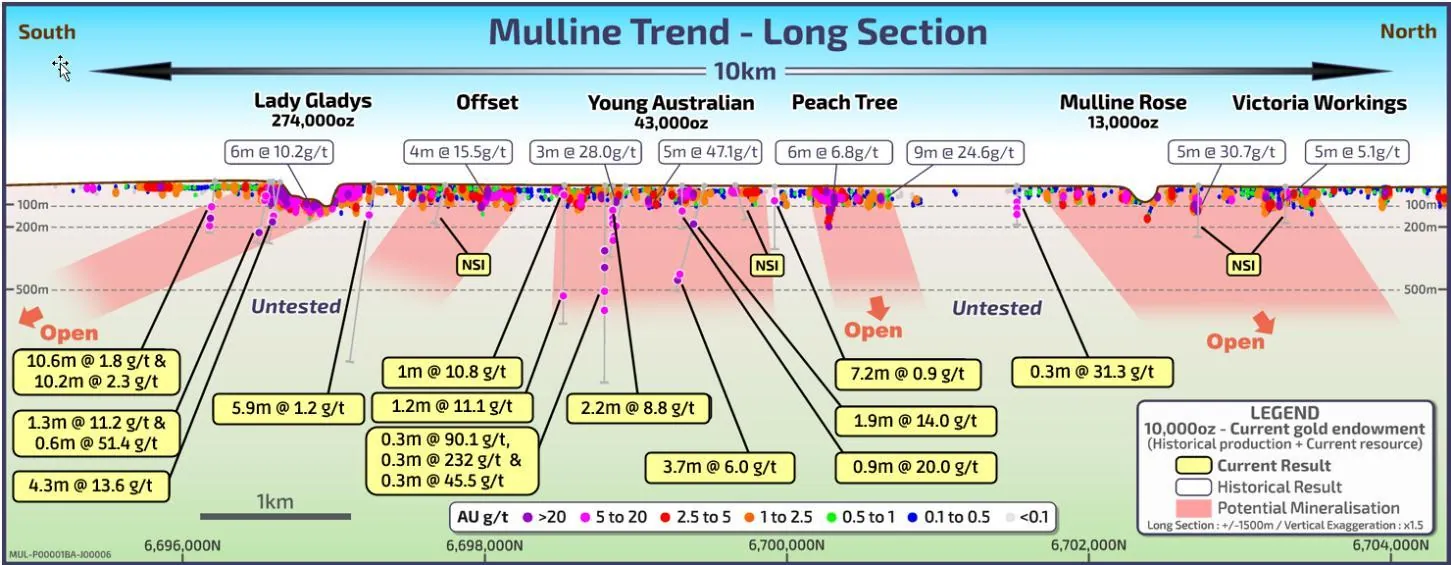
The drilling indicates mineralisation continues more than one kilometre down dip from surface and, at Lady Gladys, more than 600 metres from the former open pit. Ora Banda links the high-grade, narrow-vein style of mineralisation to future underground potential, but the spacing of the regional holes means the results are better read as a geological signal than as an immediately mineable resource.
Python Follow-Up Keeps Two Gums Alive
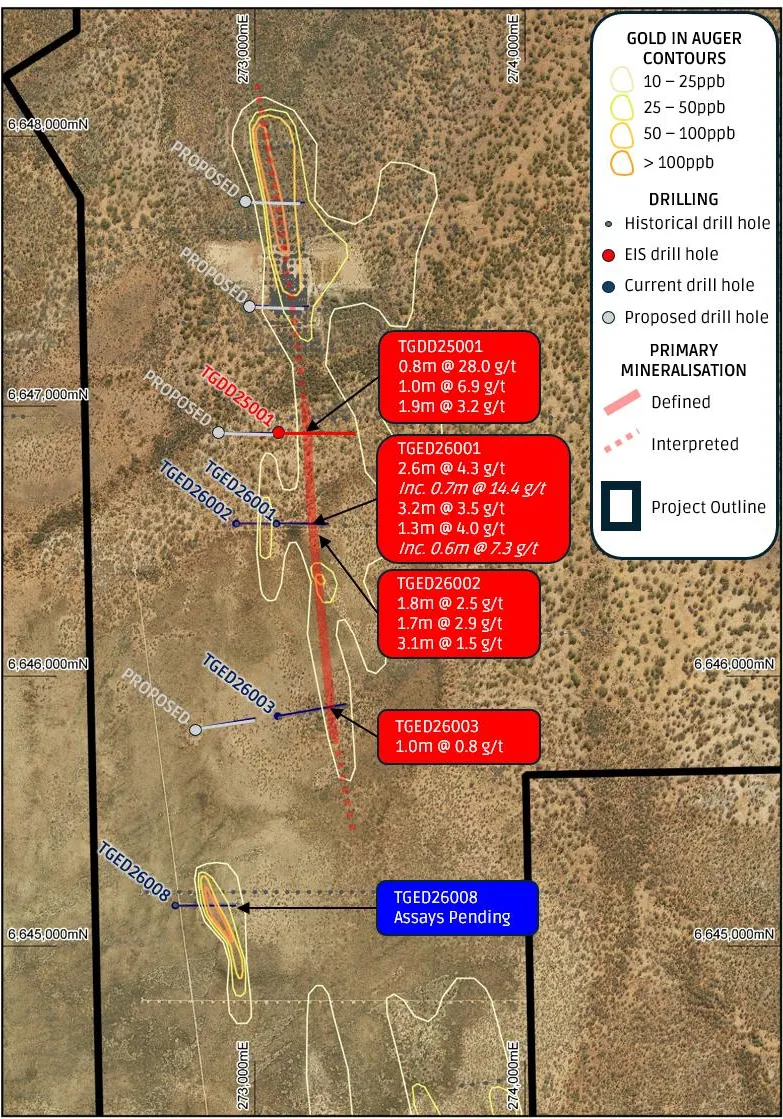
Further south, the grass-roots Python Trend is beginning to generate its own momentum. An initial four-hole diamond program at Two Gums returned 0.8 metres at 28.0 g/t, while a follow-up hole drilled 350 metres along strike produced 2.6 metres at 4.3 g/t, including 0.7 metres at 14.4 g/t. Additional diamond drilling is continuing.
These programs form part of Ora Banda’s $75 million FY27 exploration budget across the Davyhurst district. The immediate test is whether repeated drilling turns isolated high-grade intersections into coherent zones that can enter resource estimation, rather than simply adding more impressive numbers to an already crowded appendix.
Get ASX:OBM news the moment it breaks
 iPhone & iPad
 Android
Bottom Line?
The next value-inflection point is continuity: follow-up drilling must show that Round Dam, Bluey, Mulline and Two Gums contain mineable geometry, not just high-grade down-hole intervals.
Questions in the middle?
- Will deeper Round Dam mineralisation be incorporated into a larger resource or an underground study?
- Can follow-up drilling establish continuous mineralisation along the 4.5km Bluey trend?
- Will Mulline and Two Gums produce enough width and continuity to justify resource drilling and development work?
Sources
1-
Continued Regional Exploration Success (opens in a new tab)Verified source. Ora Banda Mining Ltd · 26 Nov 2026