Rimfire’s Murga tests strengthen the case for simpler scandium extraction

Rimfire Pacific Mining has reported stronger long-term scandium recovery projections from its Murga deposit, while preparing to drill the Rosehill prospect for a potential maiden resource. The encouraging metallurgy remains conditional on extended testing and a later financial study.
- 21-week recoveries of 37.1% from saprolite and 18.4% from laterite
- Conditional 52-week projections rise to at least 73% and 34%
- Low acid consumption and a high scandium-to-iron ratio support atmospheric leaching tests
- 2,500-metre Rabbit Trap air-core drilling is scheduled for early January, subject to approval
- Final metallurgy is targeted for the March 2027 quarter before a desktop financial study
 Add us as a preferred source on Google
Murga recovery projections improve after 21 weeks
Rimfire Pacific Mining (ASX:RIM) has lifted its conditional long-term recovery projections for the Murga scandium deposit, with bottle-roll testing now showing 37.1% recovery from saprolite and 18.4% from laterite after 21 weeks. The tests are still running, but a linear extrapolation of the data points to potential 52-week recoveries of at least 73% and 34%, respectively.
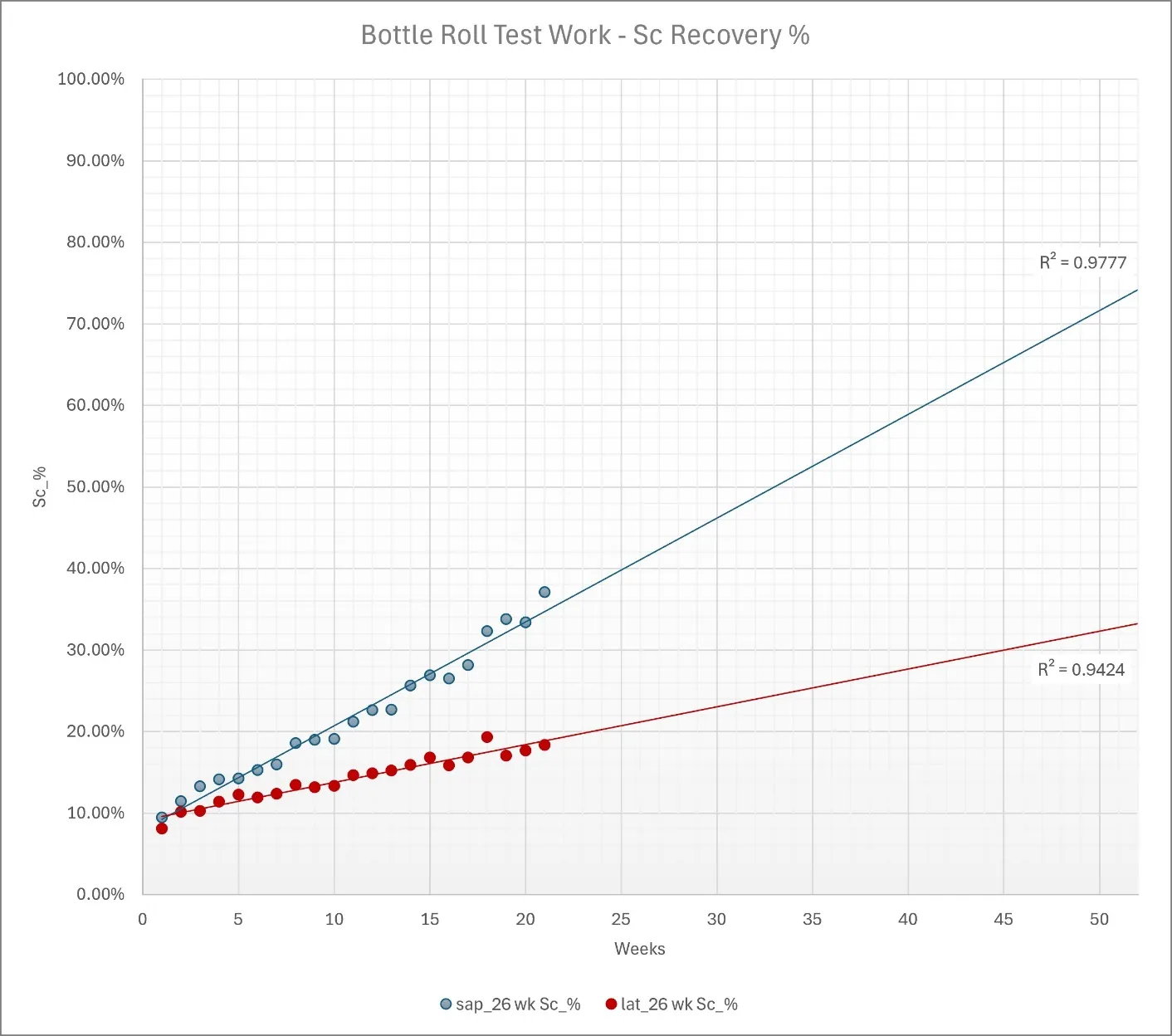
Those figures are projections, not demonstrated commercial recoveries. They assume the fitted extraction rate continues unchanged over the full period, with the initial rapid extraction excluded from the line of best fit. Rimfire says the longer timeframe is comparable with heap-leach operations for metallurgically similar laterite nickel, cobalt and scandium deposits, but the assumption still needs to survive larger-scale and more commercially representative testing.
The latest result builds on the earlier Murga bottle-roll tests, which reported 15-week recoveries of 22.7% for saprolite and 15.2% for laterite. The current samples came from diamond drillhole FI2679 and carried composite grades of 215 parts per million scandium in saprolite and 222 parts per million in laterite.
Low acid use supports a simpler processing test
At the 21-week mark, sulphuric acid consumption remained low at 0.46 tonnes per tonne for saprolite and 0.28 tonnes per tonne for laterite. The pregnant leach solution from the saprolite sample also produced a scandium-to-iron ratio of 2.21 milligrams per gram, which Rimfire says is high relative to atmospheric leaching of other scandium ores.
That combination is central to the company’s processing thesis: Murga’s low-iron host rock may allow atmospheric leaching rather than a more complex, capital-intensive route. The proposition has not yet been translated into project economics. Column leach testing, designed to simulate heap or vat leaching, and heated agitated-tank testing are intended to establish extraction behaviour, acid consumption and the suitability of alternative processing methods.
Column and tank tests set up the next decision point
Two 40-kilogram columns have been loaded with agglomerated Murga saprolite in the Philippines, with different acid concentrations and percolation rates to be compared. The tests are expected to take about 30 days. Separately, Simulus Laboratories is preparing a 10-kilogram subsample for tank-leach work, which uses heated conditions and continuous agitation to test the upper limits of chemical extraction over a much shorter period.
Rimfire expects the column and tank work to finish by the end of December, with final bottle-roll residue and solution assays targeted for the March 2027 quarter. Only after all three workstreams are complete does the company plan to begin a desktop financial study, currently scheduled for the March 2027 quarter, to assess whether atmospheric leaching at Murga is viable.
Rabbit Trap drilling targets a new scandium resource
While Murga moves through laboratory testing, Rimfire has secured a contractor for 2,500 metres of air-core drilling at the Rosehill prospect, also known as Malamute, within the 100%-owned Rabbit Trap project in central New South Wales. The program is scheduled to start in early January 2027, subject to regulatory approval.
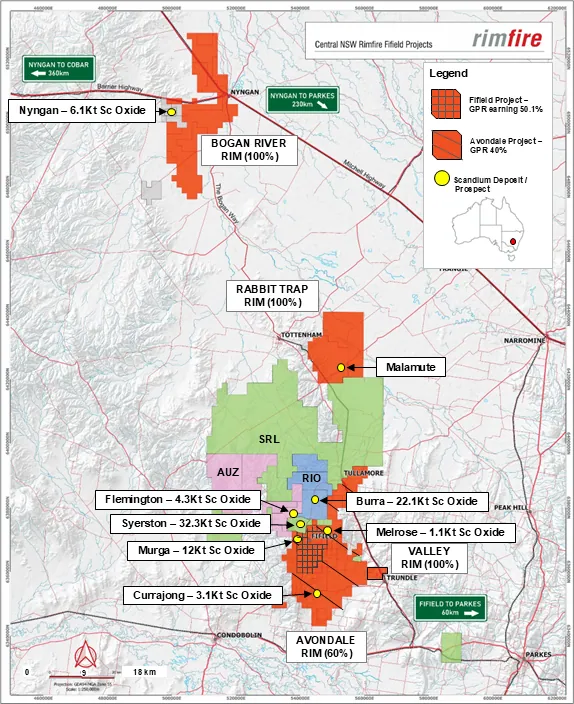
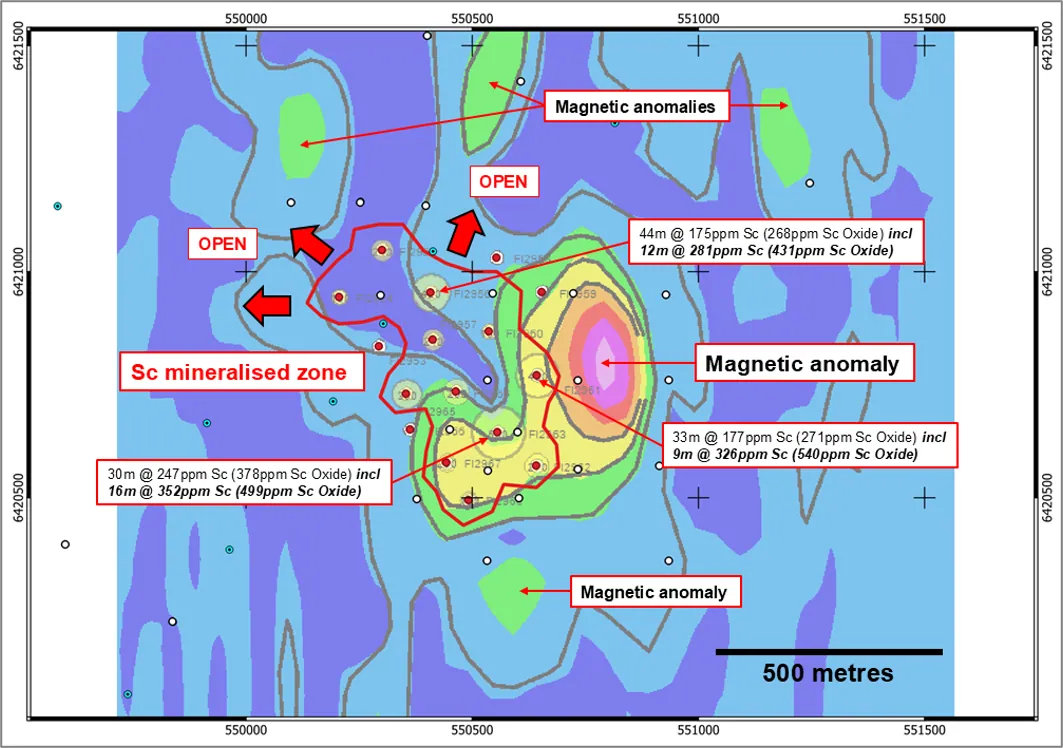
Rosehill hosts a broad, gently dipping laterite clay zone averaging about 15 metres thick across an area of roughly 700 metres by 400 metres. Previous drilling included 30 metres at 247 parts per million scandium from 25 metres, including 16 metres at 352 parts per million, as well as several other notable intercepts. The new drilling will infill and extend the known mineralisation; if the results support continuity, Rimfire says the data could underpin a maiden scandium Mineral Resource Estimate.
Get ASX:RIM news the moment it breaks
 iPhone & iPad
 Android
Bottom Line?
Murga’s metallurgy is becoming more promising, but the investment case still turns on whether projected recoveries translate into validated process performance and workable economics.
Questions in the middle?
- Will the column leach tests confirm that bottle-roll recovery rates can be replicated under more representative operating conditions?
- Can low acid consumption and the scandium-to-iron ratio support a commercially credible atmospheric leach flowsheet?
- Will January drilling establish enough continuity at Rosehill to support a maiden Mineral Resource Estimate?
Sources
1-
Scandium Metallurgy and Drilling Update (opens in a new tab)Official market announcement. Rimfire Pacific Mining Limited · 26 Nov 2026 · rimfire.com.au