Synertec’s $74.3 million order book sets up a fully contracted FY27

5 min read
9:47am on Thursday 26th of November, 2026 AEDT ~9am, 26th Nov, 26
Synertec Corporation (ASX:SOP) says its FY27 revenue guidance is fully covered by contracted work after work-in-hand surged to $74.3 million. The company has also returned to positive annual operating cash flow, although first-quarter cash outflow shows delivery will still test the balance sheet.
- FY27 revenue guidance of $37.5 million to $40.0 million is fully contracted
- Contracted work-in-hand rose to $74.3 million at 30 September
- FY26 operating cash flow turned positive at $0.5 million
- Powerhouse expanded to 15 contracted units and a pipeline of about $500 million
- First-quarter operating cash outflow was $1.9 million, including $1.1 million of timing items
 Add us as a preferred source on Google
Contracted work now covers FY27 guidance
Synertec Corporation (ASX:SOP) has entered FY27 with its upgraded revenue target fully backed by contracted work, giving the engineering and energy technology group an unusually clear execution test for the year ahead. Contracted work-in-hand reached $74.3 million at 30 September, up from $20.9 million a year earlier, while FY27 revenue guidance remains $37.5 million to $40.0 million.
The step-change was driven in part by the $45.5 million ANSTO contract for its Nuclear Medicine Manufacturing Program, which Synertec calls the largest contract in its history. Melbourne Water also awarded the delivery phase of a Brooklyn Pump Station upgrade, while AGL selected the company for the first phase of a national SCADA upgrade worth about $4 million. The Engineering pipeline of qualified opportunities stood at $157 million at quarter-end.
The ANSTO award had already been identified as a major source of future revenue in the ANSTO engineering contract, which was described as an approximately eight-year engagement with most of the initial design work concentrated in its first 26 months. At the AGM, Chair Johannes Risseeuw said contracted work had risen from $20.9 million to $74.3 million during the first quarter.
Cash flow has turned, but delivery is now critical
Synertec reported FY26 revenue and other income of approximately $21.5 million, up 18%, while its EBITDA loss narrowed 67% to $1.9 million. Operating cash flow swung to a $0.5 million inflow, a $4.6 million improvement on the prior year and the company’s first full-year operating cash inflow since FY19.
Engineering provided the steadier earnings base. Segment revenue rose 15% to $20.9 million, normalised EBITDA reached $2.7 million and contribution margin improved 35%, with more than 88% of revenue coming from existing customers. First-quarter Engineering revenue rose 16% to $5.1 million.
The early FY27 cash picture is less tidy than the order book. Group revenue reached $5.9 million in the September quarter and EBITDA reached breakeven in that month, but operating cash flow was a $1.9 million outflow, including about $1.1 million in timing items. Synertec held $4.2 million in cash and $8.7 million in undrawn facilities at 30 September, following an oversubscribed $6 million placement in August.
Powerhouse moves from validation to deployment
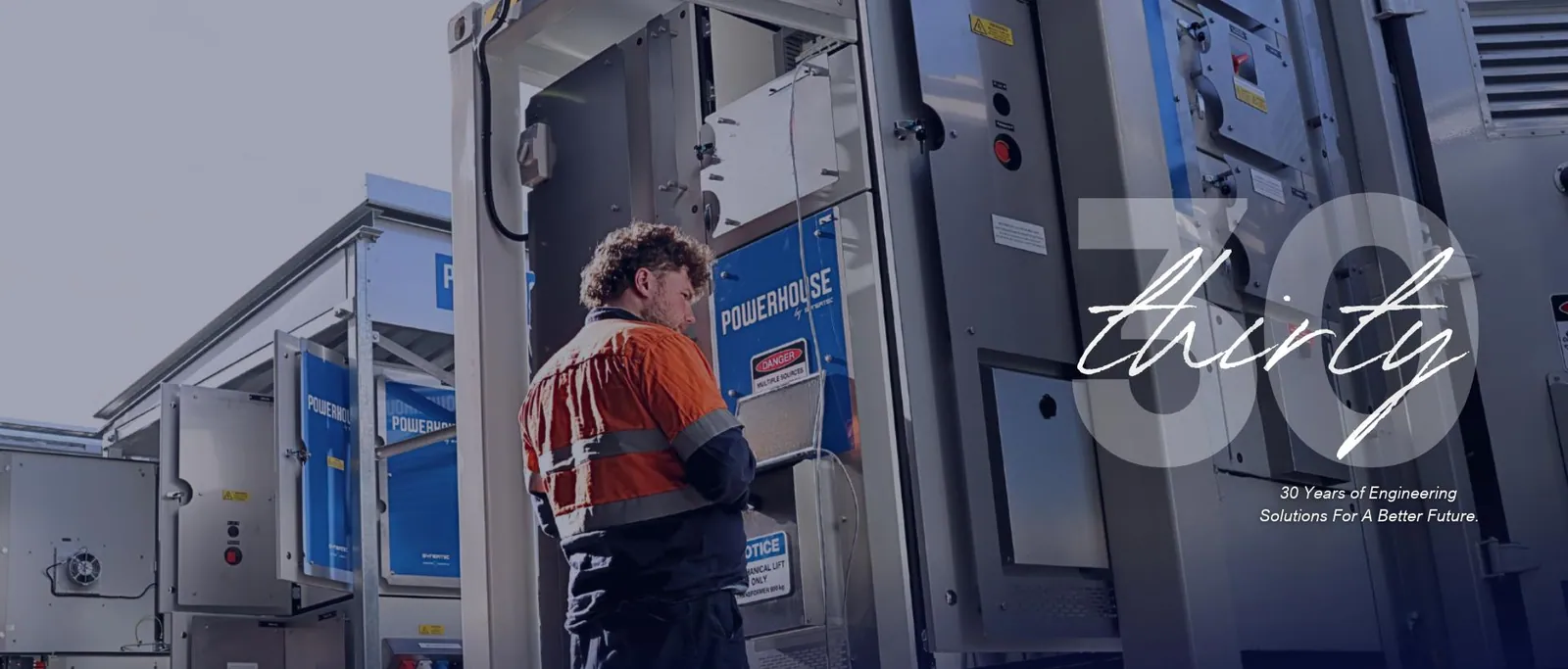
Synertec’s Powerhouse platform had 15 units under contract at 30 September, compared with 11 at 30 June. Four were operating and 11 were in design or construction. The portfolio includes six TasNetworks community batteries, seven remote units linked to GLNG and Shell QGC, and two units for industry resilience, including the approximately $6 million Santos system at Moomba with 12 megawatts and 12 megawatt-hours of capacity.
The company puts its active Powerhouse pipeline at about $500 million, representing roughly 1.2 gigawatt-hours of storage and a delivery window spanning FY27 to FY30. That figure is a pipeline, not contracted revenue. Synertec also says Powerhouse recurring revenue rose 23% in FY26 to $2.5 million, while fleet availability exceeded 99.95% across six years.
The Santos contract was part of the earlier Santos battery contract, which reported a roughly $6 million award and 15 Powerhouse units under contract. The AGM presentation now shows 11 units in delivery, with all due within 15 months, placing greater emphasis on commissioning and cash conversion than on technology validation alone.
Execution will determine the value of the order book
Synertec’s stated priorities are to deliver the contracted work safely, win further Powerhouse contracts and control costs so that growth translates into sustained earnings and cash flow. The company says FY27 guidance is 100% contracted, but the quarterly cash outflow and the concentration of Powerhouse deliveries create a practical distinction between revenue visibility and profitable execution.
For shareholders, the next evidence will come from delivery against the ANSTO, Santos, TasNetworks and other programs, alongside quarterly revenue, EBITDA and operating cash flow. The company’s own presentation also contains minor inconsistencies, including FY26 revenue and other income shown as both $21.5 million and $21.6 million, and Powerhouse FY27 guidance appearing as $8.4 million in one section and $7.6 million in another. Those figures will need to be reconciled in formal reporting as the business scales.
Get ASX:SOP news the moment it breaks
 iPhone & iPad
 Android
Bottom Line?
The order book has removed much of the FY27 revenue question; the harder test is whether Synertec can convert that visibility into repeatable cash generation.
Questions in the middle?
- Can Synertec deliver the ANSTO and Powerhouse programs without extending the first-quarter cash drain?
- How much of the approximately $500 million Powerhouse pipeline will convert into binding contracts?
- Will Engineering’s stronger margins and recurring Powerhouse revenue be enough to sustain group-level profitability?
Sources
1-
Synertec 2026 AGM - Chair Address & MD/CEO Presentation (opens in a new tab)Verified company source. Synertec Corporation Limited · 26 Nov 2026 · investors.synertec.com.au