Regis keeps FY27 guidance as cash reaches $1.28 billion despite rain-hit quarter

Regis Resources maintained FY27 production and cost guidance after September rainfall cut first-quarter output to 83.0koz and pushed AISC to $3,617/oz. Cash and bullion still rose to $1.28 billion, although a large tax payment and dividend have created a significant near-term cash call.
- 83.0koz of Q1 FY27 gold production, in line with expectations
- Group AISC of $3,617/oz after rainfall disrupted Duketon and lower-grade ore affected Tropicana
- Cash and bullion increased to $1.28 billion, including the $51 million Vault break fee
- FY27 production, AISC, growth capital and exploration guidance maintained
- Federal Court ruling supports potential McPhillamys optionality while Rosemont drilling extends mineralisation

 Add us as a preferred source on Google
Rainfall delays production recovery
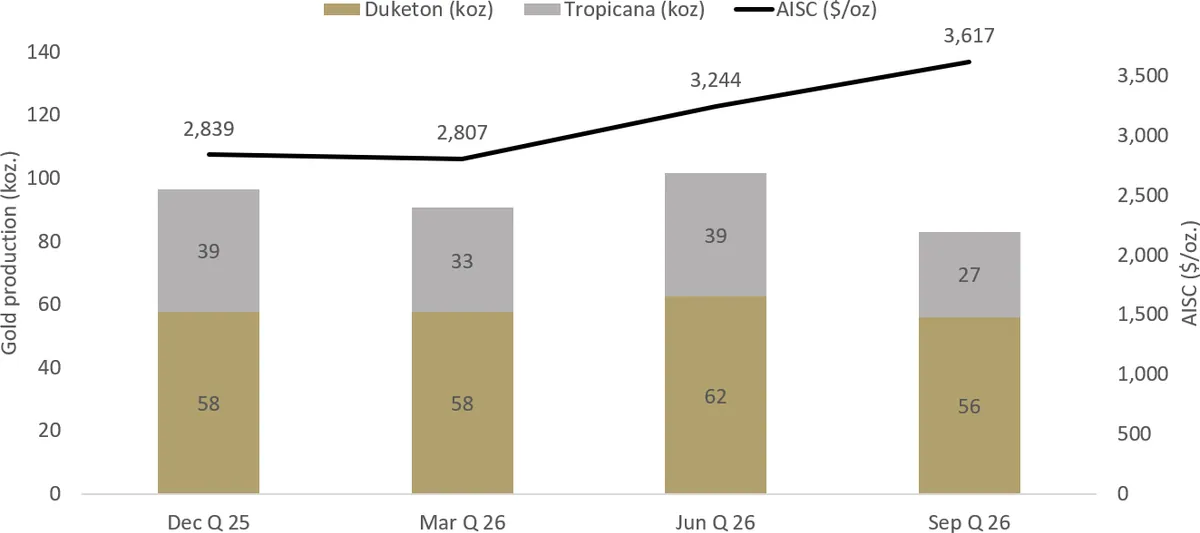
Regis Resources Limited (ASX:RRL) kept its FY27 guidance intact after producing 83.0koz of gold in the September quarter, but the result came with a warning written in weather. Significant rainfall in September delayed access to higher-grade open-pit ore and disrupted haulage, leaving group AISC at $3,617/oz compared with $3,244/oz in the June quarter.
The detailed result confirms the broad figures in the first-quarter operating preview, which had pointed to 83.0koz of production and unchanged FY27 guidance. Regis said production is expected to build through the year, with several new Duketon open pits scheduled to ramp up in the second half. The rain has slightly increased that second-half weighting.
Duketon bears the weather hit
Duketon produced 56.1koz at an AISC of $3,657/oz. Open-pit mining and ore haulage were disrupted, while lower-grade stockpiles were used to supplement mill feed. The operation processed 1.96 million tonnes at a 0.99g/t head grade, down from 1.12g/t in the previous quarter, although recovery improved to 89.6%.
Tropicana, reported at Regis’ 30% interest, produced 27.0koz at $3,423/oz. Its mill head grade fell to 1.35g/t from 1.96g/t, reflecting less open-pit ore mined at a lower grade. Development of the Havana underground mine continued, with first ore targeted for the first half of calendar 2027.
Gold receipts strengthen the balance sheet
Gold sales totalled 74.5koz at an average realised price of A$6,088/oz, generating A$453.7 million in revenue. Operating cash flow was A$265 million, comprising A$175 million from Duketon and A$90 million from Tropicana.
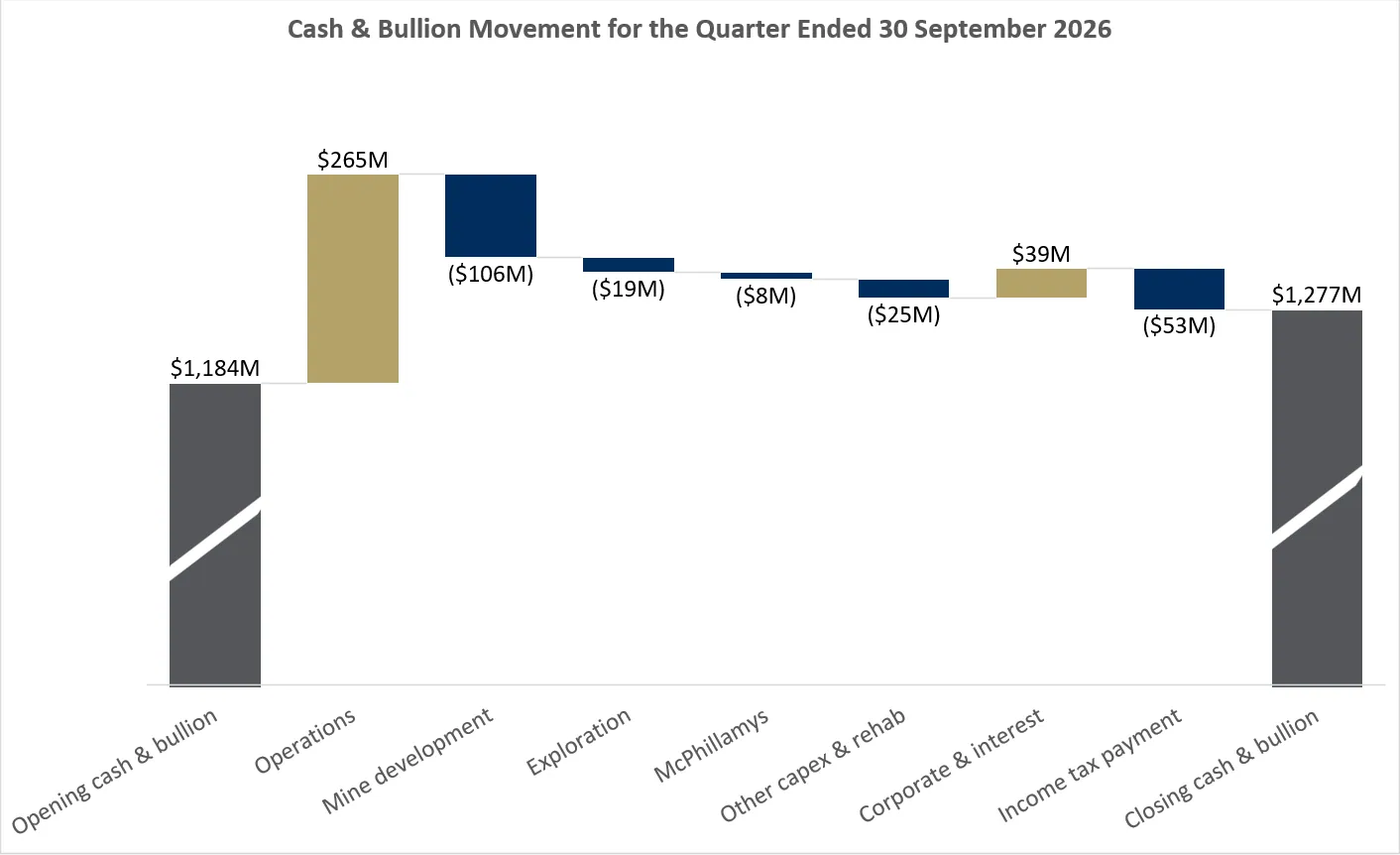
Cash and bullion increased by A$93 million during the quarter to A$1.28 billion, despite A$53 million in tax payments. The figure also includes the A$51 million break fee received after Regis stepped away from the Vault Minerals transaction, following the decision not to match Genesis proposal.
The balance sheet will face a sizeable test in the December quarter. Regis expects to make a catch-up tax payment of approximately A$220 million to A$240 million, while the A$152 million fully franked FY26 final dividend was paid on 7 October. The company had already declared a total FY26 dividend of 35 cents per share, including the special dividend, as reported in its FY26 dividend declaration.
McPhillamys ruling adds optionality
The Federal Court’s finding that the Section 10 Declaration affecting part of the approved McPhillamys site is legally invalid gives Regis another possible route for the project, but it does not remove the permitting risk. The relevant application is expected to be redetermined, and Regis said it will continue developing an alternative Integrated Waste Landform strategy in case that process is prolonged or produces an unfavourable outcome.
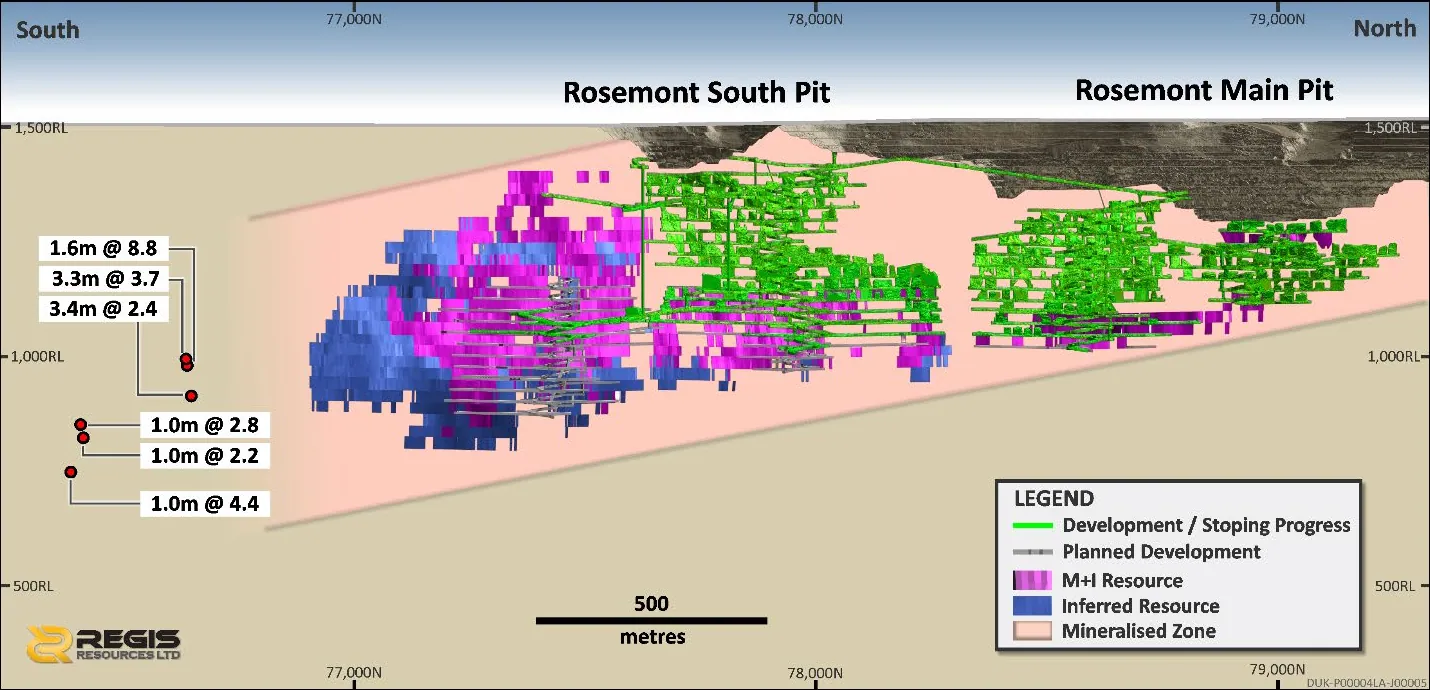
At Rosemont Underground, diamond drilling confirmed an additional 600-metre-long segment of the mineralised host unit south of the current Resource envelope. Mineralisation remains open along strike and down-dip, with reported intersections including 1.6 metres at 8.8g/t gold. These are down-hole widths and the drilling has not yet produced a revised Mineral Resource.
Guidance survives a costly first quarter
FY27 guidance remains 360koz to 400koz of gold production, group AISC of $2,990/oz to $3,390/oz, growth capital of A$250 million to A$270 million, exploration spending of A$80 million to A$90 million and McPhillamys expenditure of A$30 million to A$35 million. First-quarter growth capital was A$80 million, while exploration spending reached A$19 million.
The arithmetic leaves little room for a smooth year: production must accelerate in the second half while costs recover from a quarter affected by rain, lower grades and diesel prices above the guidance assumption. The next operating update will show whether the planned Duketon ramp-up is beginning to offset that early drag, or whether the guidance depends on an increasingly compressed recovery window.
Get ASX:RRL news the moment it breaks
 iPhone & iPad
 Android
Bottom Line?
The balance sheet is strong, but the December tax bill and second-half production ramp will provide the clearest test of FY27 execution.
Questions in the middle?
- How quickly will Duketon’s new open pits restore production after the weather-related delays?
- Can group AISC move back toward the FY27 guidance range as production rises and stockpile-related non-cash costs ease?
- Will the McPhillamys redetermination create a workable permitting path, or will the alternative waste-landform strategy become the primary route?
Sources
1-
Quarterly Activities Report (opens in a new tab)Official market announcement. Regis Resources Limited · 20 Oct 2026 · regisresources.com.au