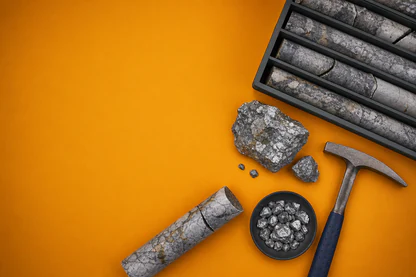
Minrex Confirms High-Grade Near-Surface Gold at Tlamino, Expands Drilling to 9,000m

Minrex Resources has reported strong assay results from the first ten infill drill holes at its Barje deposit, revealing shallow, high-grade gold-silver mineralisation that supports a low-strip, high-margin open pit scenario. The company is boosting its 2026 drilling program to 9,000 metres to explore extensions along the Barje-Liska corridor.
- First ten drill holes confirm shallow, high-grade gold-silver at Barje
- Significant intercepts include 11.4m @ 1.09 g/t AuEq from surface
- High-grade breccia core of 470Koz @ 4.7 g/t AuEq remains continuous
- Drilling program expanded to 9,000m for resource and greenfield exploration
- Environmental baseline study underway to support permitting
 Add us as a preferred source on Google
High-Grade Gold Confirmed Near Surface at Barje Deposit
Minrex Resources Limited (ASX:MRR) has delivered encouraging assay results from the first ten diamond drill holes of its 2026 infill program at the Barje deposit within the Tlamino Gold-Silver Project in Serbia. These assays reveal consistent, shallow, high-grade gold and silver mineralisation starting from surface or near surface, reinforcing the deposit’s potential as a low-strip-ratio, low-capex open pit operation capable of generating robust free cash flow.
Noteworthy intercepts include BAR040, which returned 11.4 metres at 1.09 g/t gold equivalent (AuEq) from surface, followed by 10.6 metres at 4.04 g/t AuEq starting at 37.1 metres depth, including a high-grade sub-interval of 2.5 metres at 10.05 g/t AuEq. Other holes such as BAR034 and BAR041 also reported multiple high-grade intervals, with BAR033 returning 2.5 metres at 11.74 g/t AuEq from 29.4 metres. All nine holes drilled within the resource envelope intersected mineralisation consistent with the geological model, confirming the continuity of the high-grade breccia core.
Resource Model Validated by Drilling
The Barje deposit hosts a reported inferred mineral resource of 670,000 ounces of gold equivalent at 2.9 g/t AuEq, with a discrete high-grade breccia zone containing approximately 470,000 ounces at 4.7 g/t AuEq. The recent drilling confirms that this high-grade zone is coherent and continuous where it approaches surface in the eastern portion of the deposit, rather than being isolated or discontinuous.
Minrex CEO Max Piirto highlighted that the results "confirm the deposit behaves as modelled, with high-grade mineralisation from surface in the east and grade continuity through the breccia core that underpins the resource." He pointed to the potential extensions of the shallow, high-grade mineralised envelope indicated by holes BAR040 and BAR041 in the south-central part of Barje.
Drilling Program Expanded to Explore Structural Corridor
Building on the initial success, Minrex has expanded its 2026 drilling campaign to approximately 9,000 metres, combining resource delineation and greenfield exploration. The expanded program targets the Barje-Liska corridor, a large hydrothermal system interpreted to extend several kilometres beneath shallow cover and sparsely tested by historical drilling.
This corridor hosts the same detachment geometry as Barje, which controls mineralisation, and the company aims to discover additional sulphide-rich breccias amenable to open pit mining. The greenfield program will follow completion of the current 3,200-metre infill drilling and includes reverse circulation and diamond drilling. Assays for fourteen holes are pending, with results expected throughout the remainder of 2026.
Permitting and Leadership Progress
Minrex has commenced an Environmental Baseline Study (EBS) to support the permitting pathway for Tlamino. The multi-seasonal study will capture hydrological, ecological, and air quality data over approximately 14 months, aligning with Serbian regulatory requirements and international standards. Starting the EBS now helps de-risk the permitting timeline relative to the company’s development schedule.
On the leadership front, Ian Shackleton has transitioned from Executive Director to Non-Executive Director, reflecting the company’s move into sustained project execution with in-country technical and management leadership firmly in place. Shackleton remains actively involved in exploration planning and technical governance.
Bottom Line?
Minrex’s early drilling results at Barje validate high-grade, near-surface mineralisation and underpin an expanded exploration push along a promising structural corridor, setting the stage for ongoing assay updates and resource growth potential through 2026.
Questions in the middle?
- Will the expanded drilling along the Barje-Liska corridor uncover additional deposits comparable to Barje’s high-grade breccia?
- How will pending assay results from the remaining 29 holes influence the upcoming Mineral Resource update and project economics?
- What timeline and hurdles lie ahead for permitting, and how might environmental baseline data impact project advancement?