Marmota’s Greenewood gold system stretches beyond 2km

Marmota has extended the high-grade Greenewood gold system north and to depth, with mineralisation now traced across more than 2km of strike. The latest assays include 8 metres at 11.5 grams per tonne gold, although the results are still based mainly on initial 4-metre composites and do not yet establish a mineral resource.
- High-grade mineralisation extended across 20 additional section lines
- Best result of 8m at 11.5g/t gold from 184m downhole
- Greenewood/Mainwood strike now exceeds 2km and remains open
- Mineralisation traced from within 16m of surface to 240m depth
- Further composite and detailed 1m assays remain outstanding
 Add us as a preferred source on Google
Northern drilling pushes Greenewood beyond 2km
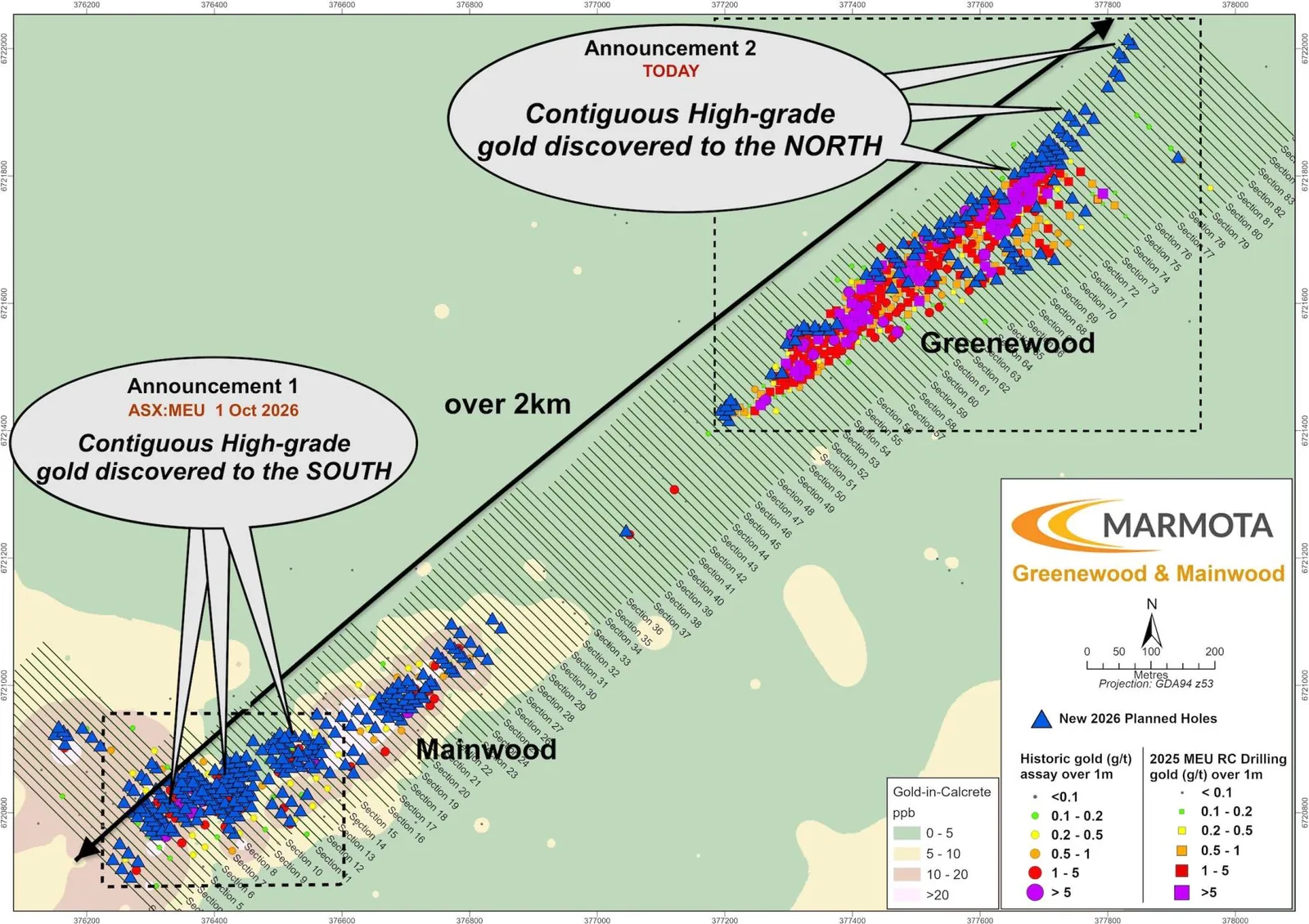
Marmota Limited (ASX:MEU) has doubled the identified high-grade strike at its Greenewood discovery in South Australia, extending the system north-east and at depth across 20 additional section lines. Greenewood and its southern Mainwood extension now stretch for more than 2km, with the mineralisation remaining open at both the northern end and at depth.
The strongest new intersection was 8 metres at 11.5 grams per tonne gold, including 4 metres at 15g/t, in hole 26GWRC035 from 184m downhole. Nearby hole 26GWRC034 returned 8m at 10g/t, including 4m at 18g/t, from 152m. Marmota also reported 12m at 4.5g/t in hole 26GWRC016, including 4m at 13g/t, and 4m at 12.5g/t in hole 26GWRC080.
Southern and northern extensions now form one exploration story
The results add the northern half of the company’s 2026 drilling narrative to the southern assays released earlier this month. Those results identified high-grade intersections in Mainwood, including 16m at 4.2g/t with a 4m zone at 15g/t. The latest announcement says high-grade gold has now been identified contiguously to both the south and north of the original Greenewood discovery.
Marmota’s 2026 RC campaign covered 337 holes and 32,085 metres, including 13,068m across 110 holes at Greenewood and 19,017m across 227 holes at Mainwood. The program had been expanded as the company pursued extensions and resource growth; its earlier drilling expansion reflected the same effort to test a potential mineralised strike of more than 2km.
Continuity reaches from near surface to 240m depth
Across the combined Greenewood/Mainwood system, Marmota says high-grade gold has been tracked from within 16m of surface to a depth of 240m. The company points to several intersections above 40 gram-metres, a measure combining grade and interval width, including 92 gram-metres in hole 26GWRC035 and 80 gram-metres in hole 26GWRC034.
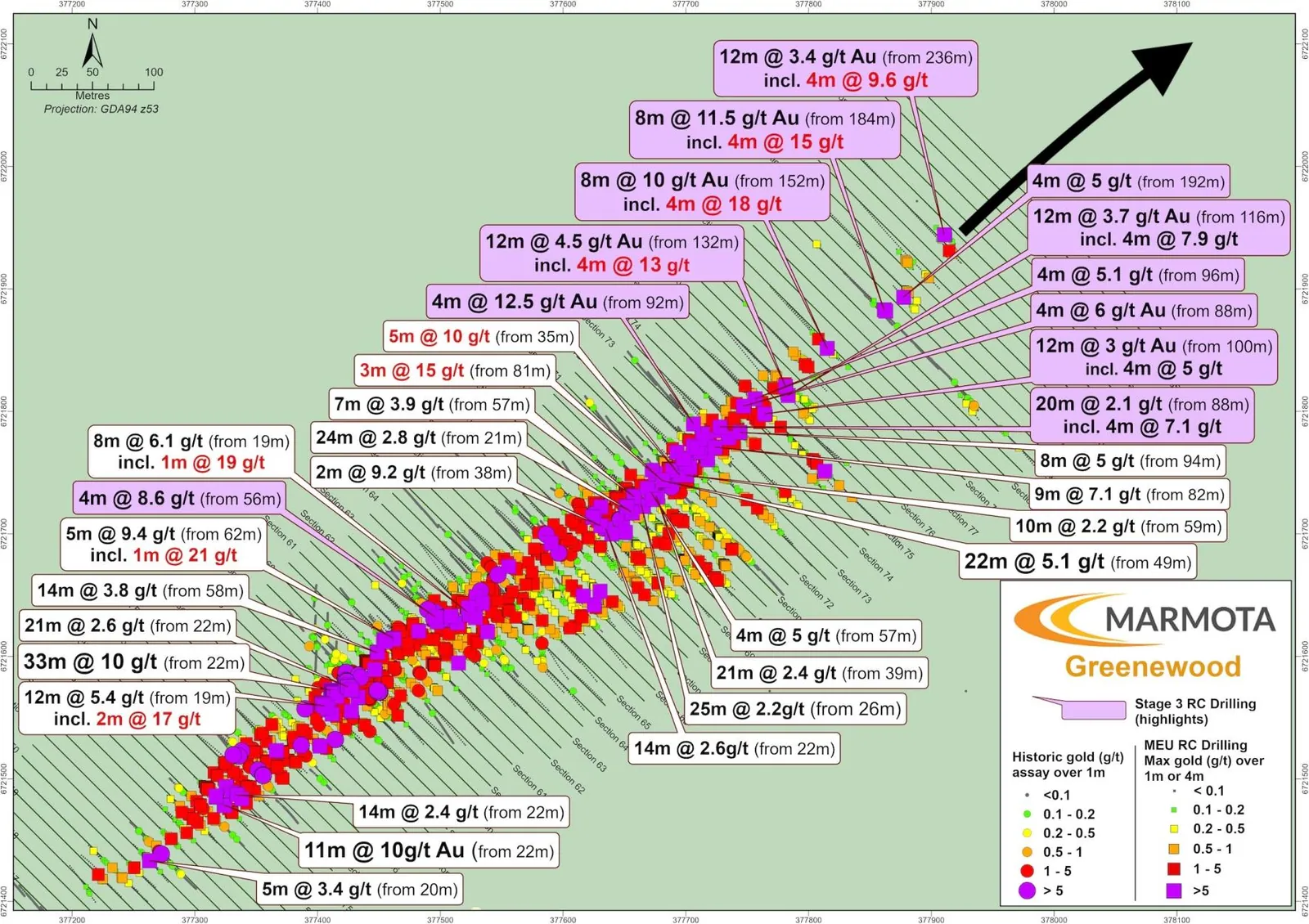
That continuity is the central claim in the announcement, but it remains an exploration result rather than an economic conclusion. The reported intervals are downhole lengths, not confirmed true widths, and the latest results are initial 4m composite assays. Marmota says remaining composite assays and subsequent detailed 1m assays will feed into its Greenewood resource model and the broader Gawler Gold scoping study.
Resource modelling is the next test
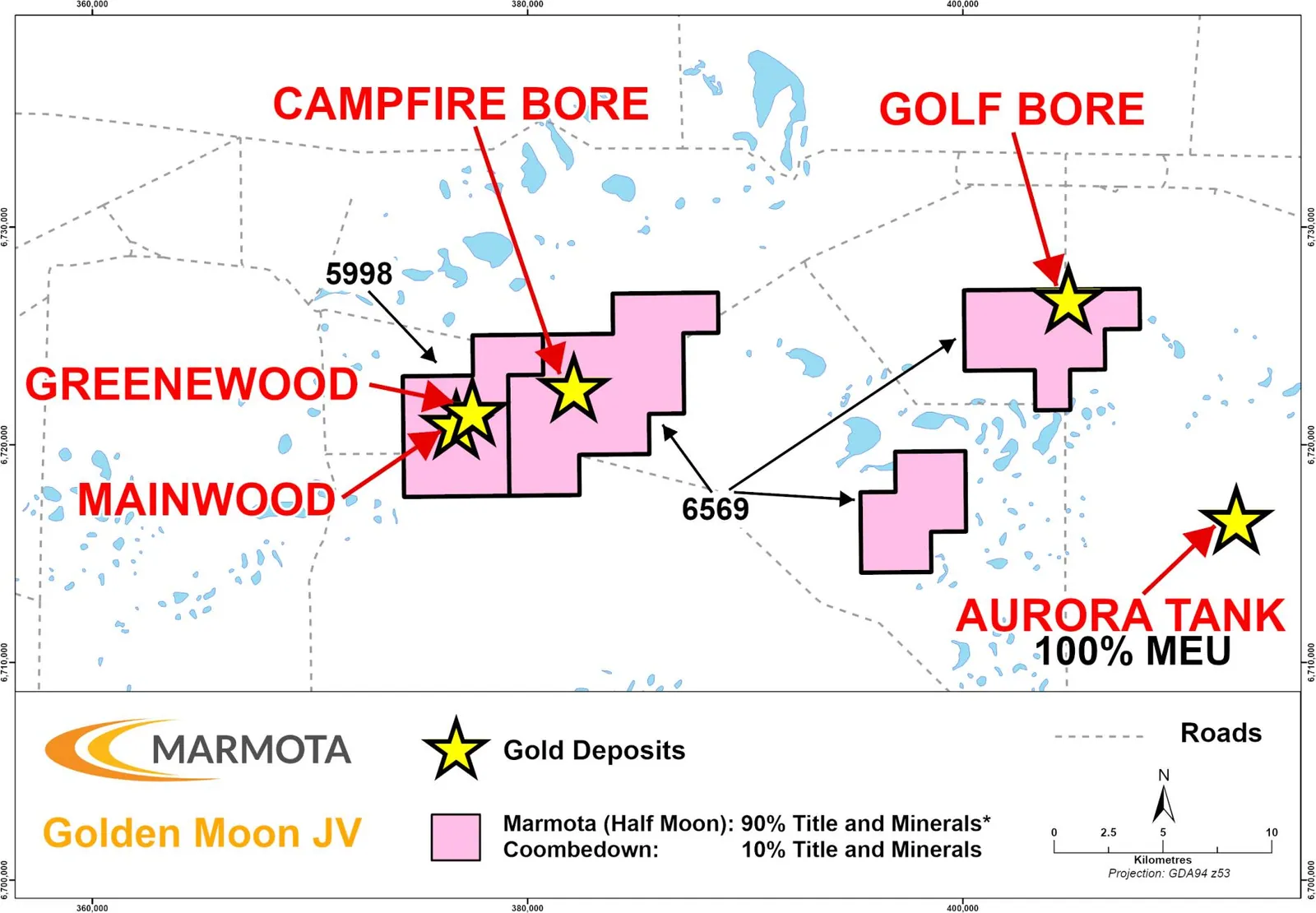
The Greenewood/Mainwood deposits sit within the Golden Moon joint venture, in which Marmota holds a 90% interest. The company says drilling has completed for Stage 3, leaving the geological model to absorb the outstanding assays and determine how much of the newly outlined strike can be converted into a resource with sufficient confidence for study work.
Until that modelling is done, the impressive grades describe the shape and tenor of a discovery, not its mineable inventory. The next meaningful step will be whether the 1m assays confirm the continuity suggested by the composites, and whether the expanded system supports the indicated resource required for production planning.
Bottom Line?
The exploration picture has strengthened materially, but the investment case now turns on detailed assays, resource classification and whether the long mineralised system can translate into a workable development study.
Questions in the middle?
- Will the pending 1m assays confirm the grade continuity suggested by the 4m composites?
- How much of the 2km-plus Greenewood/Mainwood strike can be included in a maiden mineral resource?
- Can the scoping study demonstrate practical scale, metallurgy and development sequencing for the expanded system?
Sources
1-
Massive extension to high-grade Greenewood gold (opens in a new tab)Official market announcement. Marmota Limited · 26 Oct 2026 · marmota.com.au