Red Metal expands Sybella heap leach case to 598 Mt of fresh granite

Red Metal’s latest column tests have extended the heap-leach case to the largest ore type at its Sybella rare earth project, with 65% neodymium and 68% praseodymium extraction from fresh granite. The result brings 598 million tonnes of fresh granite into the company’s pre-feasibility study, although the ore requires a longer leach cycle than its weathered counterparts.
- 65% neodymium and 68% praseodymium extraction from fresh granite
- 19 kg/t sulphuric acid consumption, with low aluminium and iron impurities
- 598 Mt fresh granite within the 936 Mt Kary Zone Inferred Resource
- 200-day terminal leach cycle, longer than weathered ore
- Sybella PFS remains targeted for the first quarter of 2027
 Add us as a preferred source on Google
Fresh Granite Brings 598 Mt Into Heap Leach Study
Red Metal Limited (ASX:RDM) has filled the largest gap in its Sybella processing case. A column leach test on the Kary Zone’s fresh granite returned 65% neodymium and 68% praseodymium extraction, while consuming 19 kilograms of sulphuric acid per tonne. That gives the company test support for evaluating 598 million tonnes of fresh granite as potential heap-leach feed.
The fresh granite makes up almost two-thirds of the Kary Zone’s 936 Mt Inferred Mineral Resource, reported at a 300 parts per million NdPr cut-off to 100 metres depth. The resource contains 335 ppm NdPr and 31.9 ppm DyTb in the fresh granite component, which remains open at depth. Red Metal’s previous results from the overlying Saprock and Transitional ores had delivered higher rare earth extractions, including results of up to 78% for neodymium and praseodymium in the earlier Kary Zone column tests.
Lower Acid Use Comes With A Longer Leach Cycle
Fresh granite did not match the weathered ores on extraction: its 65% neodymium and 68% praseodymium results compare with 70-76% neodymium and 71-78% praseodymium across the Saprock and Transitional tests. Its processing trade-off was lower acid consumption and low impurity extraction. Aluminium extraction was 3% and iron extraction 6%, against higher results recorded in the weathered samples.
The test also took longer. Terminal rare earth extraction was reached after 200 days, compared with 120 to 140 days for the reported weathered ore tests, although Red Metal said half of the total fresh granite extraction was achieved within the first 30 days. The company’s managing director Rob Rutherford said the new data would feed into the Sybella pre-feasibility study, which is assessing the project’s potential economics.
PFS Must Test Heap Size And Scheduling Trade-Offs
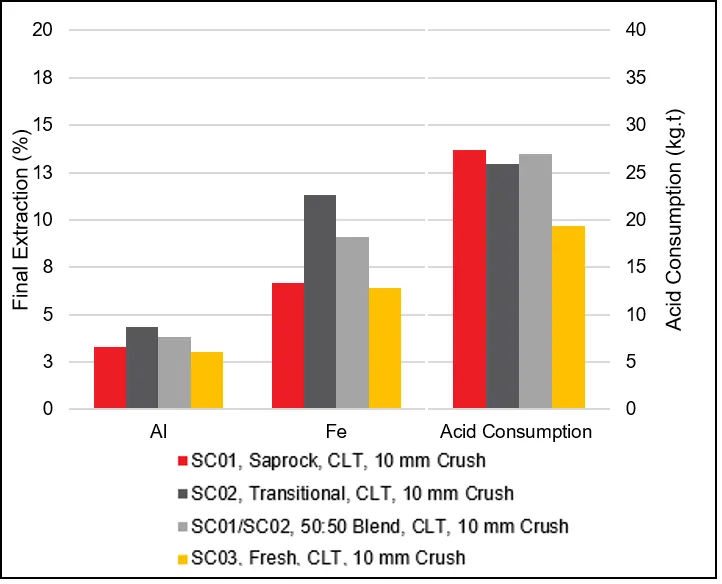
The result was generated from a two-metre column using a representative composite of minus-10 millimetre crushed core collected from multiple holes across the northern Kary Zone. Testing used weak sulphuric acid at ambient temperature, with no heating required. Red Metal said the granite is competent but readily crushed and has low acid consumption characteristics, supporting its proposed heap-leach flowsheet.
Those are still metallurgical test results, not a commercial demonstration. The longer leach residence time could affect the size of the leach inventory, mine sequencing and capital requirements, while the economic value of lower acid use and cleaner pregnant leach solution remains to be established in the PFS. Additional tests on a coarser minus-30 millimetre crush and in six-metre columns are under way, alongside ion-exchange purification work aimed at producing a mixed rare earth carbonate.
Sybella Moves Toward A First Development Study
Red Metal expects the Sybella PFS to be completed in the first quarter of 2027. The study will incorporate the new fresh granite data into pit design, heap design and mine scheduling, while a 5,000-metre reverse-circulation infill and extension drilling program continues across Kary. The fresh granite also remains open at depth, with the deepest holes starting and ending in mineralisation at 240 metres.
Bottom Line?
The test expands the feedstock case for Sybella, but the PFS must show whether lower acid use can outweigh the fresh granite’s slower leach cycle and the risks of scaling up from two-metre columns.
Questions in the middle?
- Can the PFS convert the lower acid and impurity profile into a meaningful operating-cost advantage?
- How will a 200-day fresh granite leach cycle affect heap size, mine scheduling and capital intensity?
- Will the larger-column tests and ongoing drilling support the same recovery profile across the wider Kary Zone?
Sources
1-
Sybella REO Strong Fresh Granite Leach Results (opens in a new tab)Verified source. Red Metal Limited · 26 Oct 2026