Micro-X sees Rover momentum as medical CT reset takes hold

Micro-X has reported a sharp improvement in Rover order activity and more than $3 million in annualised cost savings, while redirecting its strategy towards medical CT. The September quarter still consumed $4.4 million in operating cash, leaving funding dependent on further note proceeds, an expected tax refund and milestone receipts.
- 17 Rover units ordered across the quarter and October
- More than $3 million in annualised cost savings implemented
- $4.4 million operating cash outflow and $4.4 million quarter-end cash
- $8.6 million pro forma cash before other post-quarter flows
- Head CT, ARPA-H and DHS programs advance
 Add us as a preferred source on Google
Rover orders provide early test of Micro-X reset
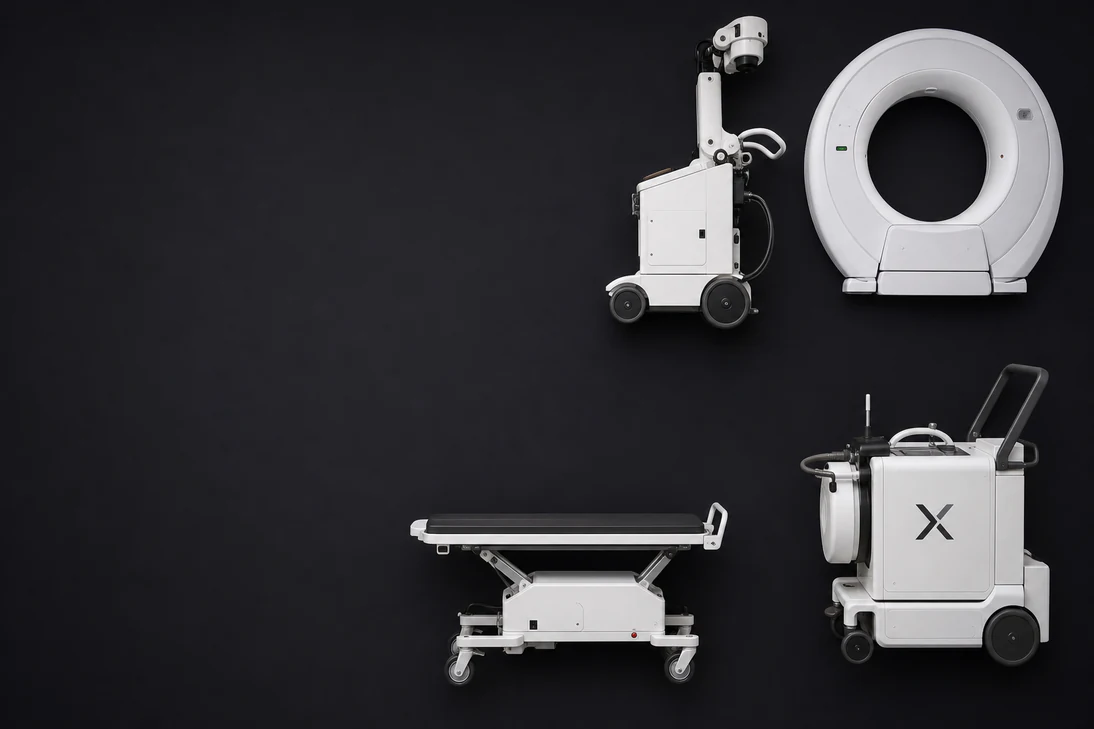
Micro-X Ltd (ASX:MX1) has begun to show commercial traction from its strategic reset, with 10 Rover units ordered during the September quarter and another seven ordered in October. The company said the quarter was its strongest Rover order period outside the Malaysian Government tender, with demand spanning the US, EMEA and Asia Pacific.
The order flow arrives as Micro-X reorganises its sales operation following a 10-week review by Altus Alliance. The company has refreshed its sales team, CRM and pipeline processes, and added a combined direct and partner sales model. It said the number of open opportunities in the Rover pipeline tripled during the quarter, although larger government and defence tenders remain uncertain. The updated RoverX is due for commercial release ahead of its launch at RSNA in Chicago.
The medical-imaging company’s strategic reset, announced alongside the $8 million note financing(b6c32917-97eb-4fb6-9302-66d933781782), has placed medical CT at the centre of its medium-term plan. Head CT is now the primary development priority, with the largest share of convertible-note proceeds allocated to clinical validation, an FDA 510(k) submission and an ambulance trial. Recent patient imaging at Royal Melbourne Hospital produced improved image quality, Micro-X said, while a final Head CT tube design was demonstrated during the quarter.
Cash burn remains the immediate constraint
Operating cash outflow was $4.4 million for the quarter, compared with $3.2 million in the June quarter. That figure included $0.5 million of one-off restructuring costs, $0.9 million of ARPA-H-funded pass-through payments to university research partners and a $0.3 million final quarterly superannuation payment. Micro-X said underlying staff costs were $3.7 million, 5% below the previous quarter after adjusting for those items and pay-run timing differences.
Cash at 30 September stood at $4.4 million, after $6 million of convertible-note proceeds helped lift the balance during the quarter. A further $1 million tranche was received in October and the final $1 million is due on 1 December, with each tranche netting $0.925 million after the 7.5% underwriting fee. The notes carry 12% annual interest, are secured over substantially all company assets and convert at $0.08 a share.
Micro-X’s pro forma cash estimate of $8.6 million depends on the remaining note proceeds and an expected $2.3 million net R&D tax refund after repayment of its Radium Capital loan. The company also points to $5.3 million of contracted development-program and grant receipts due from October onwards, subject to milestones. The quarterly Appendix 4C nevertheless records only one quarter of funding based on the historical September cash outflow, a measure that will need to be tested against the promised cost reductions and incoming receipts.
Funded CT and security programs add near-term receipts
Micro-X received a $1.6 million milestone payment from the ARPA-H Full Body CT program and a $0.45 million commencement payment for the University of Sydney Lung CT research program. The ARPA-H prototype is now producing images of phantoms, according to the company, ahead of a Phase II down-select decision expected in early November. The payment followed the critical design review that had moved the program into full-sized engineering prototype manufacture, as reported in the ARPA-H prototype milestone.
Security work is also contributing funded development revenue rather than product sales. Micro-X secured an eight-month, US$0.75 million contract extension with the US Department of Homeland Security to design and deliver an upgraded Miniaturised CT Baggage Scanner. The upgrade targets faster imaging, easier scaled manufacture and simpler deployment after testing of four existing prototypes. It extends the DHS scanner upgrade contract, but the filing does not present the work as a commercial deployment or recurring product revenue.
Micro-X enters the December quarter with a more focused operating plan, stronger Rover order activity and several externally funded technology programs. The harder question is timing: whether RoverX can convert its enlarged pipeline into repeatable, higher-margin sales quickly enough for the cost reset and contracted receipts to replace the company’s reliance on financing and expected tax proceeds.
Get ASX:MX1 news the moment it breaks
 iPhone & iPad
 Android
Bottom Line?
The reset has improved order momentum and reduced the cost base, but the next quarter must convert those gains into cash while key CT and funding milestones remain pending.
Questions in the middle?
- Will the seven post-quarter Rover orders translate into a sustained, repeatable sales run-rate?
- Will the ARPA-H Phase II decision support continued Full Body CT funding in early November?
- Can the expected R&D tax refund, final note tranche and milestone receipts arrive before cash pressure returns?
Sources
1-
MX1 - Quarterly Activities Report & Appendix 4C (opens in a new tab)Official market announcement. Micro-X Limited · 30 Oct 2026 · micro-x.com