Felix Gold moves Treasure Creek closer to Alaska mine approval

Felix Gold has lodged a mine permit application for a small seasonal operation at Treasure Creek’s NW Array prospect while reporting further near-surface gold intersections. The strongest assay graded 4.51 g/t gold over 9.12 metres, but low core recovery makes that result difficult to assess confidently.
- Mine permit application lodged with Alaska DNR for NW Array
- 9.12m at 4.51 g/t gold from surface, affected by 43% core recovery
- 20.78m at 0.91 g/t gold from surface in infill drilling
- Step-out drilling returned gold 1.2km north-northeast and south of NW Array
- 44 of 80 2026 holes still have gold results pending, with antimony assays also outstanding

 Add us as a preferred source on Google
Alaska mine permit application lodged
Felix Gold Limited (ASX:FXG) has put a formal permitting milestone behind its Treasure Creek project, lodging a Plan of Operations with Alaska’s Department of Natural Resources for proposed mining at the NW Array prospect. The application is not an approval, but it is the company’s stated step towards a targeted June 2027 mining start, subject to State approval, funding and further technical work.
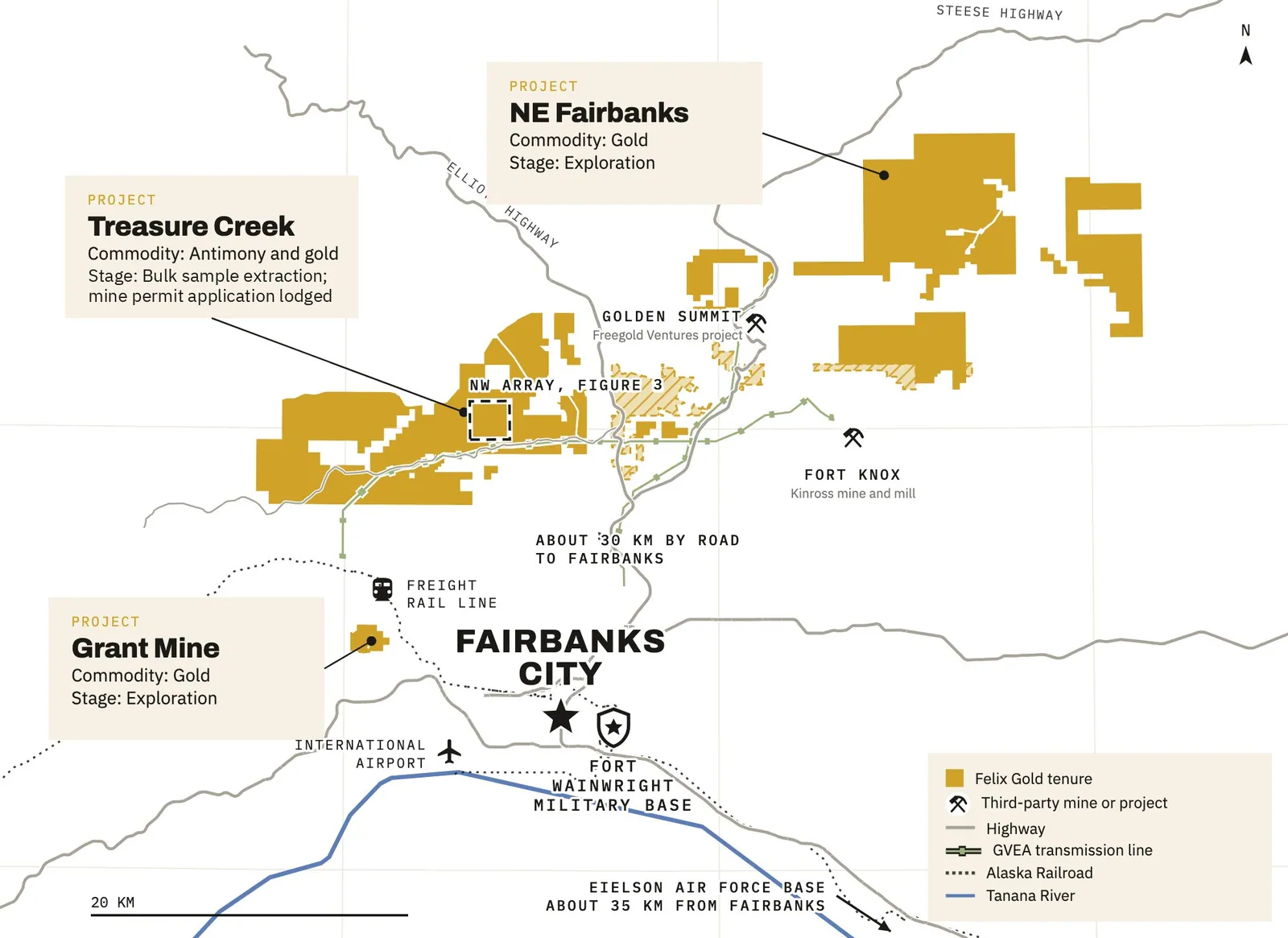
The proposed operation is deliberately modest: one small open pit, a chemical-free crushing, screening and ore-sorting plant, stockpiles and supporting infrastructure. Felix proposes about 112 acres of total disturbance, seasonal work in 2027 and 2028, and a workforce of roughly 25 staff and contractors, with no camp on site. The company said it lodged the application after consultation through Alaska’s coordinated permitting process, but reclamation, environmental, water and local mining approvals remain outstanding.
The timing follows Felix’s November funding raise, which was reported as supporting mine permitting, drilling and resource work. The filing itself cautions that funding is still one of the conditions for any move towards production, alongside regulatory and commercial evaluation.
Near-surface gold continues across NW Array
The drilling results provide further evidence of shallow gold within and around the proposed development area. Five reported diamond holes inside NW Array returned gold from surface, led by 20.78 metres at 0.91 g/t gold in hole 26TCDD007, including 7.60 metres at 1.50 g/t. Hole 26TCDD005 returned 9.00 metres at 1.06 g/t, while 26TCDD009 delivered 13.68 metres at 0.72 g/t.
Hole 26TCDD006 produced the headline grade, with 9.12 metres at 4.51 g/t from surface. That number carries an unusually prominent qualification: average core recovery across the interval was only 43%, and the result was influenced by a single 10.76 g/t assay taken across a zone with more than 50% core loss. Felix has explicitly advised treating the intersection with caution.
Outside the central area, hole 26TCRC034 returned 21.34 metres at 1.32 g/t from 32 metres, including 13.72 metres at 1.79 g/t. To the south, 26TCRC009 returned 13.72 metres at 1.10 g/t from 16.76 metres. These are downhole lengths rather than true widths, and Felix says continuity between the step-out lines and NW Array has not yet been established.
Step-out drilling extends the geological story
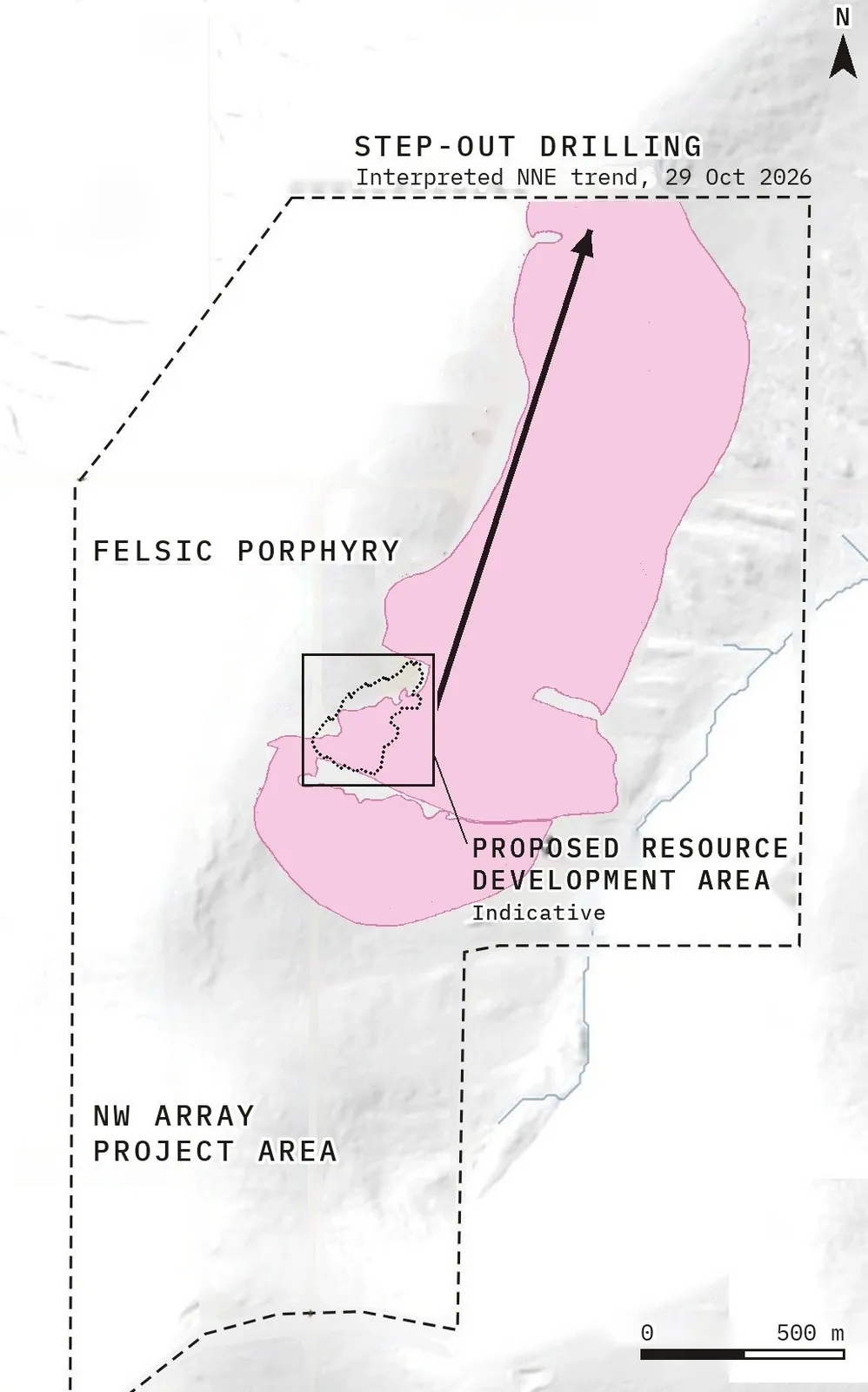
About 1.2 kilometres north-northeast of NW Array, hole 26TCRC022 intersected 19.81 metres at 0.75 g/t gold from 42.67 metres, while 26TCRC021 returned 15.24 metres at 0.93 g/t from 36.58 metres. The results add to the first step-out assays, which had reported a higher-grade interval from the same broader exploration program.
Gold also appeared in several holes testing structures south and southwest of the main prospect, although some targets returned narrow or low-grade intervals and others produced no significant intersection. Felix says the results suggest the felsic sill and separate structures in schist may both host gold, but the company is still building the geological model rather than reporting a new resource or mineable inventory.
Antimony assays and resource modelling remain key tests
The immediate development case remains antimony-led. Gold-bearing material mined alongside antimony would initially be sorted and stockpiled on site for potential future treatment, and the company says antimony assays from eight holes within this release are still pending. One reported diamond hole, 26TCDD001, contained 1.70 metres at 10.85% antimony from six metres, but no antimony Mineral Resource or Ore Reserve has been declared and no JORC-compliant economic study has been completed.
Gold results have now been reported for 36 of the 80 holes drilled during 2026, leaving assays from 14 RC holes and 30 diamond holes outstanding. Those results, together with updated resource modelling and technical studies, will determine whether the encouraging near-surface intersections translate into a coherent development opportunity. For now, the permit application moves the project into a more consequential regulatory phase while the geology remains incomplete.
Get ASX:FXG news the moment it breaks
 iPhone & iPad
 Android
Bottom Line?
The permit application gives Treasure Creek a clearer route towards 2027, but approval, funding, pending assays and proof of continuity still stand between exploration results and mining.
Questions in the middle?
- Will Alaska approve the NW Array Plan of Operations, and what additional conditions or approvals will be required?
- Do the remaining gold and antimony assays support a resource and technical case for mining alongside the proposed operation?
- Can low-recovery high-grade intersections be confirmed with reliable core and true-width data?
Sources
1-
Step Out Gold Results and Mine Permit Application (opens in a new tab)Verified company source. Felix Gold Limited · 12 Nov 2026 · felixgold.com.au