Fortuna adds rare earth potential to growing Mkanda resource

Fortuna Metals has added calculated zircon and monazite estimates to its large Mkanda rutile-graphite resource in Malawi, while deeper drilling points to further growth. The figures remain early-stage: all material is Inferred, and the accessory minerals are not yet recoverable or saleable product estimates.
- 292.5Mt at 0.86% rutile and 1.35% TGC at a 0.7% cut-off
- 97,400 tonnes of calculated zircon and 34,100 tonnes of calculated monazite
- 7,618m aircore program has tested mineralisation below the shallow resource
- Indicated MRE targeted for mid-2027
- Further metallurgical work required to validate recoveries and product quality
 Add us as a preferred source on Google
Calculated zircon and monazite broaden Mkanda’s resource story
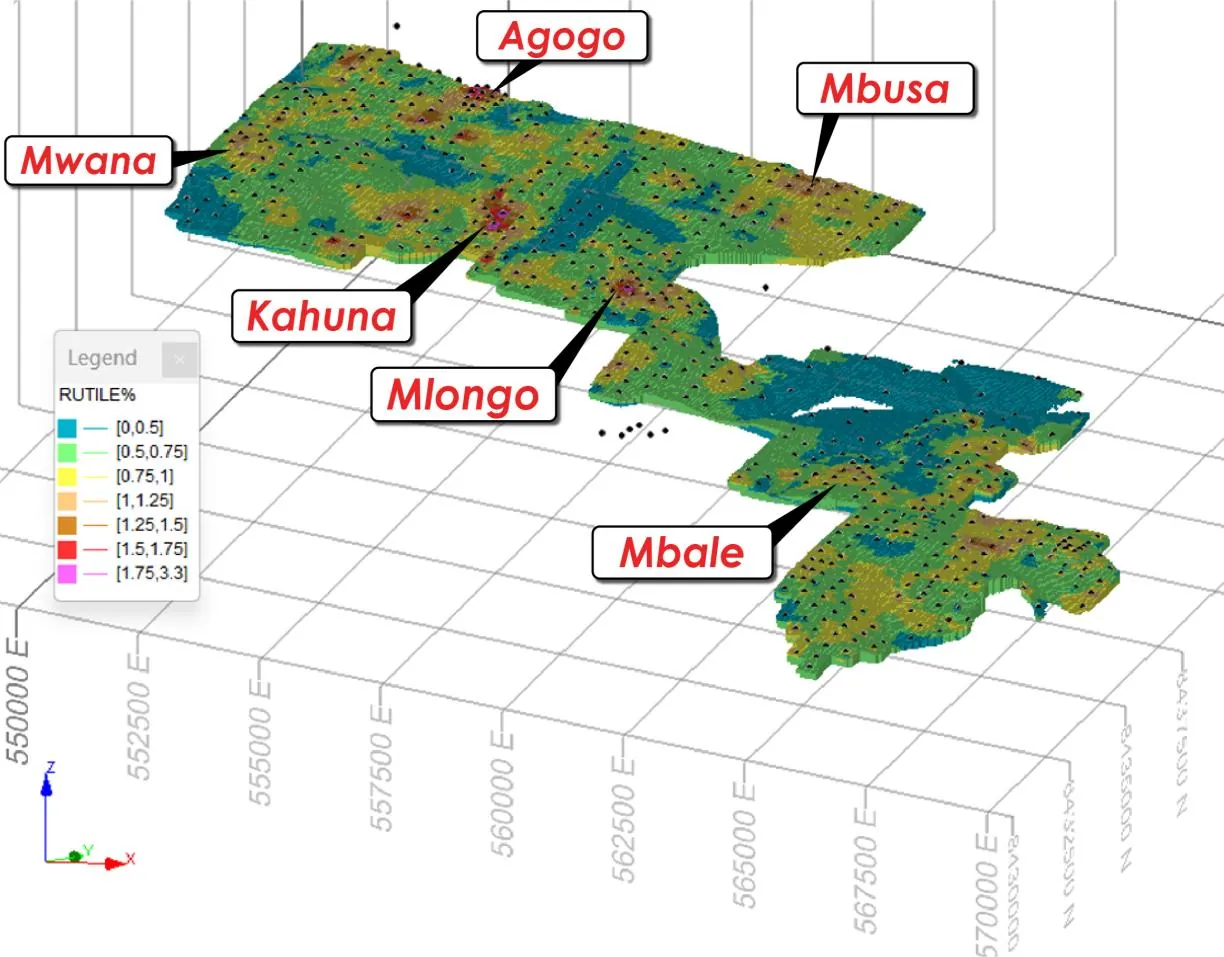
Fortuna Metals Limited (ASX:FUN) has added a new layer to its Mkanda project in Malawi, reporting calculated zircon and monazite alongside a substantial rutile and graphite resource. At the company’s principal 0.7% rutile cut-off, the updated estimate contains 292.5 million tonnes at 0.86% rutile and 1.35% total graphitic carbon, with 97,400 tonnes of calculated zircon and 34,100 tonnes of calculated monazite.
The accessory minerals are potentially significant to the project’s multi-commodity proposition, but they are not yet an economic product. Fortuna says the figures were calculated from oxide assays using stoichiometric formulas supported by physical separation work and QEMSCAN mineralogy. They do not represent total rare earth oxide, recoverable product, saleable concentrate, a payable rare earth basket or processing recovery.
Deeper drilling may matter more than the accessory credits
The more immediate exploration development is below the resource’s shallow hand-auger limit. The current estimate is based mainly on drilling averaging about 7.5 to 8 metres, while Fortuna has completed a 7,618-metre aircore program averaging roughly 22 metres. Initial results from the Mlongo and Kahuna prospects have returned high-grade rutile to the saprock boundary at depths exceeding 20 metres.
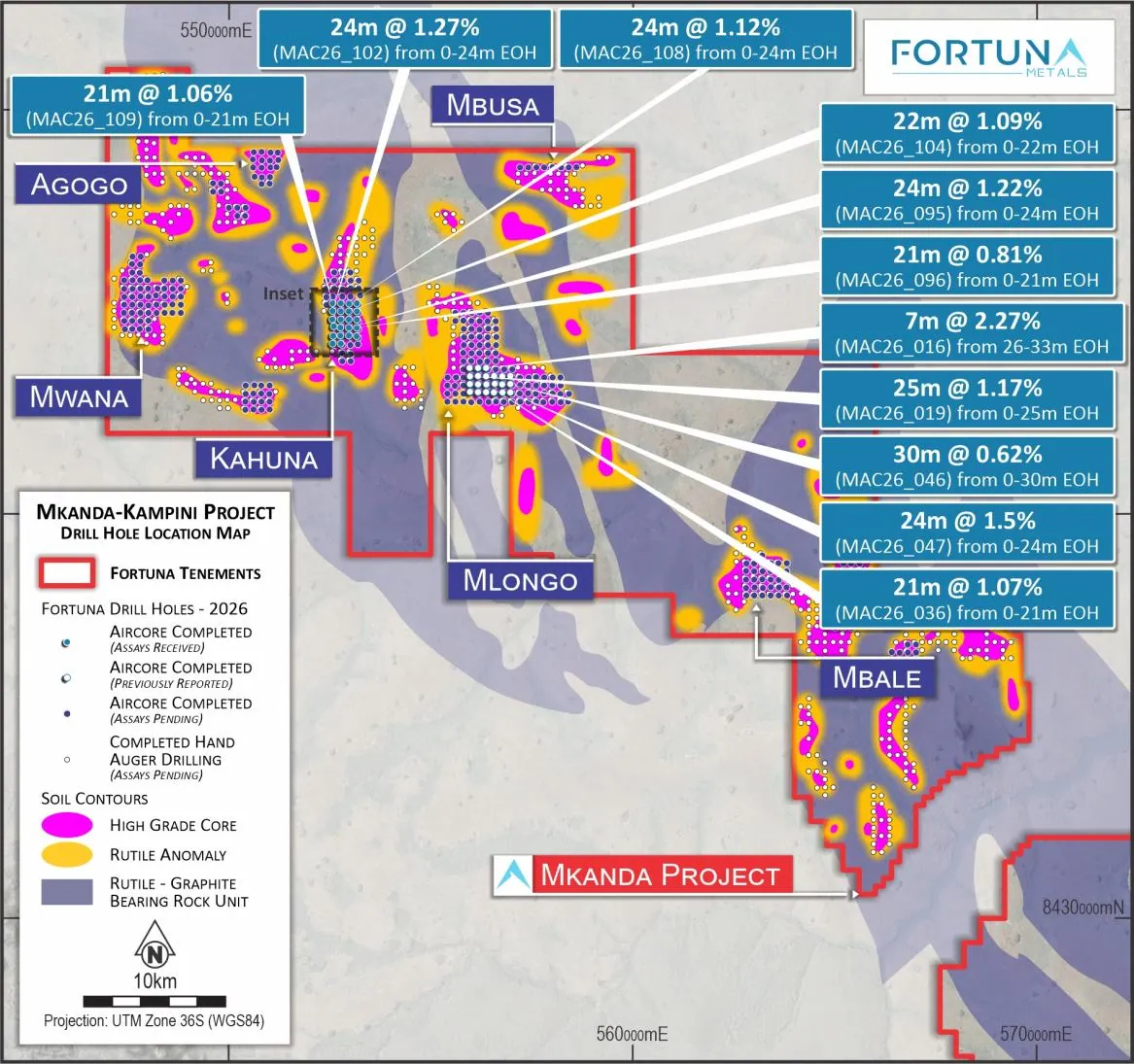
That work follows deeper Kahuna rutile results, which reported broad intersections beneath the existing resource and left mineralisation open at depth and along strike. Fortuna expects the remaining aircore results over the next four to six months and is targeting an updated Indicated MRE in mid-2027.
Resource scale remains high, but confidence remains low
The estimate is entirely classified as Inferred, reflecting broad-spaced drilling, limited deeper sampling, early-stage topographic and density data, and the need for additional geological and metallurgical verification. No Ore Reserve has been estimated, and Fortuna has not yet established project economics, recoveries or a mining schedule.
The announcement also contains a later reproduced resource table with slightly different figures from the headline updated table, including 298Mt rather than 292.5Mt at a 0.7% cut-off. That discrepancy should be reconciled before investors use the resource numbers for detailed valuation work; the headline table reports 292.5Mt, 0.86% rutile and 1.35% TGC.
Metallurgy and feasibility work now carry the burden
Fortuna is continuing test work at Mineral Technologies’ Carrara facility to assess recovery and product characteristics for rutile, graphite, zircon and monazite. Earlier bulk testing produced a rutile concentrate grading more than 96% TiO2, but the company says further work is needed to establish recoveries, impurity deportment, particle-size distribution and product quality across the resource.
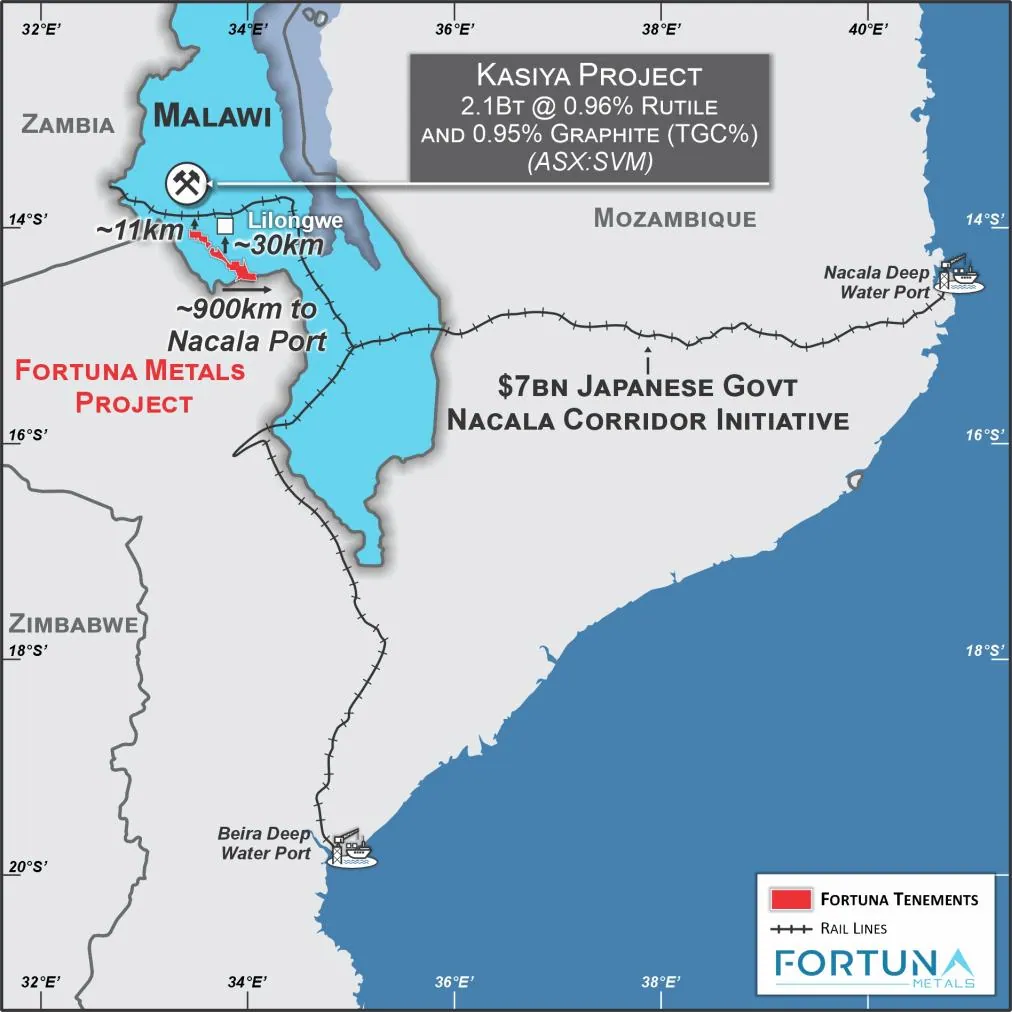
Push-tube drilling for density, lidar mapping, graphite flotation tests, environmental and social studies, bulk sampling, conceptual studies and customer discussions are also in progress. The nearby Kasiya project provides a geological and processing comparison, but it does not remove the technical work still required at Mkanda.
The next test is conversion from scale to a mineable project
Fortuna’s announcement increases the apparent commodity breadth and depth potential of Mkanda, but the investment case still rests on a chain of uncompleted steps. Aircore assays must confirm the deeper continuity, the resource must move beyond Inferred confidence, and the calculated accessory minerals must survive mineralogical, metallurgical and commercial testing.
Get ASX:FUN news the moment it breaks
 iPhone & iPad
 Android
Bottom Line?
Mkanda now has more apparent scale and more commodities, but the mid-2027 resource upgrade and recovery test work will determine whether those additions translate into a credible development case.
Questions in the middle?
- Will the remaining aircore assays support a materially larger and higher-confidence resource below the shallow hand-auger model?
- How much of the calculated monazite and zircon can be recovered into products with acceptable quality and payable value?
- Can Fortuna reconcile the conflicting resource tables and progress from Inferred resources to an economic study on schedule?
Sources
1-
Mkanda Rare Earths and Zircon Resource (opens in a new tab)Verified source. Fortuna Metals Ltd · 16 Nov 2026