Lake Resources moves Kachi closer to construction after major cost reset

Lake Resources says its Kachi lithium project in Argentina is now shovel-ready, with environmental approval secured, FEED underway and a revised Phase One plan showing lower capital costs. The harder test now is turning that progress into RIGI approval, financing, offtake agreements and a final investment decision.
- Kachi environmental approval secured in Catamarca
- Phase One capex reduced to US$1.16 billion
- Pre-tax NPV10 estimated at about US$1.5 billion
- RIGI application submitted ahead of FEED and FID
- Debt financing and strategic partnerships remain unresolved
 Add us as a preferred source on Google
Kachi clears permitting and enters final engineering
Lake Resources N.L. (ASX:LKE) has moved its flagship Kachi lithium brine project to the point where the next major decision is no longer whether it can be permitted, but whether it can be financed and built. The company says Kachi is now “shovel-ready” after receiving its Environmental Impact Declaration from Catamarca’s Ministry of Mining in September and entering the Front-End Engineering Design phase.
The approval removed a major provincial permitting hurdle, while a 200-metre exclusion zone around the Carachi Pampa lagoon is not expected to materially affect the existing ore reserve or the wellfield supporting a planned 25,000-tonne-per-year operation. The project’s direct lithium extraction process, supplied by Lilac Solutions, is designed to return more than 99% of processed brine to the aquifer, according to Lake.
Cost reductions lift Kachi’s development case
Lake’s AGM materials point to a materially leaner project than the original Phase One design. The latest figures put capital expenditure at US$1.16 billion, operating costs at US$5,895 per tonne and pre-tax NPV10 at about US$1.5 billion, with a pre-tax internal rate of return of 22.5%. The chairman’s address separately described the NPV as US$1.469 billion, while reporting a 16% fall in capex and a 3% reduction in opex.
The changes are attributed to higher brine grades, improved recovery rates and Lilac’s ion-exchange technology. Lake says the updated design requires about 22% fewer wells and a 15% to 20% smaller plant footprint than the original DFS, while a recovery rate of roughly 90% has reduced the number of DLE modules. Those claims remain project estimates rather than operating results from a commercial plant.
The project has also benefited from the Kachi environmental approval, which earlier cleared the way for engineering and financing work. Lake’s current plan is to complete FEED, optimise power supply, finalise offtake and strategic partnership discussions, and then seek a Final Investment Decision. It says first production could follow 33 months after FID, but that timetable remains dependent on the intervening approvals and funding.
RIGI application adds a regulatory milestone
Lake submitted its application under Argentina’s RIGI investment regime on 17 November, two days before the AGM address. The regime offers approved projects long-term fiscal and regulatory stability, alongside concessions including accelerated depreciation and reduced customs and export charges under its stated provisions.
The Kachi RIGI application remains subject to government approval. Lake is also pursuing support from UK Export Finance and Export Development Canada, while Citibank and J.P. Morgan have been engaged as joint coordinators for proposed limited-recourse project financing. The presentation says the proposed debt could run for more than 10 years and benefit from political risk insurance, but no financing has been completed.
Funding remains the decisive hurdle
That distinction matters. Lake’s presentation showed A$10.1 million in cash at 30 September, no debt and a fully diluted market capitalisation of about A$85 million based on its stated share price. The company has also identified a need to match its cost structure and liquidity with its development priorities. Its A$2.7 million November raise supported engineering, power optimisation and strategic work, but it did not resolve the much larger construction funding requirement.
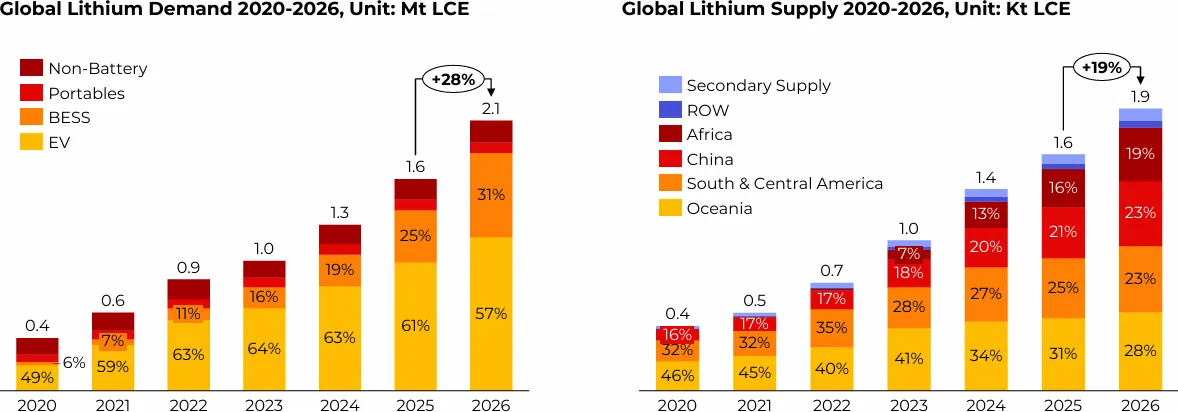
Lake is positioning Kachi against a lithium market it expects to expand sharply, citing Benchmark Mineral Intelligence’s forecast that demand will rise from about 2.1 million tonnes of lithium carbonate equivalent in 2026 to 4.1 million tonnes in 2035. The presentation also acknowledges that prices have weakened during 2026 and that the company does not independently verify the external forecasts it cites. The economics therefore remain exposed to both execution risk and the price assumptions used in the project studies.
Get ASX:LKE news the moment it breaks
 iPhone & iPad
 Android
Bottom Line?
Kachi has moved from permitting into engineering, but the investment case now turns on RIGI approval, binding offtake and strategic partners, and a financing package capable of carrying the project to FID.
Questions in the middle?
- When will Argentina decide on Kachi’s RIGI application?
- Can Lake secure debt, offtake and strategic capital without substantial further equity dilution?
- Will FEED validate the lower-cost design and preserve the 25,000-tonne-per-year production target?
Sources
2-
AGM Presentation (opens in a new tab)Verified company source. Lake Resources N.L · 19 Nov 2026 · investorhub.lakeresources.com.au
-
Chair's Address to Shareholders (opens in a new tab)Verified company source. Lake Resources N.L · 19 Nov 2026 · investorhub.lakeresources.com.au