Argent extends Trunkey Creek gold story beyond historic workings

Argent Minerals has intersected 0.3 metres at 8.32g/t gold in a second hole beyond the historic workings at Wilson’s Reef, strengthening its case for deeper exploration at Trunkey Creek. The result is encouraging, but the narrow downhole interval does not yet establish true width, continuity or a mineral resource.
- 0.3m at 8.32g/t gold in ATDD005 from 173.7m downhole
- Second hole to intersect gold beyond Wilson’s Reef historic workings
- ATDD003 and ATDD004 returned no significant assay results
- Phase 1 covers 20 holes and approximately 4,487m
- Approved drilling program expanded to 8,687m across the Trunkey corridor

 Add us as a preferred source on Google
Second high-grade intersection beyond Wilson’s Reef workings
Argent Minerals Limited (ASX:ARD) has found another narrow, high-grade gold intersection beyond the interpreted limits of historic mining at its Trunkey Creek Gold Project in central New South Wales. Diamond hole ATDD005 returned 0.3 metres at 8.32g/t gold from 173.7m downhole, although the company said the interval is not a true width.
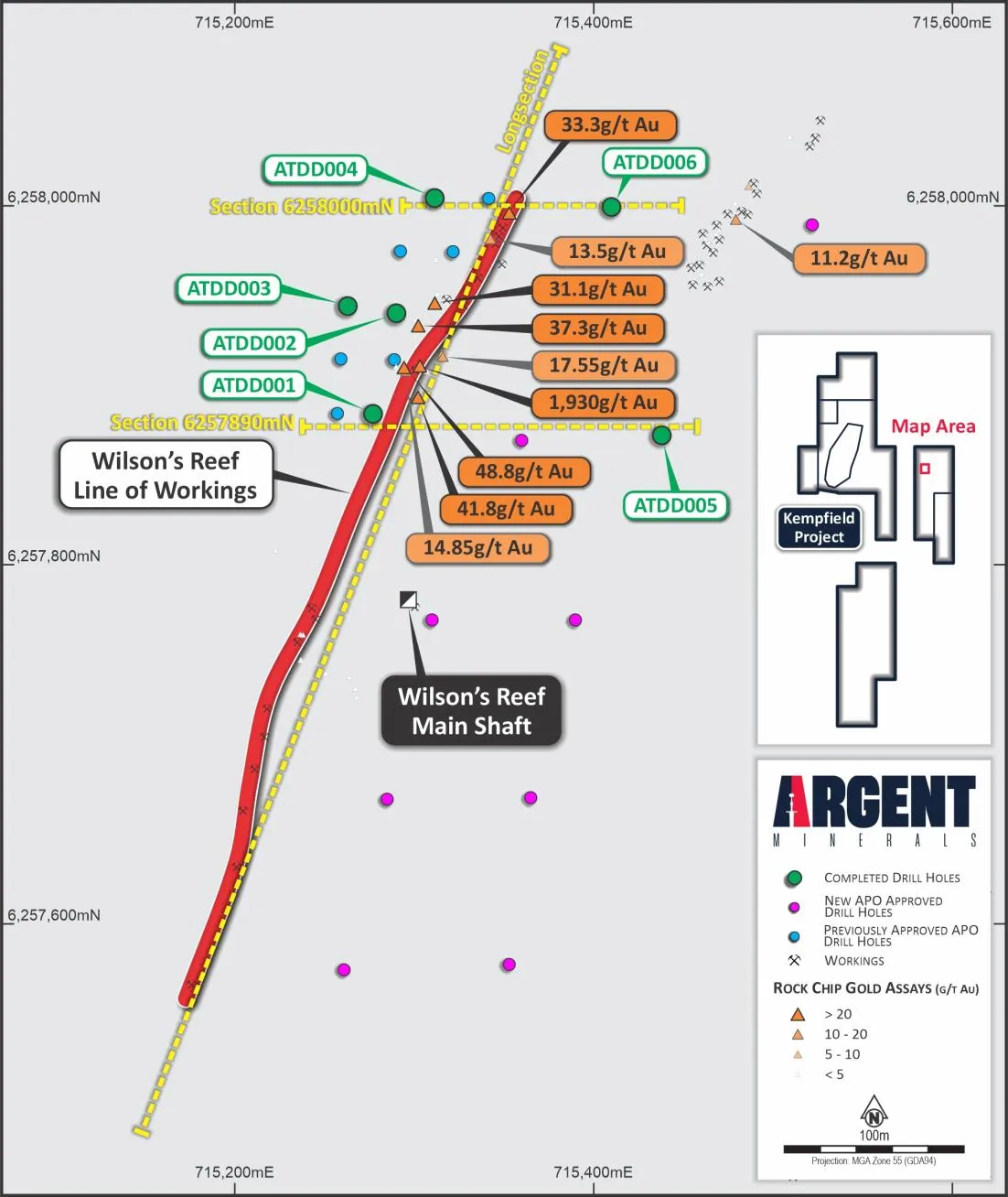
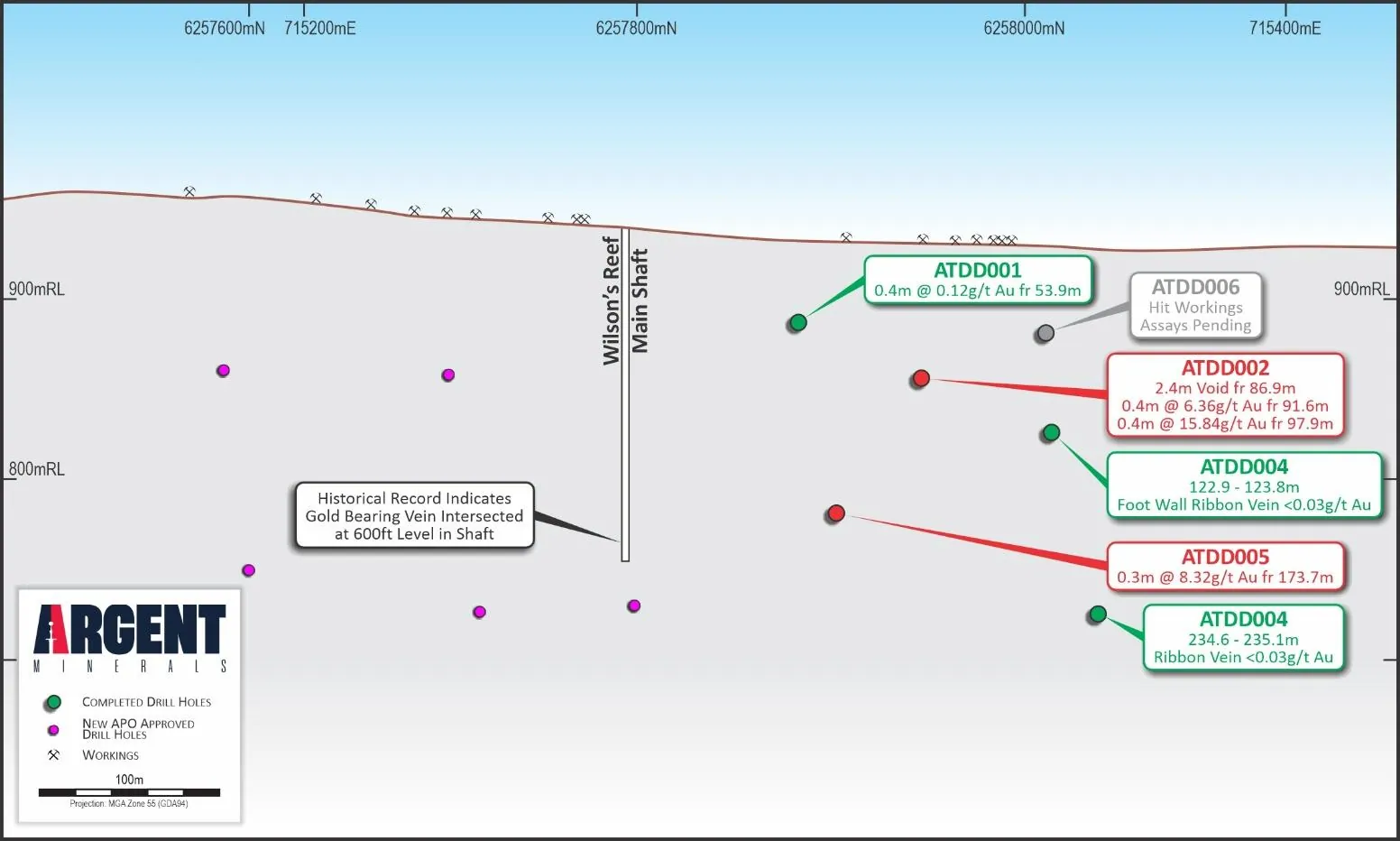
The result makes ATDD005 the second hole to intersect gold outside the old workings at Wilson’s Reef. It follows earlier Trunkey assays, which returned 0.4m at 6.35g/t and 0.4m at 15.84g/t gold in ATDD002 beneath a 2.4m underground void interpreted as historic workings.
Drilling points to a deeper south-plunging system
Argent says the results support its interpretation of a south-plunging gold system at Wilson’s Reef. The company believes drilling has not yet reached the unmined main vein, with the next holes designed to test structures at and below roughly 200m vertical depth.
That depth is central to the exploration thesis. According to Argent, historic mining stopped when groundwater inflow became difficult to manage, rather than because the reefs had been documented as exhausted. The company is now using modern drilling to test areas beside and beneath those old workings, while refining the position and extent of mining that was not fully documented in the available records.
Early program still contains significant gaps
The encouraging result sits within a very small and uneven early dataset. ATDD003 and ATDD004, drilled to approximately 300m downhole to test below the interpreted historic mining limit, returned no significant assay results. ATDD001 also failed to return materially anomalous gold, while ATDD002 and ATDD005 produced the two notable intersections reported outside the workings.
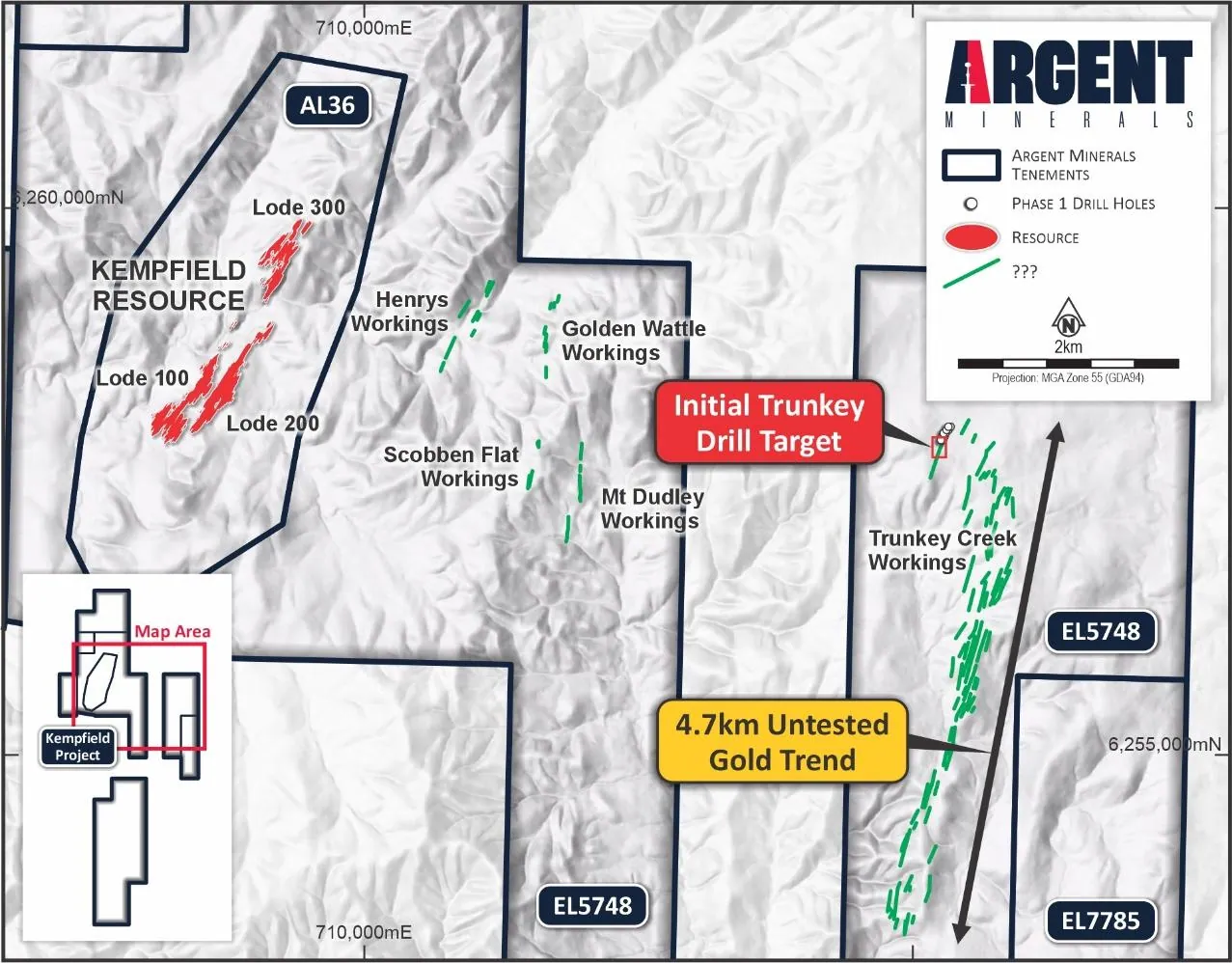
Argent has completed six holes of a 20-hole Phase 1 program targeting the northern end of a 4.7km mineralised corridor. Phase 1 covers approximately 4,487m, with Phase 2 planned to begin immediately afterwards. The broader approved program now totals 8,687m, allowing drilling to continue across Wilson’s Reef and the wider corridor into 2027. The latest result arrives after the company secured a A$1.55 million placement intended in part to fund further work at Trunkey Creek.
For now, the headline grade is more persuasive as a targeting signal than as evidence of mineable scale. Argent’s own JORC commentary says the available drilling is insufficient to establish geological or grade continuity, and the true thickness and geometry of the mineralisation remain unclear. The next assays, particularly from deeper holes, will need to show whether these isolated high-grade veins connect into a coherent system.
Get ASX:ARD news the moment it breaks
 iPhone & iPad
 Android
Bottom Line?
The next test is not another isolated high grade, but whether deeper drilling establishes width, continuity and a repeatable structure beyond the historic workings.
Questions in the middle?
- Will deeper holes below approximately 200m vertical depth intersect the interpreted unmined main vein?
- Can follow-up drilling demonstrate continuity and true widths beyond the narrow downhole intervals reported so far?
- How will the remaining Phase 1 results shape the scale, timing and funding requirements of the expanded drilling program?
Sources
1-
Further High-Grade Gold Intersected at Trunkey Creek (opens in a new tab)Verified source. Argent Minerals Limited · 25 Nov 2026